

Why Does Back Pain Worsen in the Afternoon?
If you find yourself shifting constantly or experiencing a dull ache in your lower back by 3:00 PM, you are not alone. For many remote workers, the transition from a corporate office to a home environment often meant a downgrade in equipment. We frequently observe a common pattern in customer feedback: users initially believe they can "work through" the discomfort of a kitchen chair or a soft sofa, only to find that chronic Musculoskeletal Disorders (MSDs) develop over months of static loading.
The core issue is not just "sitting too much"; it is the physiological consequence of maintaining a single, often compromised, posture for hours. When we sit without proper support, the lumbar spine—the five vertebrae between the ribs and the pelvis—loses its natural inward curve (lordosis). This flattening of the spine increases intradiscal pressure, restricts blood circulation to the lower limbs, and forces the muscles of the back to work overtime to stabilize the torso.
According to the U.S. Occupational Safety and Health Administration (OSHA), poor posture and repetitive tasks are primary risk factors for workplace injuries. In a home office, these risks are amplified by furniture that fails to support a "neutral position"—a posture where joints are naturally aligned, reducing stress on muscles, tendons, and the skeletal system.
The Physiological Principles of Spinal Support
To understand why an ergonomic chair is a necessity rather than a luxury, we must examine the biomechanics of the human spine. The spine is designed to distribute weight through its natural S-curve. However, sitting inherently places more pressure on the spinal discs than standing.
Lumbar Lordosis and Static Load
When you sit, your pelvis tends to tilt backward. This posterior tilt flattens the lumbar curve, stretching the ligaments and compressing the front of the intervertebral discs. Over time, this "static load"—the physical stress placed on the body by staying in one position—leads to muscle fatigue and localized inflammation.
Based on insights from the Canadian Centre for Occupational Health and Safety (CCOHS), the goal of any ergonomic intervention is to facilitate frequent changes in posture and maintain the spine's neutral alignment. This is where specialized furniture becomes an engineering control for health.
The Mechanism of Effective Lumbar Support
A common mistake we see on our repair bench and in user consultations is the belief that "more padding equals more support." In reality, a lumbar support system must be firm enough to maintain the lordotic curve but flexible enough to move with the user.
- Height Adjustment: The support must align with the narrowest part of your back, typically at or just above the belt line. If set too high, it pushes the thoracic spine into an unnatural extension; if too low, it fails to stabilize the pelvis.
- Depth Adjustment: This allows the chair to accommodate the specific depth of your spinal curve. Without depth adjustment, a chair may feel like it is "pushing" you out of the seat or providing no contact at all.

How Ergonomic Chairs Address Musculoskeletal Pain
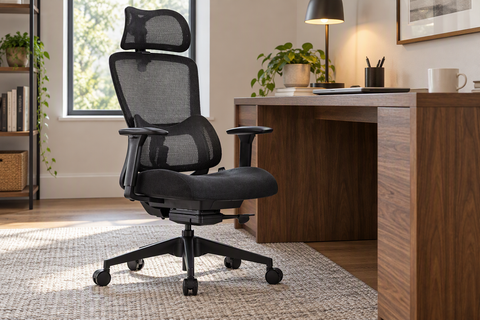
Standard chairs provide a "one-size-fits-all" approach that ignores the 5th to 95th percentile of human dimensions. Professional ergonomic chairs, such as the Royal II, Silicone & Leather Executive Ergonomic Office Chair, are engineered to fill this gap by offering multi-axis adjustability.
Seat Pan Dynamics and Pressure Distribution
The seat pan is the foundation of your posture. If a seat is too soft, the pelvis sinks and tilts, causing the spine to collapse into a "C" shape. We recommend a medium-firm seat with a contoured design. This helps distribute your weight across the ischial tuberosities (sit bones) rather than the soft tissues of the thighs.
A "waterfall edge"—a downward curve at the front of the seat—is crucial. This design prevents the seat from pressing into the back of the knees, which can restrict blood circulation and compress the popliteal nerve. This is particularly important for users who spend more than four hours a day seated, as noted in the ISO 11226 standard for evaluating static working postures.
The Role of Dynamic Recline
While "sitting up straight" is the traditional advice, modern ergonomics encourages a slight recline. A recline angle of 100 to 110 degrees can actually reduce disc pressure compared to a strict 90-degree posture. The Exis,Ergonomic Office Chair utilizes a 90°–145° recline range, allowing users to shift their weight throughout the day. This "dynamic sitting" is essential for keeping the spinal discs hydrated through a process called imbibition, where movement helps move nutrients into the discs.

Scenario Modeling: The Petite User Challenge
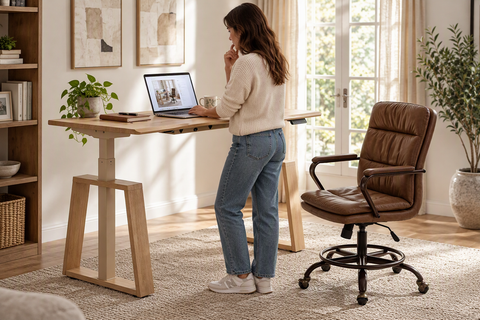
To demonstrate why adjustability is not just a feature but a requirement, let’s look at a common "edge case" we modeled: the petite female remote worker (approximately 155cm or 5'1").
Modeling Analysis: The 4-Inch Ergonomic Gap
Standard desks are typically 29 inches high. For a user who is 5'1", the ideal sitting desk height is actually closer to 25 inches (based on ANSI/HFES 100-2007 anthropometric ratios).
| Parameter | Value | Unit | Rationale |
|---|---|---|---|
| User Height | 155 | cm | 5th percentile female stature |
| Ideal Seat Height | ~40 | cm | Based on popliteal height ratio |
| Ideal Desk Height | ~63 | cm | Elbow height in neutral position |
| Standard Desk Height | ~74 | cm | Fixed industry standard (29") |
| Ergonomic Gap | ~11 | cm | The "Hidden" strain factor |
Methodology Note: This scenario is a deterministic model based on population averages from the US Army Natick Survey data. It assumes minimal footwear and a 90-degree elbow angle. Actual requirements may vary based on individual limb proportions.
The Friction Point: When this user sits in a standard chair at a standard desk, they must raise the chair to reach the keyboard. This leaves their feet dangling, which pulls the pelvis forward and creates a massive strain on the lower back. To solve this, the user needs a chair with a low-range gas lift and a seat depth that doesn't hit the back of their knees. The Lira, Ergonomic Office Chair addresses this with a "smart adjustability" silhouette that accommodates various frames.
Practical Recommendations for Setup and Use
Selecting the chair is only the first step. Proper configuration is what delivers the health benefits. We recommend following the Cornell University Ergonomics "20-8-2" rule: sit for 20 minutes, stand for 8 minutes, and move/stretch for 2 minutes.
1. The Neutral Posture Checklist
- Feet: Should be flat on the floor or a footrest. If your thighs are not parallel to the floor, your chair height is incorrect.
- Knees: Maintain a 90-degree angle with a 2-3 inch gap between the edge of the seat and the back of your knees.
- Back: The lumbar support should nestle into the curve of your lower back.
- Arms: Armrests should be level with your desk to prevent "shoulder shrugging." In our experience, armrests that are too high are a leading cause of tension headaches among remote workers.
2. Monitor and Eye Level
Even the best chair cannot fix a neck strain caused by a low monitor. Your eyes should be level with the top third of the screen. Using a Single Monitor Arm allows you to adjust the screen height independently of your desk, which is vital when switching between sitting and standing.
As detailed in The 2026 Workstation White Paper, the convergence of adjustable furniture and user behavior is the only way to achieve long-term wellness.

Balancing the Health Claims: What a Chair Can and Cannot Do
It is important to maintain a realistic perspective on ergonomic interventions. While a high-quality chair can significantly reduce the risk factors for back pain, it is not a medical cure.
A systematic review by Cochrane (2018) concluded that while sit-stand desks and ergonomic chairs reduce sedentary time and discomfort, they are most effective when combined with "behavioral interventions"—such as timers or micro-break routines.
Furthermore, a meta-analysis by Santos et al. (2025) confirms that ergonomic interventions significantly reduce work-related musculoskeletal pain, but the effect is greatest when the equipment is tailored to the specific anthropometry of the user. This reinforces the need for chairs with high adjustability ranges, such as those meeting BIFMA G1-2013 guidelines.
Investing in Long-Term Wellness
When you evaluate the cost of an ergonomic chair, consider the "Performance ROI." For a professional earning $35/hour, a 10% increase in productivity—driven by reduced pain and better focus—pays for a premium chair in less than six months.
We often see users hesitate to invest in high-end seating, only to spend more later on physical therapy or lost workdays. By prioritizing features like 4-level adjustable lumbar support (found in the Exis,Ergonomic Office Chair) and breathable mesh for temperature regulation, you are making a strategic investment in your biological "hardware."
Whether you prefer the executive feel of the Royal II or the modern, airflow-focused design of the Lira, the goal remains the same: supporting your body so your mind can focus on the work at hand.
Summary of Key Dimensions for Home Office Chairs
To help you choose, we have summarized the typical adjustment ranges aligned with BIFMA and ISO standards.
| Feature | Recommended Range | Why It Matters |
|---|---|---|
| Seat Height | 15" - 21" | Ensures feet are flat for 5th-95th percentile users. |
| Seat Depth | 15" - 18" | Prevents popliteal pressure (behind the knee). |
| Lumbar Height | 6" - 10" (above seat) | Aligns with the L1-L5 vertebrae. |
| Armrest Width | 16" - 20" (inner distance) | Prevents shoulder abduction or "winging." |
| Backrest Tilt | 90° - 120° (min) | Allows for pressure redistribution. |
For more detailed guidance, you may find our article on What Makes an Office Chair Truly Ergonomic? or How to Adjust Your Ergonomic Chair Correctly helpful for your specific setup.
Disclaimer: This article is for informational purposes only and does not constitute professional medical advice, diagnosis, or treatment. Always seek the advice of your physician or other qualified health provider with any questions you may have regarding a medical condition. The ergonomic modeling provided is based on population averages and may not apply to individuals with pre-existing spinal conditions or unique physical requirements.
References
- BIFMA G1-2013 Ergonomics Guideline for Furniture
- OSHA eTools: Computer Workstations - Neutral Working Postures
- Cochrane Library: Workplace interventions for reducing sitting at work (2018)
- ISO 9241-5:2024 Workstation layout & postural requirements
- Cornell University Ergonomics Web — Workstation Guides
- Santos et al., 2025 – Ergonomic Interventions & Work-Related Musculoskeletal Pain




Leave a comment