

Why Your Ergonomic Furniture Isn't Working: Moving Beyond the Spec Sheet
You invested in an ergonomic chair and a standing desk, expecting relief from the persistent neck strain and afternoon backaches. Yet, the discomfort remains. This is a common frustration. The problem often lies not with the furniture itself, but in how it was chosen. Marketing claims and complex specification sheets can be misleading, filled with inconsistent terminology and lacking the context needed to make an informed decision. A desk with a wide height range might seem versatile, but if its lowest setting is still too high for you when seated, it fails at a fundamental level.

This is where a structured evaluation process becomes essential. Instead of relying on isolated features, a holistic approach ensures your workstation is tailored to your body, your work, and verified safety standards. This guide introduces the Standards–Fit–Scenario (SFS) Framework, a data-driven method to simplify ergonomic furniture selection. It moves you from being a passive buyer to an informed architect of your own workspace.
The SFS Framework is built on three pillars:
- Standards Compliance: Verifying that the products meet recognized safety, durability, and ergonomic standards from bodies like BIFMA and UL.
- Anthropometric Fit: Systematically matching the key adjustable dimensions of the desk and chair to your unique body measurements.
- Scenario Needs: Accounting for the specific demands of your workflow, the constraints of your space, and the duration of your daily use.
By applying this framework, you can create a personalized scoring system to compare options objectively, ensuring your investment enhances not just your comfort, but also your long-term health and productivity.
The First Pillar: Decoding Ergonomic and Safety Standards
When you see labels like "BIFMA Compliant" or "UL Certified," they are more than just marketing buzzwords. These certifications signify that a product has undergone rigorous, independent testing to ensure it is safe, durable, and structurally sound. Understanding these standards is the first step in filtering out subpar products and building a foundation of trust and quality.
Why Industry Standards Matter
Ergonomic furniture is an investment in your well-being. Standards provide an objective benchmark for performance and safety, protecting you from potential hazards. For instance, an electric standing desk involves motors and electronics. A certification like the UL 962 standard covers electrical safety, mechanical stability, and even flame retardancy, ensuring the desk operates safely in your home or office. Without it, you risk instability or electrical faults.
Similarly, standards from the Business and Institutional Furniture Manufacturers Association (BIFMA) are crucial. These are not just suggestions; they are comprehensive guidelines developed from decades of research. For example, the ANSI/BIFMA X5.5 standard for desks tests for stability, leg strength, and the durability of the height-adjustment mechanism over thousands of cycles. For chairs, the ANSI/BIFMA X5.1 standard tests everything from the casters on the base to the durability of the backrest.
Key Standards for Desks and Chairs
When evaluating products, look for mentions of these key standards. Reputable manufacturers will openly state their compliance as a mark of quality.
-
For Desks (especially electric standing desks):
- UL 962 / CSA C22.2: Ensures electrical and mechanical safety for North American markets.
- ANSI/BIFMA X5.5: Tests the performance, durability, and structural adequacy of desk and table products.
- EPA TSCA Title VI / CARB Phase 2: Certifies that composite wood materials (like MDF) meet strict chemical emission standards for formaldehyde. This is vital for indoor air quality.
- UL GREENGUARD Certification: Goes a step further by testing for a wider range of volatile organic compound (VOC) emissions, with GREENGUARD Gold being the stricter standard for sensitive environments like schools and healthcare facilities.
-
For Chairs:
- ANSI/BIFMA X5.1: The primary standard for general-purpose office chairs, covering safety and durability.
- BIFMA G1-2013: While not a pass/fail test, this ergonomics guideline provides dimensional recommendations to fit a broad range of users (from the 5th percentile female to the 95th percentile male).
- EN 1335-1: The European equivalent for office chair dimensions, ensuring a good fit for the European population.
How to Verify Compliance
Trust but verify. Do not just take a "BIFMA-style" claim at face value. Here is a simple checklist:
- Check the Product Page & Manual: Look for explicit mentions of compliance with specific standards (e.g., "Meets ANSI/BIFMA X5.5 standards").
- Look for Certification Marks: Official UL, GREENGUARD, or FSC logos are strong indicators of third-party verification.
- Consult a General Certificate of Conformity (GCC): For products sold in the US, manufacturers must provide a GCC that lists the specific safety rules and standards with which the product complies.
- Check the BIFMA Compliant® Registry: BIFMA maintains a public registry of products that have been independently verified. This is the gold standard for confirming compliance.

The Second Pillar: Achieving a Perfect Anthropometric Fit
This is the most critical and often overlooked pillar. A desk or chair can meet every standard in the book, but if it doesn’t fit your body, it is not ergonomic for you. Anthropometry is the science of human body measurement, and applying its principles is non-negotiable for true ergonomic success.
Debunking a Common Myth: "The Most Expensive Chair is Always the Best"
A common misconception is that a higher price tag or a famous brand name guarantees comfort. This is false. The "best" chair or desk is the one that adjusts to fit your specific proportions. An expensive chair designed for a 95th-percentile male will cause discomfort and poor posture for a 5th-percentile female, as the seat pan may be too deep and the armrests too wide. Fit trumps features and price every time. Your goal is to achieve a neutral posture, where your joints are naturally aligned, minimizing stress on muscles and ligaments.
Key Measurements for a Custom Fit
Before you even start shopping, take a few minutes to measure yourself. This data is the foundation of your personalized fit. You’ll need a measuring tape and a partner can be helpful.
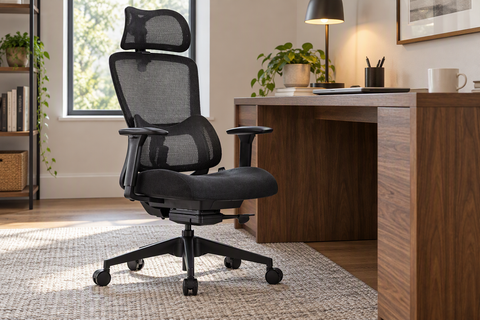
1. For Your Ergonomic Chair:
According to the U.S. Occupational Safety and Health Administration (OSHA), achieving a neutral seated posture is key. This requires specific adjustments:
- Seat Height: While wearing your typical footwear, sit with your feet flat on the floor. Measure from the floor to the crease behind your knee. Your chair’s seat height range should include this measurement.
- Seat Depth: Sit with your back against the chair’s backrest. There should be a gap of 2-3 fingers (about 2 inches) between the front edge of the seat and the back of your knees. This prevents pressure on the popliteal fossa, which can restrict blood flow. Look for chairs with a seat depth adjustment range of around 38–46 cm (15–18 inches).
- Lumbar Support: The curve of the backrest should fit into your lower back’s natural curve (the lumbar lordosis). A common mistake is setting this too high. The support should be centered around the L3 level, roughly belt-line height. Look for chairs with height-adjustable lumbar support with at least 4-6 cm (1.5-2.5 inches) of travel.
- Armrest Height: With your shoulders relaxed and elbows bent at approximately 90 degrees, the armrests should just meet the underside of your elbows. They should not force your shoulders to shrug. An adjustment span of 7–12 cm (3-5 inches) is effective for most users.
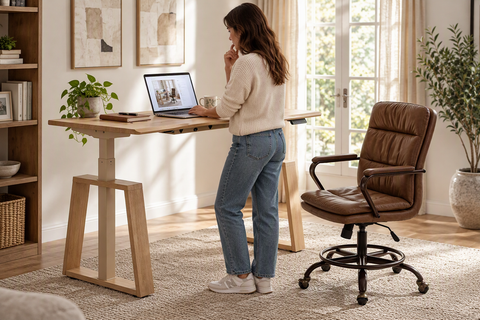
2. For Your Standing Desk:
The principle is the same: bring the work surface to a height that supports a neutral posture.
- Seated Elbow Height: Sit in your adjusted chair with your feet flat. Let your arms hang relaxed at your sides, then bend your elbows to 90 degrees. Measure from the floor to the bottom of your elbow. Your keyboard surface (either the desk or a tray) should be at this height.
- Standing Elbow Height: Stand straight with relaxed shoulders. Bend your elbows to 90 degrees. Measure from the floor to the bottom of your elbow. This is your ideal standing desk height for typing.
Anthropometric Fit Checklist
Use this table to record your measurements and compare them against potential products. This transforms shopping from guesswork into a data-driven process.
| Measurement | Your Dimension (cm/in) | Product A Range | Product B Range | Fit Score (A/B) |
|---|---|---|---|---|
| Chair: Seat Height | ||||
| Chair: Seat Depth | ||||
| Chair: Armrest Height | ||||
| Desk: Seated Height | ||||
| Desk: Standing Height |
The Third Pillar: Aligning with Your Work Scenario
An ergonomically sound workstation is more than a collection of well-fitting parts; it’s a system that adapts to your unique daily activities. Your workflow, available space, and usage patterns are critical factors that should guide your final decision.
Workflow: What Do You Actually Do All Day?
Consider the nature of your tasks. Are you primarily typing, or do you also need space for writing, sketching, or referencing physical documents? The answer dictates your need for desk space, shape, and load capacity.
- Surface Area & Shape: A standard rectangular desk may suffice for simple laptop work. However, for creative professionals, programmers with multiple monitors, or executives managing diverse tasks, a larger surface is essential. An L-shaped desk provides distinct zones for computer work and analog tasks, helping to keep your primary workspace organized and uncluttered. For example, a spacious desk like the Ark Pro L-Shaped Standing Desk offers ample room to spread out, supporting complex, multi-device workflows.
- Load Capacity: Calculate the total weight of your equipment—monitors, computer, speakers, and anything else on the desk. A crucial piece of practical advice is to choose a desk with a rated load capacity at least 20-30% higher than your calculated total. This "safety margin" accounts for the dynamic load when the desk is in motion and prevents long-term motor strain and wobble, contributing to better desk stability.

Space: Optimizing for Your Environment
Your physical environment imposes real constraints. Before committing to a large desk, measure your room and map out the desk’s footprint, including the clearance needed for a chair to move freely. For those in smaller apartments or multi-purpose rooms, finding a balance between functionality and size is key. There are many stylish standing desk designs for small home offices that offer ergonomic benefits without overwhelming the space.
Duration and Dynamics: The Importance of Movement
Static posture, whether sitting or standing, is the enemy of musculoskeletal health. The primary benefit of a sit-stand workstation is that it encourages movement. Research from sources like the World Health Organization emphasizes reducing sedentary time and interrupting long periods of static behavior.
- The Sit-Stand Rhythm: Don




Leave a comment