

Why Your Expensive Ergonomic Chair Might Still Be Uncomfortable
You have invested in a high-end ergonomic chair and a sleek standing desk, yet you still end the day with a familiar ache in your lower back and tightness in your shoulders. It is a common frustration. The issue often isn't the quality of the furniture, but a disconnect between its specifications and your unique body geometry. A chair that fits 95% of people might not fit you if it's not adjusted correctly. The secret lies in translating cold, hard product dimensions into a personalized ergonomic blueprint.
This guide will teach you how to become your own ergonomic consultant. We will walk through how to take precise body measurements using simple household tools. Then, we will provide a clear framework for mapping those numbers directly to desk and chair specifications. You will learn to identify your ideal seat height, desk height, and monitor position down to the centimeter. By understanding concepts like "tolerance stacking," where small mismatches accumulate into significant discomfort, you will be able to diagnose and correct your setup with confidence. The goal is to move beyond guesswork and build a workstation that is truly custom-fit to your body.

The Foundation: Taking Your Ergonomic Measurements
Before you can adjust your furniture, you need reliable data about your body. Accurate measurements are the foundation of a personalized ergonomic setup. Following the principle of "measure twice, cut once," taking a few minutes to do this properly will save you hours of discomfort later. Vague estimates lead to vague results; precision is key.
Your Measurement Toolkit
You don’t need sophisticated equipment. All you need is:
- A firm, flat chair where your feet can rest on the floor
- A rigid tape measure (like a construction or sewing tape)
- A flat, level floor
- Someone to help you (optional, but recommended for accuracy)
For best results, a practitioner tip is to always take these measurements with your shoes off and on a hard surface, not plush carpet. This prevents footwear and soft flooring from skewing your true postural height. Repeat each measurement twice and average the results to account for slight shifts in posture.
Step-by-Step Guide to Your Key Body Dimensions
These five measurements are the critical inputs for configuring your chair and desk.
-
Popliteal Height: Sit on the flat chair with your feet flat on the floor and your knees bent at approximately 90 degrees. Measure the vertical distance from the floor to the crease behind your knee (the popliteal fossa). This number is the single most important factor for determining your ideal chair seat height.
-
Buttock-Popliteal Length (Seat Depth): While seated, measure the horizontal distance from your rearmost point to the back of your knee (the popliteal crease). This measurement ensures your chair seat is deep enough to support you without cutting off circulation behind your knees.
-
Seated Elbow Height: Sit with your spine straight, shoulders relaxed, and upper arms hanging naturally by your sides. Bend your elbows to a 90-degree angle. Measure the vertical distance from the surface of the chair seat to the bottom of your elbow. This determines the correct height for your chair’s armrests.
-
Standing Elbow Height: Stand straight with your shoulders relaxed and arms by your sides. Bend your elbows to a 90-degree angle. Measure the vertical distance from the floor to the bottom of your elbow. This is your target height for a standing desk.
-
Seated Eye Height: While seated correctly, look straight ahead. Measure the vertical distance from the floor to the center of your eyes. This measurement is crucial for positioning your monitor to prevent neck strain.
| Measurement | Purpose in Ergonomics | Common "Gotcha" to Avoid |
|---|---|---|
| Popliteal Height | Sets the ideal chair seat height to allow flat feet and level thighs. | Measuring with heeled shoes on, which artificially increases the height. |
| Buttock-Popliteal Length | Determines the correct seat pan depth for thigh support. | Forgetting to leave a 2-3 finger gap between the seat and knee. |
| Seated Elbow Height | Sets the target armrest height to keep shoulders relaxed. | Hunching or shrugging your shoulders during the measurement. |
| Standing Elbow Height | Defines the proper standing desk height for a neutral wrist posture. | Leaning on a surface while measuring, which alters your true height. |
| Seated Eye Height | Establishes the correct monitor height to maintain a neutral neck. | Slouching your head forward; keep your head aligned over your spine. |
Mapping Your Body to Your Chair
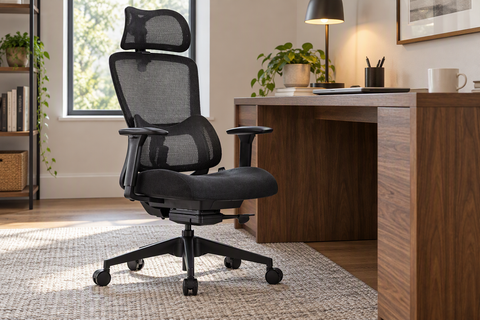
With your measurements in hand, you can now assess any ergonomic chair against your personal requirements. This process turns a confusing list of features into a clear fit-check. A truly ergonomic chair is one that adjusts to you, not the other way around. For a deeper dive into chair features, our guide on what makes an office chair truly ergonomic can provide additional context.
Decoding Chair Specifications
When you look at a chair’s product page, focus on these adjustment ranges:
- Seat Height Range: The minimum and maximum height of the seat from the floor.
- Seat Depth: The front-to-back length of the seat cushion. Some chairs offer adjustable depth.
- Armrest Height Range: The vertical distance the armrests can travel.
- Lumbar Support: Notes whether the support is present, its size, and if it’s height- or depth-adjustable.
The Chair Fit-Check Framework
Use this checklist to systematically evaluate a chair’s fit against your body measurements.
1. Seat Height Adjustment
- Goal: Your Popliteal Height should fall comfortably within the chair’s Seat Height Range.
- How to Check: Set the chair height so your feet are flat on the floor and your thighs are roughly parallel to it. There should be no pressure on the back of your thighs. According to OSHA's guidelines for computer workstations, this posture helps maintain good blood circulation and a stable base.
- Pass/Fail: If you cannot get your feet flat or your knees are pointing significantly upward, the range is wrong for you.
2. Seat Depth
- Goal: When sitting back against the backrest, you should have a gap of about two to three finger-widths (approx. 2-4 cm) between the front edge of the seat and the back of your knees.
- How to Check: Your Buttock-Popliteal Length minus that 2-4 cm gap should roughly equal the chair’s seat depth.
- Pass/Fail: If the seat edge presses into your calves, it’s too deep. If your thighs are largely unsupported, it’s too shallow. This is a common issue for very tall or short users, making adjustable seat depth a valuable feature.
3. Armrest Height
- Goal: Your armrests should support your forearms without causing your shoulders to shrug upwards.
- How to Check: Adjust the armrests to your Seated Elbow Height. Your shoulders should remain relaxed and your wrists neutral. The armrests should be close enough to use without leaning.
- Pass/Fail: If the armrests are too high, they will force shoulder elevation, leading to neck and shoulder pain. If too low, they are useless and may encourage you to lean on your desk, creating wrist pressure.
4. Lumbar Support
- Goal: The curve of the chair’s backrest should fit the natural curve (lordosis) of your lower spine.
- How to Check: Sit back fully in the chair. The support should feel firm but comfortable in the small of your back. If the chair has adjustable lumbar support, position it so it fills this curve perfectly. Mastering lumbar support is crucial for preventing lower back pain.
- Pass/Fail: If the curve is too aggressive or in the wrong place, it can create pressure points and do more harm than good.

Mapping Your Body to Your Desk
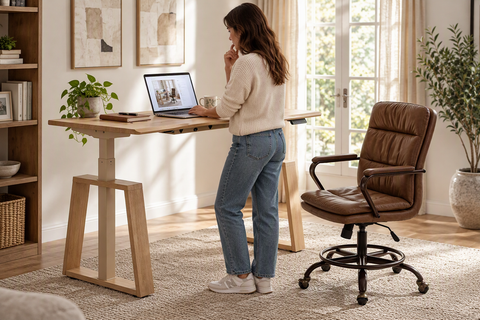
Once your chair is set, the desk is the next critical piece of the ergonomic puzzle. An improperly positioned desk forces you to adapt, undoing all the good work of a well-fitted chair. A height-adjustable desk is a powerful tool, but only when programmed to your specific measurements.
From Fixed to Fluid: The Rise of Sit-Stand Desks
The modern workspace is dynamic. Height-adjustable desks are not just about standing; they are about matching the work surface to your ideal posture, whether sitting or standing. A landmark 2018 Cochrane systematic review found that sit-stand desks can reduce daily sitting time by over an hour and a half. This variety in posture is key to mitigating the risks of a sedentary work style. To get started, you can explore our guide on finding your ideal ergonomic standing desk height.
Models like the Ark EL Executive Standing Desk (60"x26") offer a wide adjustment range designed to accommodate a broad spectrum of users, aligning with design principles from standards like the BIFMA G1-2013 Ergonomics Guideline. This ensures that whether you are short or tall, you can find a precise fit.
The Desk Fit-Check Framework
1. Seated Desk Height
- Goal: With your chair set correctly, the desk should be at a height that allows your forearms to be parallel to the floor (or angled slightly downward 0-5°) when typing.
- How to Check: Sit in your adjusted chair and bring it close to the desk. Adjust the desk height until your elbows are at a comfortable 90-100 degree angle with your wrists straight. Your Seated Elbow Height (measured from the floor) is your primary reference point.
- Pass/Fail: If the desk is too high, you’ll shrug your shoulders. If it’s too low, you’ll hunch over and put pressure on your wrists.
2. Standing Desk Height
- Goal: The desk should be at a height where your elbows are bent at 90-110 degrees with your shoulders relaxed.
- How to Check: Use your Standing Elbow Height measurement as the target. Adjust the desk so your forearms rest comfortably for typing without wrist extension or shoulder tension.
- Pro Tip: A game-changing habit is to use the memory presets on your electric standing desk. Program your exact measured sit and stand heights. This removes the daily guesswork and ensures you return to a perfect posture every time you switch.
For complex setups, an L-shaped desk like the L-Shaped Standing Desk with Accessories Set (60"x23") provides ample room. This allows you to create distinct zones for primary computer work and secondary tasks, preventing the screen and keyboard from creeping too far away and compromising your posture.
The Ripple Effect: Understanding Tolerance Stacking
One of the most overlooked concepts in personal ergonomics is "tolerance stacking." It explains why a setup with individually "good" components can still feel terrible. It’s the idea that small, seemingly minor imperfections in your setup accumulate, forcing your body into a compromised posture.
Debunking the Myth of the "Perfect" Setting
A common misconception is that buying the "best" chair or "best" desk will solve all ergonomic problems. In reality, ergonomics is a system where every component affects the others. A 2 cm error in desk height, combined with armrests that are 1 cm too low and a monitor that is 3 cm too far away, doesn't create three small problems. It creates one large problem, forcing your shoulders up, your head forward, and your wrists to bend.
As one practitioner insight reveals, a setup where the desk is 3 cm too high, armrests are 2 cm too low, and the monitor is 4 cm too far forward forces a cascade of postural compensations. The user elevates their shoulders to reach the desk and juts their head forward to see the screen, leading directly to neck and shoulder strain.
A Prioritized Adjustment Strategy
To avoid tolerance stacking, you must adjust your workstation in a specific order. Each step builds on the last, creating a stable and aligned foundation. The experts at Cornell University Ergonomics Web advocate a similar sequential approach.
-
Start with Your Chair: Your chair is your foundation. Use your body measurements to set the seat height, depth, and lumbar support first. Your feet on the floor and your back against the backrest is the anchor point for everything else.
-
Bring the Desk to You: Once seated correctly, adjust your desk height to match your seated elbow height. Do not adjust your chair to fit the desk.
-
Position Your Monitor: With your posture set, adjust your monitor. The top of the screen should be at or just below eye level, and it should be about an arm's length away (50-70 cm). This encourages a neutral neck posture with a slight downward gaze of 10-20 degrees.
-
Place Your Keyboard and Mouse: Finally, position your keyboard and mouse close to you, so your elbows remain comfortably by your side while you work. Avoid reaching for them.
Wrapping Up: From Specifications to Sanctuary
Building an ergonomic workstation is not about buying expensive equipment; it's about creating a system that is finely tuned to your body. By taking the time to measure yourself accurately, you transform abstract product dimensions into actionable, personal fit targets. This knowledge empowers you to look past marketing claims and evaluate furniture based on how well it aligns with your unique physical needs.
Remember the core principles: measure your body first, map those dimensions to your chair and desk, and always adjust in the proper sequence—chair, desk, monitor. Understand that small errors can stack up, so precision matters. Your workstation should not be a source of pain. It should be a place of comfort and productivity, a sanctuary that supports your well-being throughout the workday.
Frequently Asked Questions (FAQ)
What if my body measurements fall between standard product sizes? If your measurements are on the edge of a product's adjustment range, prioritize the component that is most critical for you. For example, if you have a short popliteal height, a chair with a lower-than-average seat height range is more important than one with extra-wide armrests. Look for products with the widest possible adjustment ranges or those that come in different sizes (e.g., small, medium, large).
How often should I re-measure or re-adjust my setup? It's a good practice to do a quick ergonomic check every 6 months. Our bodies and work habits can change. You might also need to re-adjust if you get new footwear you regularly wear at your desk, change your primary tasks, or add new equipment like a keyboard tray.
Can I apply these principles to my gaming setup? Absolutely. The ergonomic principles for a gaming setup are identical to an office setup. In fact, due to the long hours and intense focus associated with gaming, a proper fit is arguably even more critical to prevent repetitive strain injuries (RSI).
Is a standing desk mat really necessary? While not strictly mandatory, an anti-fatigue mat is highly recommended. As one ergonomist noted, it can easily double the amount of time you can stand comfortably. It reduces the strain on your feet, legs, and back by encouraging subtle movements and improving circulation.
Disclaimer: This article is for informational purposes only and does not constitute professional medical advice. The information provided is intended to help you make informed decisions about your workstation setup. If you have pre-existing health conditions, chronic pain, or musculoskeletal disorders, you should consult with a qualified physician, physical therapist, or certified ergonomist to address your specific needs.




Leave a comment