

The High Cost of Poor Ergonomics: Understanding the Problem
It often starts subtly. A dull ache in the lower back by late afternoon. A persistent tightness in the neck and shoulders. We dismiss it as a normal part of a hard day's work. But what if this discomfort is more than just fatigue? What if it's a warning sign from your body, an early indicator of a Work-related Musculoskeletal Disorder (MSD)?
Ergonomics is the science of designing and arranging things people use so that the people and things interact most efficiently and safely. It's not about luxury; it's about fundamental health and safety. When ergonomic principles are ignored, the consequences are significant, impacting not just individual well-being but also a company's bottom line.
What are Work-Related Musculoskeletal Disorders (MSDs)?
According to the U.S. National Institute for Occupational Safety and Health (CDC / NIOSH), MSDs are injuries or disorders of the muscles, nerves, tendons, joints, cartilage, and spinal discs. They are not the result of a single acute event like a fall. Instead, they develop gradually over time from the cumulative effect of micro-traumas caused by risk factors like:
- Awkward Postures: Looking down at a laptop screen for hours, craning your neck to hold a phone.
- Repetitive Motions: Typing and mouse use without breaks or variation.
- Static Loading: Holding one position for too long, whether sitting or standing.
These conditions are alarmingly common. A landmark 2019 report from the European Agency for Safety and Health at Work (EU-OSHA) revealed that three out of every five workers in the EU reported MSD complaints, with backache and upper limb muscle pains being the most prevalent. The financial toll is staggering, costing economies billions in lost productivity, sick leave, and healthcare expenses.
The Science of Sedentary Work
For decades, the default for office work has been the chair. This prolonged static sitting, however, creates significant physiological strain. When you sit for extended periods, blood circulation to the lower limbs is reduced, pressure on spinal discs increases, and crucial postural muscles in your core and glutes become inactive. This contributes directly to the lower back pain that plagues so many office workers.
In response, global health bodies have issued clear warnings. The World Health Organization's 2020 Guidelines emphasize the need for adults to not only engage in regular physical activity but also to actively reduce and interrupt long periods of sedentary behavior. The message is clear: our bodies are designed for movement, and a static work life works directly against our biology.

Debunking the Myth: "Discomfort is Just Part of the Job"
One of the most damaging misconceptions is that pain is an unavoidable price for professional dedication. This is fundamentally untrue. Pain is your body's primary feedback mechanism, signaling that damage is occurring. Ignoring these signals can lead to chronic conditions that are far more difficult and costly to treat.
The principle of early intervention is critical. Addressing the root causes of discomfort when they first appear can prevent the progression to debilitating MSDs. This proactive approach—adjusting your workstation, changing your habits, and listening to your body—is the cornerstone of a sustainable and healthy career.
The Hierarchy of Controls: A Framework for Effective Ergonomics
When faced with a problem like workplace discomfort, our first instinct is often to find a simple, immediate fix, like stretching or taking a break. While helpful, these actions only scratch the surface. To create lasting change, we need a more systematic approach. The U.S. Occupational Safety and Health Administration (OSHA) provides a powerful framework for this: the Hierarchy of Controls.
This model prioritizes ergonomic interventions into three levels, from most to least effective:
- Engineering Controls: Physically changing the work environment to remove the hazard.
- Administrative Controls: Changing how work is performed through policies and procedures.
- Personal Protective Equipment (PPE): Providing equipment to protect the individual.
Engineering Controls: The Foundation of a Safe Workspace
This is the most effective level of intervention because it removes the hazard at its source. Instead of asking the worker to adapt to a poorly designed environment, you redesign the environment to fit the worker. In an office setting, engineering controls are the core of any successful ergonomics program.
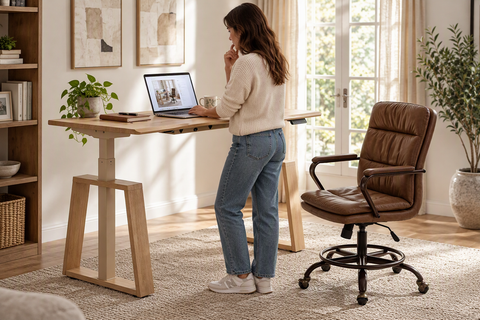
This is precisely where ergonomic furniture, such as adjustable standing desks and chairs, proves its value. A standing desk isn't just a desk; it’s an engineering control that directly combats the hazard of prolonged static sitting. It fundamentally alters the physical environment to enable posture variation, which is impossible with a fixed-height desk. This is why investing in adjustable furniture delivers a far greater return than simply reminding employees to "take more breaks" (an administrative control). The best solution removes the barrier to healthy behavior.
Administrative Controls & Work Practices
Administrative controls are policies and procedures that modify how work is done. They are essential for reinforcing the benefits of engineering controls but are less effective on their own. Examples include:
- Work-Rest Scheduling: Implementing structured breaks for movement. A well-regarded guideline comes from Cornell University, which suggests a "20-8-2" rhythm: for every 30 minutes, sit for 20, stand for 8, and move or stretch for 2.
- Task Variation: Alternating between computer-based tasks and other duties (if possible) to engage different muscle groups.
- Training Programs: Educating employees on the principles of ergonomics, proper posture, and how to adjust their new equipment. For an organization, providing clear guides for desk presets can significantly reduce help-desk calls and ensure equipment is used correctly.
Building Your High-Performance Workstation: A Step-by-Step Guide
Creating an ergonomic workstation is a systematic process. You don't just add a new piece of equipment; you build a cohesive system where each component works in harmony with your body. The goal is to achieve a "neutral posture"—a comfortable, unstrained position that minimizes stress on your musculoskeletal system. Always start with your chair, then adjust your desk and equipment to fit you.
The Anchor: Your Ergonomic Chair
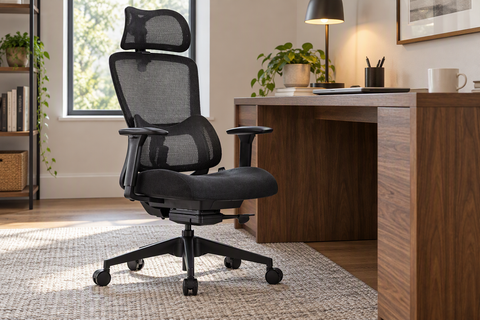
Your chair is the foundation of your seated posture. Before even thinking about your desk or monitors, you must set your chair correctly. A truly ergonomic chair provides a stable base and promotes a healthy spinal curve. While a full guide on chair selection is extensive, you can start by ensuring your chair allows you to sit with your feet flat on the floor, your knees at roughly a 90-degree angle, and your back supported by the lumbar curve. You can learn more by reading our guide on what makes an office chair truly ergonomic.
The Centerpiece: The Adjustable Standing Desk
An adjustable-height standing desk is the single most impactful engineering control for a modern computer workstation. It empowers you to seamlessly switch between sitting and standing, fighting the negative effects of a sedentary work style. A systematic review by Cochrane concluded that sit-stand desks are effective at reducing sitting time at work, with users sitting between 84 to 116 fewer minutes per day.
When selecting a desk, stability and functionality are paramount. For users with extensive setups, such as multiple monitors or heavy equipment, a robust frame and powerful lift system are crucial. For example, the Aero Pro Wing-Shaped Standing Desk (72"x23") is designed with dual motors that provide a smooth, quiet lift and a weight capacity of 220 lbs, preventing the wobble and motor strain common in lesser models. Its expansive wing-shaped surface keeps all your tools within easy reach, while programmable presets allow you to store your ideal sitting and standing heights, making transitions effortless.
How to Set Your Desk Height (Standing):
- Stand with your feet shoulder-width apart, wearing the shoes you typically use at your workstation.
- Adjust the desk height until your forearms are roughly parallel to the floor when your hands are on the keyboard.
- Your elbows should be bent at an open angle, around 90-100 degrees, allowing your shoulders to remain relaxed.
A common mistake is setting the desk too high, which forces you to shrug your shoulders, leading to neck and shoulder strain. Always start with your arm position, then bring the desk up to meet them.
Achieving Neutral Posture: Monitors and Input Devices
With your desk at the correct height, the next step is to arrange your screens and input devices to maintain a neutral posture.
Monitor Placement: According to OSHA's computer workstation eTools, your monitor(s) should be positioned directly in front of you, at about an arm's length away. The top line of the screen should be at or slightly below eye level. This placement allows you to keep your neck in a neutral, relaxed position. If the monitor is too low, you'll constantly flex your neck downwards, leading to strain.
For fixed-height desks or to gain more precise control, a monitor stand is an essential accessory. A product like the Carbon Fiber Dual Monitor Stand not only elevates screens to the correct ergonomic height but also creates valuable storage space underneath for your keyboard or other documents, helping to maintain a clutter-free workspace.

Keyboard and Mouse Position: Your keyboard and mouse should be on the same level, close to your body to avoid reaching. The goal is to keep your wrists straight, not bent up, down, or to the side. Some users find that a slight negative tilt on their keyboard (where the top is lower than the bottom) helps maintain a neutral wrist posture. A Pull-out Keyboard Tray can be an excellent addition, as it often allows for height and angle adjustments independent of the main desk surface, freeing up desktop space and enabling an ideal typing posture.

Managing Your Environment: Cables and Accessories
A clean and organized workspace is a safe and efficient one. For standing desks, proper cable management is not just about aesthetics; it’s about safety. Ensure all cables have enough slack to move freely from your lowest sitting to highest standing position without snagging or pulling on expensive equipment. Using tools like a Magnetic Cable Tie can help bundle cables neatly and prevent them from becoming a trip hazard or putting strain on connectors.
Implementing Ergonomics: From Individual Habits to Organizational Strategy
Having the right equipment is only half the battle. True ergonomic success comes from using that equipment correctly and integrating healthy habits into your daily routine.
For the Individual: Finding Your Sit-Stand Rhythm
Switching to a standing desk can be surprisingly fatiguing at first if you do too much too soon. Your body needs time to adapt. A graded adaptation plan is the most effective way to build endurance without causing discomfort.
Structured Asset: Sample First-Week Standing Desk Schedule
This schedule aims for a gradual increase in standing time, allowing your body to adjust. The goal is not to stand all day, but to find a sustainable rhythm that works for you. Most experienced users settle into a routine of standing for 2-4 hours spread throughout an 8-hour day.
| Day | Standing Interval | Total Standing Time (Approx.) | Notes |
|---|---|---|---|
| Day 1 | 15 minutes, 4 times per day | 60 minutes | Focus on posture. Don't lock your knees. |
| Day 2 | 20 minutes, 4 times per day | 80 minutes | Check your monitor and keyboard height. |
| Day 3 | 25 minutes, 4 times per day | 100 minutes | Try a small stretch during a sitting period. |
| Day 4 | 30 minutes, 4 times per day | 120 minutes | Notice how your energy levels feel in the afternoon. |
| Day 5 | 35-40 minutes, 4 times per day | 140-160 minutes | You're building a habit. Consider an anti-fatigue mat. |
Common Mistakes and How to Avoid Them
From years of observation, ergonomists see the same preventable mistakes time and again. Being aware of these common pitfalls is the first step to avoiding them.
- Desk Set Too High: This is the most frequent error. It causes shrugged shoulders and immediate neck/shoulder tension. The Fix: Re-calibrate your height so elbows are at ~90 degrees and shoulders are relaxed.
- Monitors Too Low: After raising the desk to stand, many forget to raise their monitors. This forces the neck into flexion, defeating the purpose. The Fix: Use a monitor arm or stand to ensure the top of the screen is at eye level in both sitting and standing postures.
- Standing for Too Long: Enthusiasm can lead to overdoing it. Standing statically for hours on end can cause lower back pain and foot fatigue. The Fix: Follow a graded plan and prioritize alternating between sitting and standing.
- Neglecting Support: Standing on a hard floor for extended periods is tough on your body. The Fix: An anti-fatigue mat is not an optional accessory; it is essential for anyone serious about standing. Its cushioning reduces pressure on your feet, back, and joints, easily doubling comfortable standing time.
For the Organization: The Business Case for Ergonomics
For managers and business leaders, implementing an ergonomics program is a strategic investment in human capital. The benefits extend far beyond employee comfort. As detailed in our article on The Business Case for Standing Desks, a well-executed ergonomics program delivers a measurable ROI through:
- Increased Productivity: Comfortable workers are focused and efficient.
- Reduced Costs: Lower rates of absenteeism and workers' compensation claims related to MSDs.
- Improved Talent Attraction & Retention: A demonstrated commitment to employee well-being is a powerful competitive advantage in the modern talent market.
To ensure success, organizations should look to industry standards like those from the Business and Institutional Furniture Manufacturers Association (BIFMA). These guidelines provide a framework for safety, durability, and ergonomic dimensions, ensuring that furniture is suitable for a wide range of users. When rolling out a new program, it's wise to start with a pilot group (10-20% of staff), collect feedback, and use the findings to refine the process for the entire organization.
The Future of Ergonomics: Predictive, Personalized, and Sustainable
Ergonomics is a constantly evolving field. As technology and work culture change, so too will our approach to designing healthy and productive workspaces.
The Next Wave: AI, Wearables, and Data-Driven Design
The future of ergonomics is proactive, not reactive. Imagine a workspace that adjusts to you in real-time. Wearable sensors could provide subtle feedback on your posture, prompting you to adjust before discomfort even begins. Smart desks and chairs could learn your preferences and automatically shift to encourage movement throughout the day. This data-driven approach promises a level of personalization and preventative care that was once science fiction.
Ergonomics Beyond the Office: Gaming and Remote Work
The principles of ergonomics are universal. Whether you are a professional in a home office, a dedicated gamer, or a content creator, the interaction between you and your equipment dictates your health and performance. The unique demands of these fields, such as the prolonged focus required in gaming or the often-compromised setups in remote work, make ergonomics even more critical. Applying the workstation setup principles discussed here is vital for sustainability in any performance-oriented activity. For more specific advice, explore our guides on how to break bad gaming posture habits and the ergonomics of a corner desk for remote workers.
Sustainability and the Circular Economy
Finally, modern ergonomics must also consider environmental impact. A truly "good" design is one that is not only good for the user but also for the planet. This means prioritizing durable products built to last, using sustainable materials like EPA-certified panels, and designing for repairability and eventual recycling. Investing in high-quality, long-lasting furniture is not just an ergonomic choice; it's an economic and environmental one.
Wrapping Up: Key Takeaways for a Healthier Work Life
Building an ergonomic workspace is one of the most powerful investments you can make in your long-term health, comfort, and productivity. It is not a one-time fix but an ongoing process of refinement. Remember these core principles:
- Ergonomics is a Science: It is a proactive discipline focused on designing your workspace around your body's needs, not the other way around.
- Prioritize Engineering Controls: Invest in adjustable, high-quality furniture like a standing desk and ergonomic chair. These are the foundation of a healthy workspace.
- Follow a System: Set up your station in order: start with your chair and feet on the floor, then adjust your desk, monitors, and input devices to maintain a neutral posture.
- Movement is Key: The goal is not to stand all day but to alternate between sitting and standing. Listen to your body and build healthy habits gradually.
- Don't Ignore Discomfort: Pain is a signal. Use it as a prompt to evaluate your setup and habits before minor issues become chronic problems.
By embracing these principles, you can transform your relationship with your work environment from a source of strain into a source of strength, enabling you to perform at your best, day after day.
Frequently Asked Questions (FAQ)
How long should I stand each day with a standing desk?
A good target for most people is 2 to 4 hours of standing, spread out across the workday. It's crucial to break this time into manageable intervals, such as 25-30 minutes of standing for every hour. Avoid standing for more than an hour at a time without a break for movement.
Is standing all day better than sitting all day?
No. Prolonged static standing can cause its own set of problems, including lower back pain, leg swelling, and fatigue. The most beneficial approach, as supported by ergonomic research, is to alternate regularly between sitting and standing to promote movement and vary the load on your body.
Do I really need an anti-fatigue mat?
If you plan to stand for any significant period (more than 30 minutes at a time), an anti-fatigue mat is highly recommended. It provides essential cushioning that reduces stress on your feet, legs, and back, significantly increasing the amount of time you can stand comfortably.
Can an ergonomic setup completely fix my existing back pain?
While a proper ergonomic setup can significantly alleviate and prevent many types of work-related discomfort, it is not a medical treatment. If you have a pre-existing or chronic condition like back pain or sciatica, it is essential to consult with a physician or physical therapist. They can provide a proper diagnosis and recommend a comprehensive treatment plan, of which an ergonomic workstation will be a critical part.
Disclaimer: This article is for informational purposes only and does not constitute professional medical advice. Always consult a qualified healthcare professional for diagnosis and treatment of any medical conditions or before making significant changes to your work routine, especially if you have pre-existing health concerns.
References
- CDC / NIOSH – About Ergonomics
- Work-related musculoskeletal disorders: prevalence, costs and demographics in the EU (EU-OSHA, 2019)
- WHO 2020 Guidelines on Physical Activity & Sedentary Behaviour
- Ergonomics - Solutions to Control Hazards (OSHA)
- OSHA eTools: Computer Workstations - Monitors
- BIFMA G1-2013 Ergonomics Guideline for Furniture




Leave a comment