

The Science of Recovery: Why an Ergonomic Lounge Chair is a High-Impact Gift for Remote Workers
Answer First Summary: To effectively combat remote work burnout, gifting a dedicated ergonomic lounge chair that supports a 100°–120° recline is often more beneficial than simply upgrading a task chair. This creates a "recovery station" that allows the musculoskeletal system to offload tension in ways a standard desk setup cannot.
Note: This guide features product examples from our Eureka Ergonomic collection to illustrate professional setup principles.
The transition to permanent remote work has blurred the boundaries between professional obligations and personal recovery. For many knowledge workers, the home office is no longer a temporary setup but a primary environment where the "always-on" culture manifests as a persistent physiological and psychological strain. While much attention is given to the ergonomics of the active workday, the science of recovery is often neglected.
Remote work burnout is often not merely a state of mental exhaustion; it can be rooted in a "static load" on the musculoskeletal system. When the body remains in a fixed position for extended periods, it may experience reduced blood circulation and sustained muscle contraction. Gifting a standard office chair may seem like a logical solution, but for a remote worker already tethered to their desk, a highly effective wellness gift is often a dedicated "recovery station"—an ergonomic lounge chair designed for psychological detachment and physical offloading.
The Physiological Cost of the "Always-On" Home Office
The human body is not designed for the prolonged static postures typical of modern telework. According to the U.S. National Institute for Occupational Safety and Health (NIOSH), work-related musculoskeletal disorders (MSDs) are linked to risk factors such as repetitive tasks, excessive force, and awkward or static postures.
When a worker sits at a desk, even in a high-quality task chair, the body maintains a "work-ready" state. This involves a sustained, low-level contraction of the spinal erectors and hip flexors. Over time, this static sitting can lead to muscle fatigue and spinal compression. Research cited by Boke Seating (manufacturer data) suggests that thigh compression from ill-fitting seats can reduce leg blood flow by a reported 26% during an 8-hour shift, highlighting the importance of pressure distribution.
Furthermore, the Occupational Safety and Health Administration (OSHA) identifies poor posture as a significant driver of MSDs. In a home environment, the lack of spatial separation between the "work zone" and the "rest zone" means the brain and body rarely receive the signal to fully disengage. This is where the concept of a dedicated ergonomic lounge chair becomes a practical intervention for both physical comfort and burnout prevention.
The Recovery Paradox: Why Your Task Chair Isn't Enough
A common misconception is that a high-end office chair is the only ergonomic tool required for a home office. However, practitioners in physical therapy often observe a "recovery paradox": the posture required for focused desk work is fundamentally different from the posture required for physiological recovery.
Desk work requires a neutral spinal position with an upright or slightly reclined torso (90-105 degrees). In contrast, true recovery—the kind that offloads the intervertebral discs—typically requires a greater recline of 100-120 degrees. This angle, combined with proper thigh support, helps reduce tension in the hamstrings and hip flexors, which are often chronically shortened during desk work.
One practical heuristic used by ergonomics experts is the "15-minute rule": if you cannot sit in a chair with your eyes closed, breathing diaphragmatically, for 15 minutes without feeling the need to shift due to discomfort, that chair is likely not serving a recovery function. Standard office chairs, designed for task-oriented stability, may fail this test because they do not always provide the contoured lumbar support or the specific pressure distribution needed for deep relaxation.
Modeling the "Tall Worker" Challenge
To illustrate how furniture fit impacts burnout, we modeled a scenario involving a 190cm (approx. 6'3") male knowledge worker. This individual represents the 95th percentile of male height, a group frequently underserved by standard furniture.
Modeling Methodology & Reproducible Parameters: This scenario is based on ANSI/HFES 100-2007 anthropometric ratios. To replicate this model, we calculate seated elbow height and eye level against standard fixed-height surfaces.
- Input: User height (190cm) -> Estimated seated elbow height (~77cm).
- Comparison: Standard desk height (73.6cm) vs. Required height (77cm).
- Result: A 3.4cm discrepancy forcing a forward trunk lean of approximately 15°.
Parameter Value Unit Rationale User Height 190 cm 95th percentile male stature Recommended Desk Height 77 cm Optimized for neutral elbow angle Standard Desk Height 73.6 cm Typical 29-inch fixed desk Depth Deficit ~19 in Gap between standard 24" desk and 43" optimal viewing distance Potential Productivity Uplift 15 % Heuristic based on Texas A&M ergonomic studies (varies by task)
For this worker, a standard 29-inch desk is too low, often forcing a persistent forward lean. Our modeling indicates that introducing a sit-stand rhythm can theoretically burn an additional 22,300 kcal per year (an estimate based on moving from 8 hours of sitting to a 20-8-2 rhythm, assuming a metabolic increase of ~0.5 kcal/min during standing). However, physical recovery is most effective when it happens away from the desk.
Building a Dedicated Relaxation Nook
The most effective wellness gift for a remote worker is the creation of a "Holiday Relaxation Nook"—a space physically and visually separated from the computer. This setup encourages "psychological detachment," a state associated with reduced burnout.
1. The Anchor: The Ergonomic Lounge Chair
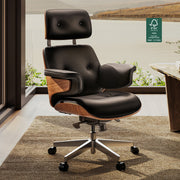
The center of this nook should be a piece of furniture that supports a recovery posture. The Beverly, Loveseat Sofa, 2 Seater (brand example) is a furniture piece that bridges the gap between luxury aesthetics and ergonomic support. Its curved silhouette and high-density foam cushions are designed to cradle the body, supporting the 100-120 degree recline angle mentioned earlier.

2. Supporting the Lower Limbs
Proper recovery involves elevating the feet to help reduce venous pressure in the lower legs. Using an Adjustable Ergonomic Footrest (brand example) in a lounge setting allows the user to find a comfortable angle (typically 0-20 degrees) that promotes healthy circulation. This is particularly useful for workers who spend several hours standing at a desk.
3. Functional Accessories
A relaxation nook is most effective when it remains a "no-work" zone.
- Surface Area: A 23" Contemporary Style Side Table provides a place for tea or books, preventing the need to return to the desk.
- Cable Management: Using Magnetic Cable Ties keeps the environment tidy, reducing visual clutter that can trigger "work brain."

The Science of Thermoregulation and Materials
When selecting a lounge chair, materials are as important as mechanics. A common mistake in lounge furniture is the use of non-breathable materials like bonded leather, which can trap heat.
Thermoregulation is linked to the autonomic nervous system. When the body overheats, it can trigger a mild stress response. High-quality velvet or performance fabrics, as seen in the Beverly Loveseat, allow for better airflow. This supports a stable core temperature, which is a physiological prerequisite for rest.
Practical Recommendation: The 20-8-2 Rhythm
To maximize the benefits of an ergonomic setup, users can follow a structured movement rhythm. Cornell University's Ergonomics Web suggests the "20-8-2" rule for workstation usage:
- 20 Minutes Sitting: In a neutral, supported position.
- 8 Minutes Standing: To encourage blood flow.
- 2 Minutes Moving: Gentle stretching or walking.
Integrating a lounge chair into this routine provides a fourth dimension: The 15-Minute Recovery Break. Every 2-3 hours, remote workers should transition to their relaxation nook. This physical move acts as a "circuit breaker" for the stress cycle.
Logic Summary: Our recommendation for a dedicated lounge chair is based on the principle of "Engineering Controls" defined by OSHA. Changing the physical environment (the chair) is often a more reliable solution for reducing MSD risk than relying solely on "Administrative Controls" like reminders to take breaks.
Why an Ergonomic Lounge Chair is a High-Impact Gift
Gifting an ergonomic lounge chair is an investment in the recipient's long-term health. It addresses the root causes of remote work burnout by providing:
- Physical Relief: Offloading the spine through optimized recline angles.
- Circulatory Support: Reducing leg pressure through proper cushioning and elevation.
- Psychological Detachment: Creating a spatial boundary that allows the mind to "log off."
As discussed in The 2026 Workstation White Paper (brand study), the future of home office design lies in the integration of professional performance with holistic wellness.

Summary of Ergonomic Principles for Lounge Furniture
Use the following checklist derived from BIFMA G1-2013 and ISO 9241-5 standards to evaluate furniture options.
| Feature | Ergonomic Requirement | Benefit |
|---|---|---|
| Recline Angle | 100° to 120° | Helps reduce intervertebral disc pressure. |
| Seat Depth | Supports 5th to 95th percentile | Prevents pressure on the popliteal area. |
| Cushion Density | High-density foam | Distributes body weight to prevent pressure points. |
| Fabric | Breathable (Velvet or Mesh) | Supports thermoregulation. |
| Lumbar Support | Contoured to lower spine | Helps maintain the natural curve of the back. |
YMYL Disclaimer: This article is for informational purposes only and does not constitute professional medical advice. Ergonomic requirements vary based on individual health. Always consult with a qualified healthcare professional or occupational therapist before making significant changes to your workstation, especially if you experience chronic pain.
References
- BIFMA G1-2013 Ergonomics Guideline for Furniture
- CDC / NIOSH – About Ergonomics and Musculoskeletal Disorders
- Cornell University Ergonomics Web — Workstation Guides
- OSHA eTools: Computer Workstations - Neutral Working Postures
- ISO 9241-5:2024 Workstation Layout & Postural Requirements
- The 2026 Workstation White Paper: Converging Ergonomic Science and Sustainable Engineering

Leave a comment