

If your monitor is too high or too low, start by placing the top of the screen at or slightly below eye level and the center about 15–20° below your horizontal line of sight. Keep the screen roughly an arm's length away, then fine-tune the monitor arm in small increments until you can read comfortably without lifting, lowering, or pushing your head forward.
This guide explains how to adjust monitor arm height for sitting, standing, gaming, creative work, ultrawide screens, and multi-monitor setups. The goal is not one universal measurement, but a repeatable setup that keeps your neck neutral and makes posture changes easier throughout the day.
Use this quick reference to jump straight to your situation, then read on for the full reasoning and edge cases:
| Setup | Start With | Final Check | Symptom → Adjustment |
|---|---|---|---|
| Sitting | Set chair and desk height first, then bring the top of the screen to at or just below eye level | Eyes rest slightly downward with no chin lift | Chin tilts up to read → lower the screen |
| Standing | Raise the desk first, then re-match the same eye-level target you used while sitting | Same downward gaze as your sitting setup | Leaning toward the screen → enlarge text or shorten distance |
| Multi-monitor | Center the primary monitor, angle secondary screens 20–30° toward you | Little to no neck rotation to reach your main content | Frequent head turning → move your main task to the center screen |
It's also worth a quick glance at screen tilt and glare: a slight backward tilt and repositioning away from windows or overhead lights can resolve squinting or leaning that looks like a height problem, even when the height itself is fine.
Why Monitor Arm Height Belongs in Your 2026 Ergonomic Resolutions
Many people upgrade to a standing desk or new chair but leave the monitor at the same height it was on the old setup. The result is a redesigned workspace that may still create the same neck and shoulder strain.
According to the OSHA neutral postures guide, the head and neck should stay balanced and in line with the torso — the specific viewing-angle numbers are covered in the next section. In practice, a screen set too high encourages neck extension, while one set too low leads to forward neck flexion.
The World Health Organization's WHO activity guidelines emphasize reducing sedentary time and adding movement throughout the day. A monitor arm does not replace movement, but it can make screen repositioning faster when you change posture or switch between sitting and standing.
Aligning your monitor arm is a high‑impact, low‑effort resolution. Once dialed in, it supports every other productivity habit you build in 2026.
The Science Behind "Neutral" Viewing Height
The science of "neutral" viewing height is about gaze angle, not one fixed measurement: your eyes should look slightly downward toward your main content while your head and neck stay upright and balanced over your shoulders. OSHA, ISO, and other ergonomics resources frame this as a comfortable downward viewing zone rather than one universal screen height.
Neutral Gaze Matters More Than a Rigid Eye-Level Rule
Guidance reflected in ISO 9241 visual display standards, OSHA, and other ergonomics resources focuses on that comfortable downward viewing angle rather than one universal screen height. In practice, that means:
- Your eyes should look slightly downward toward the area you use most, such as a document body, code window, timeline, or game HUD.
- The top of the screen should generally be at or slightly below eye level, while the center of the display sits lower.
- Taller and larger displays may extend farther below eye level, provided you can view the main content without bending your neck.
The real goal is to keep your head balanced over your shoulders while your eyes—not your neck—do most of the vertical movement.
Why Small Height Errors Matter
The EU‑OSHA feature on prolonged static sitting at work explains that discomfort and musculoskeletal risk increase when a posture is held for too long. Even a modest upward or downward head angle can become tiring when maintained for hours.
Monitor-height changes alone do not guarantee a specific reduction in pain. However, broader evidence indicates that ergonomic interventions—including equipment adjustment, workstation changes, and training—can reduce work-related musculoskeletal pain, as summarized in the systematic review and meta-analysis by Santos et al., 2025.
Step‑by‑Step: Find Your Ideal Monitor Arm Height
This section gives a practical process you can apply to almost any adjustable monitor arm, with or without a sit-stand desk.
1. Start With Posture, Not the Arm
Before touching the monitor arm:
- Sit or stand in a neutral posture (based on OSHA's neutral postures guide): head balanced over shoulders, shoulders relaxed, elbows about 90–110°, wrists straight.
- Adjust chair and desk first: feet flat, thighs roughly parallel to the floor; forearms level when typing while seated, or desk roughly at elbow height while standing.
Only once this foundation is set should you move the monitor. A frequent mistake is raising or lowering the monitor first, which forces the rest of the body into awkward angles to "chase" the screen.
2. Use the "Top Edge" and "Eye Line" Check
A practical starting point is to set the monitor so the top edge of the screen is at or slightly below eye level, creating a gentle downward gaze toward the main content.
A fast method you can test today:
- Mark your eye height while in neutral posture (e.g., a small piece of tape on the wall).
- Raise or lower the monitor arm so the top edge aligns with or sits just below that mark.
- Sit back, relax your shoulders, and look straight ahead. Your eyes should naturally land in the upper part of the display, with the center of the screen below eye level.
This starting point is consistent with the viewing-angle principles reflected in ISO 9241 visual display standards and national ergonomics guidance. The screen should be low enough that you do not tip your chin upward, but not so low that you bend your neck to read.
3. Check Viewing Distance by Screen Size
Height and distance work together. A screen that is too far away may make you lean forward, while a screen that is too close can make viewing uncomfortable. The ranges below are practical reference points compiled from common ergonomic guidance, not a fixed standard — the right distance for you depends on your eyesight, text size, and task:
- 24–27" monitors: often about 50–70 cm from your eyes.
- 32" and larger: often about 70–100 cm, depending on resolution, text size, and task.
A simple test is to place the screen around an arm's length away, then increase text or interface scaling before pulling the monitor uncomfortably close.
4. Fine-Tune With a Short Working Trial
Once you have a reasonable starting point:
- Work for 3–5 minutes on a typical task (coding, editing, gaming, design).
- Notice where your eyes spend most of their time on the screen.
- Adjust the arm up or down by 1–2 cm — treat this as a small experimental step, not a required precision target — and repeat.
Most users find a small range in which their neck stays relaxed and visual scanning feels natural. Treat the setup as an experiment over several days rather than a one-time adjustment.
Sit–Stand Workstations: Dialing in Two Heights
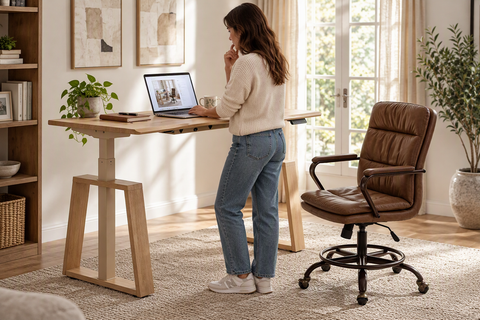
Standing more is a classic New Year's resolution. However, simply adding a sit-stand desk is not enough; your monitor arm must follow you.
The Sit-to-Stand Height Delta
Do not assume that the monitor must move by one fixed amount when you switch from sitting to standing. The required adjustment depends on your body proportions, desk presets, monitor-arm mounting point, and whether the screen rises with the desktop. Recheck the same visual target in both positions: top of screen at or slightly below eye level, with the main content below your horizontal gaze.
A practical routine:
- Set your sitting height first using the steps above.
- Raise the desk to your standing height (elbows around 90° or slightly more open), then adjust the monitor until you regain the same comfortable downward gaze.
- Save the sitting and standing desk heights as memory presets. If the arm also needs separate adjustment, note its position or mark the post discreetly.
- Retest each position with a short trial, fine-tuning in the small increments described earlier.
Research on sit-stand workstations does not support one universal discomfort reduction or one ideal configuration. The sit-stand workstation trial findings reported different discomfort outcomes across workstation conditions, reinforcing the need to adjust the setup to the user rather than copy a fixed height. The practical goal is a slightly downward gaze, neutral neck posture, and regular movement.
How Often to Switch Between Sitting and Standing
Cornell University's ergonomics program has suggested a 20‑8‑2 pattern as one reference starting point: for every 30 minutes, spend about 20 minutes sitting, 8 minutes standing, and 2 minutes moving or stretching. Treat the exact ratio as a flexible guideline rather than a required schedule — what matters most is changing position regularly, which also reflects the broader principle in ISO 11226 static postures standard of limiting prolonged fixed postures.
To make this realistic in daily work:
- Use desk reminders or apps to prompt position changes.
- Each time you switch, quickly check the monitor: eyes aimed slightly downward, shoulders relaxed, no need to tilt your head.
For a deeper look at sit-stand strategy, you can pair these tips with the workflow advice in the guide on standing desk setup guide.
Task‑Specific Monitor Heights: Office, Gaming, and Creative Work
Different tasks demand different visual zones on the screen. The "right" monitor arm height in 2026 is not one value; it is a small range adjusted to what you do most.
Office / Knowledge Work
For typing, spreadsheets, browsing, and general office tasks:
- Center of screen: slightly below eye level.
- Top of screen: at or a few centimeters below eye height.
- Gaze: 10–20° downward for most of your work zone.
This layout keeps the neck near neutral and minimizes frequent vertical eye travel.
Gaming Setups
Gaming layouts vary by genre and HUD design, but the same ergonomic rule applies: the content you watch most should sit within a comfortable downward gaze. Some gamers prefer the monitor slightly lower than a general office setup, especially when the crosshair or primary action area sits near the center of the screen.
- Keep the main action area at or slightly below your natural gaze.
- Keep the keyboard and mouse close to the body to reduce shoulder reach and help the neck stay relaxed.
Avoid raising the display solely to match speakers, shelves, or decorative items.
For more gaming‑specific sit-stand strategies, you can combine this guide with the dedicated article on gamer's sit-stand desk guide.
Creative Work and Coding
Like gaming setups, coding, editing, and reading long documents often work better with the monitor slightly lower than a general office position, so your gaze naturally tracks down the page, code window, or editing timeline. Make the adjustment only if your head remains upright — the goal is to move your eyes through the content without gradually dropping your chin or leaning toward the screen.
Curved and Ultrawide Monitors
With curved or ultrawide monitors, focus on the central band of active content, not on forcing the entire top edge to match a fixed eye-level rule.
- Move the display far enough away that you can scan the active area without leaning forward or repeatedly rotating your neck.
- Keep the vertical center of your primary content within a comfortable downward gaze.
- Increase interface scaling when necessary instead of moving a very large screen too close.
The wider or taller the display, the more important it is to judge the position by your main work zone. The top edge may sit below eye level, but the exact distance should come from posture and visibility rather than a preset number.
Multi‑Monitor Arms: Height, Angle, and Neck Rotation
Many professionals and gamers now run dual or triple monitors on a single arm system. Here, height is only part of the story; neck rotation matters just as much.
Primary vs. Secondary Monitors
Based on guidance such as the UC dual-monitor ergonomics guide:
- Place the primary monitor directly in front of you.
- Angle secondary monitors 20–30° toward you in a shallow "V" — a practical reference range rather than a fixed target; adjust based on desk width, monitor size, and how often you use the secondary screen.
- Keep top edges roughly aligned, but allow a small difference if it helps place your primary task at the most comfortable height.
OSHA recommends placing the primary screen directly in front and keeping monitors generally within about 35° to the left or right. Prioritize limiting repeated side-to-side neck turning over making every screen perfectly level.
Vertical Stacking
If you use a vertical monitor stack:
- Treat the lower monitor as primary in most cases.
- Keep the upper monitor as a secondary reference, tilted downward 10–20°.
- Avoid placing critical content (chat, code, full‑time dashboards) only on the upper screen; this forces neck extension.
Pro Tip: The Real Rule Behind "Eye‑Level" Myths
Many checklists simply say "top of screen at eye level." In practice, the more useful version of that rule is the gaze-angle principle covered above: top of screen at or slightly below eye level, with the content you use most sitting below your straight-ahead line of sight.
On a tall or ultrawide display, the top edge may sit lower than expected. That is acceptable when your head stays upright and you do not need to look upward at the main content. Use comfort, visibility, and gaze direction as the final checks — not a preset number.
Expert Warning: Special Rules for Progressive/Bifocal Lenses
Authoritative agencies such as the CCOHS monitor positioning guidance note that people using bifocal or progressive lenses need different monitor heights.
Because the near-vision segment is in the lower part of the lens, users may tilt the head back when the screen is too high. To reduce that tendency:
- Lower the monitor below the standard starting position until you can read without lifting your chin.
- Tilt the screen upward slightly if needed, while checking for glare and image distortion.
- Increase text size or consider computer-specific lenses if screen clarity still requires an awkward posture.
The correct amount varies by prescription and viewing distance. If you repeatedly tip your chin upward to read, lower the monitor and reassess the angle.
Anyone with persistent neck pain or complex vision prescriptions should consult an eye-care professional or ergonomist for tailored guidance.
Practical Asset: Quick Monitor Arm Height Checklist for 2026
Use this checklist as a monthly self‑audit to keep your ergonomic resolution on track.
Posture first
- [ ] Chair and desk adjusted so elbows are ~90–110°.
- [ ] Feet flat on the floor (or supported), shoulders relaxed.
- [ ] Wrists straight, hovering over the keyboard or on a tray.
Height & gaze
- [ ] In neutral posture, eyes look slightly downward to the main work zone.
- [ ] Top edge of the screen is at or slightly below eye level.
- [ ] No need to tilt the head up or down to see most content.
Distance & size
- [ ] 24–27" monitor: about 50–70 cm from eyes.
- [ ] 32"+ monitor: about 70–100 cm from eyes.
- [ ] Text and UI large enough to read without leaning forward.
Sit–stand use
- [ ] Separate memory heights saved for sitting and standing.
- [ ] Monitor readjusted as needed to preserve the same downward gaze when standing.
- [ ] Gaze remains slightly downward in both positions.
Multi‑monitor setups
- [ ] Primary monitor centered directly in front.
- [ ] Secondary monitors angled 20–30° toward you.
- [ ] Frequently viewed screens stay within about 35° of center.
Special cases
- [ ] Progressive/bifocal lenses: monitor lowered enough to avoid tipping the chin up.
- [ ] Curved/ultrawide: primary content centered within a comfortable downward gaze.
If you cannot tick most boxes, invest 10–15 minutes to reset your arm and test again over several days.
Common Monitor Arm Mistakes That Break Your Resolution
Real‑world installations reveal recurring errors that quietly undermine even the best equipment.
1. Designing Around Decorations, Not Your Neck
A frequent issue in home offices and gaming rooms is raising the monitor to clear speakers, collectibles, or a desktop shelf. This often pushes the screen too high, forcing the neck into extension.
Fix: Prioritize your neutral gaze. If necessary, move accessories to the side or use wall shelves so the monitor can sit lower while remaining centered.
2. Forgetting Cable Slack on Sit-Stand Desks
When a sit-stand desk moves but cables are tight, users stop adjusting the height to avoid disconnections. This effectively locks them into one posture.
Fix: Create service loops in cables and route them through the arm's channels. Consider a CPU stand or tower cart so the computer moves with the desk, reducing cable tension.
3. One Preset, Never Revisited
Many people dial in a monitor height once and never revisit it—even when their chair, desk, or primary task changes in the new year.
Fix: Treat monitor height as a living setting. Recheck it when you change chairs, glasses, primary tasks, or desk height. A quick monthly checklist can prevent drift.
4. Multi-Monitor "Wall" Too Far and Too High
Mounting three large monitors in a flat wall above the desk often results in:
- Excessive viewing distance, pushing users to lean forward.
- Top edges well above eye height, especially on the side screens.
Fix: Bring the monitors closer, angle side screens in a shallow V, and lower the entire array until your primary content sits in that 10–20° downward gaze zone.
When to Seek Professional Help
Most people can significantly reduce neck and shoulder discomfort with the adjustments covered here. However, monitor arm height is only one piece of your musculoskeletal health.
Escalate to a clinician (physician, physical therapist, or occupational health professional) if:
- Pain persists, worsens, or repeatedly returns despite careful workstation adjustments.
- You notice numbness, tingling, weakness, or sharp pain in the neck, shoulders, or arms.
- You have a history of spinal conditions or recent injury.
According to OSHA's page on identifying ergonomic problems, early intervention is critical to prevent acute discomfort from developing into longer-term musculoskeletal disorders.
Bringing It All Together for Your 2026 Productivity Goals
Ergonomic resolutions are often more effective than vague productivity goals because they change the physical conditions that shape habits. Correct monitor arm height keeps your neck and shoulders in a neutral, low‑load position, makes it easier to follow sit-stand and movement recommendations from organizations like the WHO movement guidelines, and supports longer work or gaming sessions with fewer posture-related interruptions.
Combine this with an adjustable chair, a well‑set standing desk, and a clutter‑free, task‑oriented layout. For complementary guidance on desk height and overall workstation planning, see the walkthrough on ideal standing desk height guide and the comparison of adjustable standing vs. fixed‑height desks.
Revisit your setup monthly in 2026. A small height correction and a more consistent sit-stand rhythm can support more comfortable, higher-quality work across the year.
Health & Safety Disclaimer
This article is for informational and educational purposes only and does not constitute medical, health, or occupational safety advice. It does not replace consultation with a qualified healthcare or ergonomics professional. If you have existing musculoskeletal conditions, vision issues, or experience persistent or severe pain, seek personalized guidance from a licensed professional before making significant changes to your workstation.
References
- OSHA neutral working postures guide
- OSHA Ergonomics – Identify Problems
- WHO 2020 activity guidelines
- ISO 9241 display standards
- ISO 11226 static postures standard
- CCOHS monitor positioning guide
- EU-OSHA static sitting guidance
- UC dual monitors ergonomics guide
- sit-stand workstation trial findings
- Santos et al. 2025 review




Leave a comment