

2026 New Year Desk Reset: A 30-Day Standing Desk Plan
The first weeks of a new year often start with strong intentions and vague plans. Many remote and hybrid professionals “want to stand more” or “fix their posture,” but by February the standing desk is back at one height and old habits have returned.
This guide turns that intention into a concrete, 30-day sit‑stand routine. It combines:
- A progressive daily schedule that protects you from overuse and fatigue
- Evidence-based posture guidelines from bodies such as OSHA, CCOHS, and ISO standards
- Practical behavior strategies used by ergonomists and workplace consultants
The goal is simple: by the end of 30 days, you will have a sustainable sit‑stand rhythm that reduces static sitting time, supports musculoskeletal health, and fits your actual workday.
1. Why a 30‑Day Standing Desk Plan Beats New Year Willpower
1.1 The real problem: static sitting, not chairs
Most knowledge work is done in static, seated postures for hours at a time. The World Health Organization physical activity guidelines emphasize two points that matter directly for remote workers:
- Adults should accumulate 150–300 minutes of moderate activity per week.
- They should also reduce sedentary time and break up long periods of sitting.
That second point is where a sit‑stand desk becomes useful. It does not replace exercise, but it helps reduce uninterrupted sitting, which research links to musculoskeletal discomfort and cardiometabolic risk.
EU‑OSHA’s feature on prolonged static sitting at work highlights how holding the same seated posture for long periods increases load on spinal discs, reduces blood circulation in the legs, and contributes to musculoskeletal disorders (MSDs). This effect is most obvious in the afternoon slump: heavier legs, stiff lower back, and fading concentration.
1.2 What the evidence actually says about sit‑stand desks
A common misconception is that “standing desks will fix back pain and boost productivity in a month.” The evidence is more nuanced:
- A Cochrane review of workplace interventions found that sit‑stand desks reduce sitting time by about 84–116 minutes per workday but showed limited evidence for long‑term health outcomes such as weight or blood pressure changes. The benefit is clear for sedentary time; other outcomes change more slowly.
- A systematic review on sit‑stand desks and low back discomfort by Agarwal et al. (2018) reported modest reductions in perceived low back discomfort in several studies, but not dramatic, universal pain relief.
- Cluster trials like the SMArT Work study, summarized in BMJ, show that multi‑component sit‑stand interventions (hardware plus prompts, coaching, and workflow changes) sustain roughly 60–80 minutes per day less sitting at 12 months without harming productivity.
These results align with a key insight: your desk is a tool; your habits deliver the change. A structured 30‑day plan addresses the behavior side that most New Year setups ignore.
1.3 Why not just stand all day?
Another myth is that “if sitting is bad, standing all day must be good.” EU‑OSHA’s overview on prolonged static standing links standing for >30–60 minutes continuously and >4 hours per day to higher rates of leg pain, joint symptoms, and venous issues.
The message from standards such as ISO 11226, which evaluates static working postures, is consistent: prolonged static positions—sitting or standing—are the problem. The healthy answer is regular posture variation.
2. Set Up Your Sit‑Stand Workstation Before Day 1
Before starting the 30‑day plan, lock in a safe, neutral workstation. Poor setup is the fastest way to turn enthusiasm into calf pain or neck strain.
According to the OSHA eTools guide on neutral working postures, both sitting and standing should keep joints near their mid‑range:
- Head balanced over shoulders (not jutting forward)
- Elbows near the body, bent around 90–100°
- Wrists straight, not cocked up or down
- Hips and knees around 90° when seated
2.1 Quick chair and desk height configuration
Use this sequence so the desk fits you, not the other way around:
-
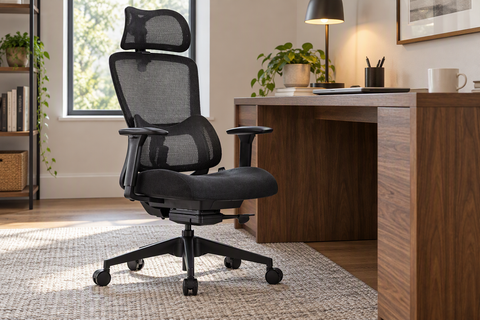
Adjust the chair (for sitting work):
- Sit with your feet flat on the floor or on a footrest.
- Adjust seat height so your knees are roughly level with or slightly lower than your hips.
- Ensure your lower back is supported by the backrest’s lumbar curve.
-
Set sitting desk height:
- Relax shoulders and bend elbows to ~90°.
- Measure from the floor to your elbow. Desk height should match elbow height minus 1–3 cm so your wrists stay neutral when typing.
-
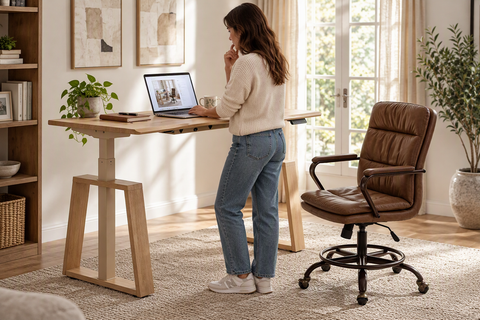
Set standing desk height:
- Stand tall with weight evenly distributed on both feet.
- Bend elbows to 90° again and raise the desk so the keyboard surface is at the same elbow‑height‑minus‑1–3 cm position.
The BIFMA G1 ergonomics guideline explains that properly designed adjustable furniture should cover at least the 5th to 95th percentile range for adult body dimensions. If your desk has height markings or a digital controller, note your “Sit” and “Stand” heights so you can return to them quickly.
2.2 Monitor and keyboard placement: protect your neck and wrists
CCOHS’s sit‑stand guidance states that the top line of text should be at or slightly below eye level and the monitor should be roughly an arm’s length away to reduce neck strain and encourage a neutral gaze. This matches the OSHA monitor guidelines.
Use this quick checklist:
- Monitor height: top 2–3 cm of the screen at or just below eye level.
- Distance: about 50–70 cm from your eyes (roughly one arm’s length).
- Keyboard: directly in front of you, shoulders relaxed, elbows at your sides.
- Tilt: a slight negative tilt on the keyboard helps keep wrists straight.
If your desktop is too high for this neutral forearm angle while seated, a pull‑out keyboard tray or a lower auxiliary surface can make a significant difference in wrist comfort.
2.3 Cable and accessory basics for a smooth start
Early technical frustrations often derail good intentions. Take 20 minutes to:
- Ensure cables have enough slack for full height travel.
- Use cable clips or a simple management tray to prevent tugging.
- If you use a desktop tower, place it on a mobile cart or hanging rack so the desk can move freely.
- Program 3–4 memory presets if your desk allows (e.g., sit, stand, and a higher “presentation” or “meeting” height).
This small investment eliminates the common “the desk pulls my laptop off the edge” issue that causes users to abandon height changes.

3. The 30‑Day Standing Desk Habit Plan
The following program is designed for remote and hybrid professionals who are new to sit‑stand work. It assumes a standard 8‑hour day but can be scaled up or down.
Core principles behind the plan:
- Start small to avoid overuse of the feet, calves, and lower back.
- Build up standing in short blocks, not long marathons.
- Use prompts and routines, not willpower, to trigger position changes.
- Track one simple metric: total standing minutes per day, plus a quick “effort” rating.
3.1 At‑a‑glance progression table
This table summarizes total standing targets and typical block lengths. Treat it as a guide, not a rigid rule.
| Week | Goal (total standing per workday) | Typical block length | Suggested sit‑stand pattern |
|---|---|---|---|
| 1 | 60–120 minutes | 15–30 minutes | 30–45 min sitting / 15–20 min standing |
| 2 | 90–150 minutes | 20–30 minutes | 30 min sitting / 20–25 min standing |
| 3 | 120–180 minutes | 20–35 minutes | Alternate blocks throughout the day |
| 4 | 150–240 minutes (flexible) | 20–40 minutes | Personalized rhythm (aim for 1:1 to 2:1 sit:stand ratio) |
These ranges reflect practitioner experience and align with guidance that continuous standing should rarely exceed 30–60 minutes without a brief movement break, as highlighted by EU‑OSHA’s summary on standing at work.
3.2 Week 1: Getting acquainted (Days 1–7)
Objective: Introduce your body to standing work without triggering overuse.
- Daily goal: 60–120 minutes of total standing time.
- Block size: 15–20 minutes, 3–6 times per day.
Suggested schedule for an 8‑hour day:
- 09:30–09:45 — Stand while answering non‑urgent emails.
- 10:30–10:45 — Stand for a virtual meeting where you mostly listen.
- 13:30–13:45 — Stand after lunch for light work (planning, reading).
- 15:30–15:45 — Stand during routine admin tasks.
Micro‑movement rule: Every 10–15 minutes while standing, spend 20–30 seconds shifting weight, rolling shoulders, or doing gentle calf raises. The OSHA work process guidance emphasizes brief, frequent changes to reduce static load on muscles and joints.
Common sensations this week:
- Mild calf or foot fatigue by the afternoon
- Slight lower‑back stiffness during longer standing periods
These are usually adaptation signals, not red flags. If discomfort exceeds a “3 out of 10” effort level or lasts more than an hour after sitting, shorten your blocks by 5 minutes or reduce one block that day.
3.3 Week 2: Building rhythm (Days 8–14)
Objective: Turn standing into a predictable part of your work pattern.
- Daily goal: 90–150 minutes of standing.
- Block size: 20–25 minutes, 4–6 times per day.
Link standing to recurring tasks to reduce decision fatigue:
- Always stand for email triage.
- Stand for the first 20 minutes of any one‑hour meeting.
- Stand for “low‑cognitive‑load” work such as file organization or basic reporting.
Continue using micro‑movements; they are critical for circulation in the lower limbs, as highlighted in EU‑OSHA material on lower limb MSDs.
3.4 Week 3: Finding your preferred ratio (Days 15–21)
Objective: Approach a sustainable sit‑stand balance.
Cornell University’s ergonomics group suggests a “20‑8‑2” pattern for seated workers: for every 30 minutes, spend 20 minutes sitting, 8 minutes standing, and 2 minutes moving. This rule of thumb is based on acute studies of vascular and comfort responses rather than long‑term trials, but it offers a helpful starting structure.
By Week 3, many remote workers are comfortable with:
- 20–30 minutes standing at a time
- Alternating standing and sitting throughout the day
Daily goal: 120–180 minutes standing.
Try this sequence for a 2‑hour chunk of focused work:
- 25 minutes deep focus (sitting)
- 20 minutes lighter tasks (standing)
- 5 minutes walking or stretching away from the desk
This pattern typically reduces continuous sitting stints to under an hour, aligning with ISO 11226 recommendations to avoid long static postures.
3.5 Week 4: Personalizing and stress‑testing (Days 22–30)
Objective: Lock in a routine that fits your workload and body.
By now, you should have a sense of:
- What block length feels “natural” when standing
- Times of day when standing improves alertness (often mid‑morning and mid‑afternoon)
- Tasks that are easier seated (deep writing) vs. standing (calls, planning)
Daily goal: 150–240 minutes standing, adjusted to your comfort and schedule.
Conduct two “stress‑test” days in this week:
- Day A: Aim for the lower end (150 minutes standing) with more frequent switches.
- Day B: Aim for the higher end (up to 240 minutes), but cap continuous standing blocks at 35–40 minutes.
Track your end‑of‑day energy and discomfort levels. Most users find that a 1:1 to 2:1 ratio of sitting to standing across the day offers a sustainable balance. This aligns with expert reviews summarized in Onagbiye et al. 2024, which show that reducing daily sedentary time by 60–90 minutes is associated with measurable improvements in cardiometabolic risk markers over time.
4. Daily Tracking Template: Make Progress Visible
Progress often stalls when users “lose track” of how much they stand. A simple log is usually enough to keep the habit alive.
4.1 One‑line daily log
Use this format at the end of the day (or in a note app):
Date — Total standing: ___ minutes — Max continuous standing: ___ minutes — Effort (1–10): ___ — Notes: ___
Effort rating guide (RPE – Rate of Perceived Exertion):
- 1–3: Comfortable, light effort
- 4–6: Noticeable fatigue but manageable
- 7–8: Hard; cut back next day
- 9–10: Excessive; reduce immediately and consider a professional review
If your average effort rating climbs above 6 for more than three days in a row, hold your standing time steady or reduce it slightly until it decreases.
4.2 Weekly review checklist
At the end of each week, ask:
- Did I meet the weekly standing time range on at least 3 days?
- Are discomfort levels trending down, stable, or up?
- Do I have clear “standing tasks” and “sitting tasks” defined?
- Are there technical or layout issues that still make standing awkward (cables, screen height, lighting)?
This simple reflection mirrors the self‑assessment logic of tools like OSHA’s workstation evaluation checklist and the risk assessment and telework checklist from OSHwiki, adapted to a home office context.
5. Pro Tips and Expert Warnings
5.1 Pro Tip: Hardware alone is rarely enough
The SMArT Work trial and similar cluster studies reviewed in BMJ show that sustained reductions in sitting come when sit‑stand desks are combined with prompts, coaching, and organizational support. Analysis of these interventions indicates that behavioral strategies can contribute as much as the hardware itself to achieving an extra 60–80 minutes of reduced sitting over 12 months.
For remote workers, “organizational support” may simply mean:
- Using calendar prompts or a Pomodoro timer for sit‑stand switches
- Agreeing with team members that cameras‑on calls can be done standing
- Adding standing time to New Year goals alongside step counts or exercise minutes
5.2 Expert Warning: Standing is not exercise
A frequent misconception is that a standing desk “replaces” workouts. The WHO 2020 guidelines are clear that adults still need 150–300 minutes of moderate‑intensity activity per week for health benefits. Standing delivers a light increase in energy expenditure and reduces static sitting, but it does not provide the cardiovascular or muscular load of walking, cycling, or resistance training.
Use your 30‑day desk reset to complement, not substitute, your movement goals.
5.3 Expert Warning: Watch for red‑flag symptoms
Most initial discomfort can be managed by shorter blocks, micro‑movements, or adding supportive surfaces. However, stop the plan and seek clinical advice if you notice:
- Increasing pain that radiates down an arm or leg
- Persistent numbness, tingling, or weakness
- Unexplained joint swelling or redness
These can indicate underlying conditions that require a clinician to tailor your ergonomics.
6. Role‑Specific Scenarios: Tailor the Plan to Your Work
6.1 Deep‑focus knowledge worker (writers, developers, analysts)
Key challenge: Long periods of intensive concentration where frequent posture changes feel disruptive.
Recommended approach:
- Use 50–60 minute focus blocks seated.
- Insert 15–20 minutes of standing for lighter tasks between deep‑work sprints.
- Batch email, documentation review, and planning as “standing tasks.”
Over a standard day, this pattern usually yields 90–150 minutes of standing without fragmenting high‑value focus time.
6.2 Meeting‑heavy roles (managers, consultants, team leads)
Key challenge: Many hours of calls and virtual meetings, often back‑to‑back.
Recommended approach:
- Default to standing for the first half of any meeting where you do not need intensive note‑taking.
- Use a wireless headset so you can pace gently during less interactive segments.
- Between meetings, sit for short intervals to recover the lower limbs.
In practice, this can add 120–180 standing minutes across the day without any dedicated “standing sessions.”
6.3 Hybrid workers splitting office and home
Key challenge: Two different workstations, often with inconsistent ergonomics.
Recommended approach:
- Measure your optimal sit/stand heights at home and replicate them on your office desk where possible.
- Use a consistent sit‑stand schedule across both locations (e.g., stand for the first 15 minutes of each morning and post‑lunch work block).
- Apply the same monitor and keyboard alignment rules at both sites to reduce adaptation stress on the neck and shoulders.
According to OSHwiki’s article on musculoskeletal disorders and telework, inconsistent setups between home and office can contribute to increased MSD risk; standardizing your posture strategy reduces this variability.
7. Common Mistakes to Avoid in Your New Year Desk Reset
7.1 Jumping from 0 to 4 hours of standing
Going “all in” by standing for most of the day in week one is one of the fastest paths to:
- Foot and ankle pain
- Knee and hip stiffness
- Lower‑back fatigue
EU‑OSHA’s standing guidance and real‑world experience both indicate that continuous standing beyond 30–60 minutes and daily totals exceeding 4 hours are associated with higher rates of lower limb symptoms. The 30‑day plan purposefully keeps block lengths shorter and builds total standing gradually to reduce this risk.
7.2 Adjusting the desk before the chair
Another common error is raising the desk to a “comfortable” height while seated, then discovering that feet dangle or thighs are compressed. OSHA’s desk component guide stresses that chair and leg position should be set first to preserve a neutral hip and knee angle. Always:
- Adjust chair height and backrest support.
- Place feet flat (or on a footrest).
- Then bring the desk to your elbows.
7.3 Ignoring the monitor when changing height
Users often raise the desk but leave the monitor too low, leading to forward head posture and neck strain. Each time you change height significantly (e.g., for a new user or a major posture tweak), re‑check that the top third of the screen aligns with your eye level.
7.4 Treating standing blocks as “static time”
Standing rigidly is only marginally better than sitting rigidly. Small movements—weight shifting, gentle ankle motion, light pacing during calls—support blood circulation and reduce static load on muscles, as summarized in Practical tools and guidance on musculoskeletal disorders.
8. Turning the 30‑Day Challenge into a Long‑Term Habit
The 30‑day reset is a starting point, not a finish line. To extend the benefits into the rest of 2026:
8.1 Set a “maintenance” sit‑stand target
After Week 4, choose a realistic personal baseline for most workdays:
- Beginner maintenance: 90–120 minutes standing per day
- Intermediate maintenance: 120–180 minutes
- Advanced (well‑adapted) maintenance: 180–240 minutes with frequent micro‑breaks
These targets align with research summarized in cardiometabolic impact reviews, where reductions of 60–90 minutes in sedentary time are associated with modest but meaningful improvements in markers like fasting glucose and waist circumference.
8.2 Audit your workspace quarterly
Every quarter, run a quick self‑audit inspired by the HSE DSE checklist:
- Are your sit and stand heights still correct, or have footwear or seating changes altered them?
- Is the monitor distance and height still comfortable, or are you leaning forward?
- Do you experience new or recurring discomfort in the neck, shoulders, back, or legs?
Adjust your setup and routine as needed. Many users discover that a small change—such as raising the monitor by 2 cm or shortening one standing block—resolves emerging issues.
8.3 Combine workspace optimization with productivity goals
Your New Year resolutions often span both health and performance: deeper focus, more consistent output, fewer afternoon slumps. Align the 30‑day sit‑stand plan with those goals by:
- Scheduling your most cognitively demanding tasks at times when you feel most alert (often sitting, mid‑morning).
- Using standing for transitions—after lunch, before long calls, or when you sense focus fading.
- Keeping your desk surface decluttered, which reduces visual noise and makes it easier to move between sitting and standing without rearranging equipment.
For more layout inspiration and small‑space tactics, you can explore ideas similar to those in guides like “Setting Up Your Standing Desk for Peak Productivity” and “Stylish Standing Desk Designs for Small Home Offices”.
Key Takeaways for Your 2026 Desk Reset
- Start small and progress gradually. Begin with 60–120 minutes of standing per day in week one and build toward 150–240 minutes by week four, keeping continuous blocks under 30–40 minutes.
- Prioritize neutral posture and movement. Match desk height to elbow height, align the monitor with your eye level, and incorporate micro‑movements every 10–15 minutes.
- Track one simple metric. Daily total standing minutes plus an effort score give you enough data to adjust without overwhelm.
- Use standing strategically. Reserve standing for emails, calls, and lighter tasks while protecting deep‑focus work with stable sitting blocks.
- Think beyond January. Set a realistic maintenance target, revisit your setup quarterly, and integrate sit‑stand habits with your broader activity and productivity goals.
Adopt this 30‑day plan as a structured experiment. By the end of January, your standing desk will be more than a New Year purchase—it will be a reliable part of how you work, think, and feel at your best.
Disclaimer
This article is for informational and educational purposes only and does not constitute medical, occupational health, or safety advice. It is not a substitute for professional assessment, diagnosis, or treatment. Always consult a qualified healthcare or ergonomics professional before making significant changes to your workstation or activity levels, especially if you have existing musculoskeletal, cardiovascular, or neurological conditions.
Sources
- World Health Organization – 2020 Guidelines on Physical Activity and Sedentary Behaviour
- OSHA eTools – Computer Workstations
- CCOHS – Office Ergonomics: Sit/Stand Desk
- Cochrane – Workplace Interventions for Reducing Sitting at Work
- EU‑OSHA – Prolonged Static Sitting at Work
- EU‑OSHA – Musculoskeletal Disorders and Prolonged Static Standing
- ISO 11226 – Evaluation of Static Working Postures
- BIFMA G1‑2013 – Ergonomics Guideline for Furniture
- OSHwiki – Risk Assessment and Telework Checklist
- OSHwiki – Musculoskeletal Disorders and Telework
- EU‑OSHA – Practical Tools and Guidance on Musculoskeletal Disorders
- Onagbiye et al., 2024 – Sedentary Time & Cardiovascular Disease Risk
- Cardiometabolic Impact of Changing Sitting, Standing and Stepping in the Workplace
- SMArT Work Trial – Stand More AT Work
- Agarwal et al., 2018 – Sit‑Stand Desks and Low Back Discomfort




Leave a comment