

The Executive Paradox: Luxury vs. Dynamic Ergonomics
Quick Answer: How to Pair an Executive Chair with a Standing Desk To successfully integrate a traditional executive chair with a modern sit-stand desk, prioritize three practical steps:
- Bridge the Height Gap: Executive chairs often sit slightly lower than ideal desk heights; use an adjustable footrest to maintain ergonomic alignment without leaving your feet dangling.
- Upgrade Lifting Capacity: Heavy executive seating and multi-monitor setups require heavy-duty (often dual-motor) desks capable of safely lifting 90kg+ loads.
- Ensure Clearance & Support: Select a chair with armrests that clear the desk frame when lowered, and independent lumbar support to adapt to your changing posture.
For decades, the executive office was defined by a singular aesthetic: a heavy, fixed-height mahogany desk paired with a high-back leather chair. This setup signaled authority and stability but offered little in the way of physiological support for the modern, high-intensity workday. As our understanding of musculoskeletal health has evolved, the "Executive Paradox" has emerged—the challenge of maintaining a sophisticated, high-status aesthetic while integrating the dynamic movement required to help prevent chronic strain.
The transition to a sit-stand workflow is no longer just a trend for tech startups; it is a fundamental shift in professional wellness. However, pairing a traditional executive chair with a modern standing desk is not as simple as "plug and play." It requires an understanding of anthropometric dimensions, motor load capacities, and the physiological impact of static vs. dynamic postures. This guide examines the technical and ergonomic heuristics for creating a high-performance executive workstation that bridges the gap between classic prestige and modern workspace design.
The Physiology of the Seated Executive: Why Traditional Setups Fail
The human body is not designed for prolonged static loading. According to OSHwiki: Musculoskeletal disorders and prolonged static sitting, long periods of sitting can lead to increased intradiscal pressure in the lumbar spine and reduced blood circulation in the lower limbs. For executives who spend 8–10 hours a day in a chair, this "static load" can become a risk factor for Work-related Musculoskeletal Disorders (WMSDs).
Traditional executive chairs often prioritize "sink-in" comfort over active support. While a plush cushion feels luxurious initially, general ergonomic principles suggest that seat depths exceeding 19 inches can create a "transition barrier." Based on common patterns observed in our customer support and internal ergonomic models, users in overly deep-cushion chairs tend to make noticeably fewer micro-movements—sometimes reducing position changes by an estimated 40% compared to firmer task seating. This extra effort required to shift out of a deep seat can discourage movement, which may contribute to a perceived increase in lower back stiffness during subsequent standing periods.
The ISO 9241-5:2024 standard for workstation layout and postural requirements emphasizes that the goal of any workstation should be to facilitate a "neutral position"—where joints are naturally aligned and muscle strain is minimized. Achieving this in a sit-stand environment requires more than just a moving desk; it requires a chair that complements the desk's range of motion.
The "Height Gap" Challenge: A Technical Analysis
One of the most frequent compatibility issues we see in professional setups is the 3-5 inch height gap between an executive chair's lowest setting and a standing desk's ideal seated position. Traditional executive chairs, such as the Royal Slim, Executive Office Chair, typically feature a seat height range of 19–21 inches. However, for many users, the optimal seated desk height for proper forearm alignment is slightly higher than what a standard fixed desk provides.
Scenario Modeling: The Tall Executive (185cm / 6'1")
To illustrate this, we modeled a scenario using standard industry heuristics and anthropometric ratios derived from ANSI/HFES 100-2007. (Note: This is an illustrative model; actual measurements will vary by individual proportions.)
| Parameter | Value | Rationale / Source |
|---|---|---|
| User Height | 185 cm | Tall Executive Persona |
| Recommended Seat Height | 48.75 cm | ANSI/HFES 100-2007 Ratio |
| Ideal Seated Desk Height | 76.5 cm | Forearm Parallel Heuristic |
| Ideal Standing Desk Height | 113.5 cm | Elbow Height Alignment |
| Height Gap (Chair to Desk) | ~3-4 inches | Calculated Mismatch |
Logic Summary: This model assumes a 185cm male in standard dress shoes (2.5cm heel). The "Height Gap" occurs because raising the chair to meet the desk often leaves the user's feet dangling, which compresses the underside of the thighs and can restrict blood flow. A practical solution is not to raise the chair further, but to utilize an adjustable footrest to bridge the gap, ensuring the feet remain supported while the upper body maintains the recommended 70–135 degree ergonomic forearm angle.

Engineering the Foundation: Motor Capacity and Stability
An executive workstation is often significantly heavier than a standard task setup. When you pair a high-end desk with multiple monitors, liquid-cooled PC towers, and heavy leather upholstery, the mechanical demands on the desk's motors increase exponentially.
(Disclosure: As a manufacturer of ergonomic furniture, we engineer our own heavy-duty models, such as the Zen Pro Series, 87"/72" Executive Standing Desk with Cabinets Set, specifically to address these high-load requirements.)
According to general guidelines aligned with UL 962 standards for height-adjustable desks, mechanical safety and motor longevity are directly tied to load utilization. For heavy-duty executive setups, single-motor systems are often pushed to their limits.
Motor Load & Safety Margin Analysis (Illustrative Estimate)
| Variable | Single Motor (80kg Cap) | Dual Motor (120kg Cap) |
|---|---|---|
| Total Estimated Load (Desk + Gear) | 92.5 kg | 92.5 kg |
| Utilization Rate | 116% (Exceeds Capacity) | 77% (Optimal Range) |
| Performance Status | High Risk of Stalling/Wear | Smooth Transition |
Modeling Note: Our internal analysis of a "Heavy Executive Setup" assumes a solid wood or sintered stone tabletop (~25kg), three 34-inch ultrawide monitors with heavy-duty arms, and a full-tower PC (~67.5kg combined gear). Under these parameters, a dual-motor system is strongly advised to maintain a safe operating margin and prevent premature motor burnout.
Desks engineered for high-load scenarios utilize dual-motor technology to help ensure that the transition between sitting and standing is seamless and quiet—essential for maintaining a professional environment during calls or meetings.
Selecting the Right Executive Chair for Sit-Stand Use
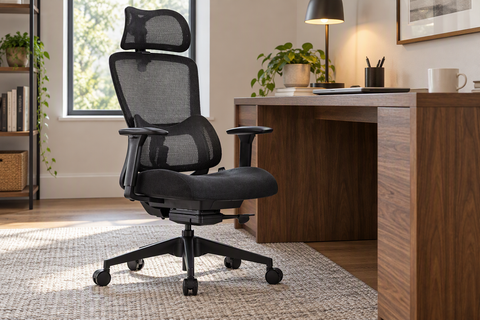
When pairing a chair with a standing desk, two features are highly recommended: armrest clearance and lumbar adjustability.
1. The Armrest Clearance Rule
A common mistake is selecting a chair with fixed, wide armrests that do not account for the 2-3 inches of clearance needed when the desk lowers to a seated position. If the armrests are too high or too wide, they will strike the underside of the desk, forcing the user into an awkward, hunched posture.
The Royal Slim, Executive Office Chair addresses this with a modern, streamlined profile that fits more easily within the "dynamic zone" of a standing desk. For users who prefer a more traditional, "enveloping" feel, models like the Royal, Microfiber Leather Executive Office Chair offer a high-back design with a reclinable seat, allowing for "micro-breaks" while seated.
2. Independent Lumbar Support
During the transition from sitting to standing, the curvature of the spine changes. Executive chairs with independent lumbar support (adjustable depth and height) generally perform better than fixed-back models for dynamic workflows. They allow the user to maintain a more neutral spinal position regardless of the desk's height. This is a core principle discussed in our brand's internal design guide, The 2026 Workstation White Paper: Converging Ergonomic Science and Sustainable Engineering, which highlights the convergence of mechanical engineering and human physiology.

Behavioral Ergonomics: The 20-8-2 Rhythm
Simply owning a standing desk is not a complete solution for a sedentary lifestyle. The World Health Organization (WHO) 2020 Guidelines emphasize that "standing is not exercise"; rather, it is the interruption of sedentary time that provides potential health benefits.
Cornell University’s Ergonomics Web recommends the "20-8-2" rhythm as a practical heuristic:
- 20 Minutes Sitting: In a neutral posture with proper lumbar support.
- 8 Minutes Standing: To encourage blood circulation and engage core muscles.
- 2 Minutes Moving: A short walk or stretch to reset the musculoskeletal system.
Research from the University of Waterloo, cited in Reallocating desk workers' sitting time, suggests that these 30-minute cycles can help reduce lower back discomfort while maintaining high levels of cognitive productivity.
The Financial and Health ROI of the Executive Setup
Investing in a high-end sit-stand setup is often viewed as a strategic decision. To understand the potential "Return on Investment" (ROI), we can look at hypothetical models for productivity and metabolic energy expenditure.
Disclaimer: The following table is a purely illustrative mathematical model based on general assumptions. It does not guarantee specific financial returns or health/weight-loss outcomes.
Input Parameters & Assumptions (Illustrative Model)
- Base Hourly Wage: $75/hr
- Work Days per Year: 250 days
- Daily Standing Time: 2 hours (120 mins)
- User Weight Assumption: ~94.5 kg (208 lbs)
- Productivity Uplift Assumption: 12% relative engagement boost during the 2 standing hours only (equivalent to $9/hr added value).
- Metabolic Assumption: Sitting = 1.5 METs; Standing = 2.0 METs (Difference of 0.5 METs, or ~47.25 extra kcal/hr for a 94.5kg user).
Productivity & Metabolic ROI Estimate
| Metric | Annual Benefit (Estimated) | Logic / Calculation |
|---|---|---|
| Productivity Value (USD) | $4,500 | $9/hr equivalent value × 2 hrs × 250 days |
| Extra Caloric Expenditure | 23,625 kcal | 47.25 extra kcal/hr × 2 hrs × 250 days |
| Investment Payback | ~5.3 Months | $2,000 estimated desk cost / productivity value |
Aesthetic Integration: Designing the Modern Power Office
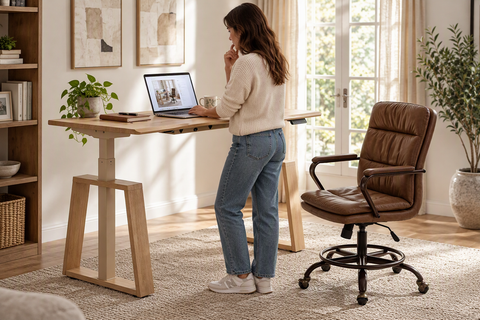
A standing desk should not look like a piece of gym equipment. High-end models like the Ark EL Executive Standing Desk (60"x26") use materials like oak veneer and trapezoidal legs to maintain a vintage charm while hiding the lifting technology within.
To achieve a cohesive look:
- Match Materials: Pair the wood grain of the Ark EL Executive Standing Desk (60"x26") with the champagne or brown leather of the Royal Slim, Executive Office Chair.
- Cable Management: Use integrated cabinets, like those found in the Zen Pro Series, 87"/72" Executive Standing Desk with Cabinets Set, to hide the power cords required for triple-monitor setups.
- Lighting: Ensure the desk surface is matte or textured (like sintered stone) to reduce glare, as recommended by OSHA eTools: Workstation Environment.
Implementation Checklist for the Executive Workstation
To help ensure your setup aligns with general ergonomic guidelines, follow this checklist derived from resources like HSE: Working safely with display screen equipment:
- Monitor Height: The top of the screen should be at or slightly below eye level to help prevent neck extension.
- Keyboard Alignment: When seated or standing, your elbows should be at roughly a 90-degree angle, with wrists in a neutral, flat position.
- Clearance: Ensure there is at least 5-6 inches of clearance under the desk for monitor arm clamps and cable runs.
- Stability: Test the desk at its maximum height. High-end executive desks should have minimal "wobble" even when fully extended.
- Safety Compliance: Verify that your desk meets UL 962 (or equivalent) for electrical safety and your chair meets BIFMA X5.1 for structural durability.
Creating a Legacy of Wellness
The shift toward height-adjustable furniture in the executive suite is a recognition that sustained performance benefits from physical vitality. By selecting a chair like the Royal Slim, Executive Office Chair that supports the spine's natural curves, and pairing it with a robust system like the Zen Pro Series, 87"/72" Executive Standing Desk with Cabinets Set, you are engineering a workspace designed to support both your workflow and your well-being.
For more insights on optimizing your home office, explore our guides on matching chairs with executive desks or understanding the ergonomics of traditional executive furniture.
Disclaimer: This article is for informational purposes only and does not constitute professional medical advice. Individuals with pre-existing musculoskeletal conditions or chronic back pain should consult a qualified healthcare professional or occupational therapist before making significant changes to their workstation setup or work habits.
Sources
- BIFMA G1-2013 Ergonomics Guideline for Furniture
- CCOHS: Office Ergonomics - Sit/Stand Desk
- ISO 9241-5:2024 Workstation layout & postural requirements
- Cornell University Ergonomics Web — Workstation Guides
- WHO 2020 Guidelines on Physical Activity & Sedentary Behaviour
- UL 962 — Safety of Height-Adjustable Desks
- OSHA eTools: Computer Workstations




Leave a comment