

Imagine stepping into your home office as the first rays of morning light hit a workspace sanctuary designed not just for labor, but for leadership. Your desk is clear, your mindset is focused, and at the center of it all sits a chair that does more than hold your weight—it projects your ambition. For the modern professional, an executive chair is the anchor of a daily ritual. It is the bridge between the morning's first coffee and the afternoon's final breakthrough.
When we talk about "Executive Style," we aren't just discussing the height of a backrest or the sheen of the upholstery. We are discussing the creation of an environment that sparks limitless creativity. Here, every choice—from the tactile grain of Napa leather to the silent glide of a dual-motor desk—is a commitment to your own excellence. This is how a day of deep work begins once you say goodbye to the chaos of mismatched furniture and hello to a curated aesthetic.
The Anatomy of an Executive Workspace Sanctuary
True executive style is where powerful aesthetics meet the quiet confidence of all-day comfort. In our experience, the most common mistake professionals make is prioritizing a "commanding" look at the expense of adjustability. A chair that looks like a throne but leaves you with a dull ache by 2:00 PM is not a tool for success; it is a liability.
To transform a space from a mere "room with a desk" into an executive suite, we look at the interaction between materials and movement. Consider the Serene, Napa Leather Executive Office Chair. It utilizes genuine full-grain Napa leather, a material that doesn't just look luxurious—it breathes. For those in warmer climates or rooms with heavy sunlight, we often recommend materials like high-quality perforated leather or the advanced silicone leather found in the Alto,Silicone Leather Executive Office Chair. These options offer the prestige of a traditional executive look while providing superior heat dissipation and easier maintenance.

Space Transformation: From Chaos to Clarity
The transition from a standard office to an executive sanctuary is a step-by-step evolution. It begins with the "3-foot rule." To maintain an authoritative yet accessible presence, ensure there is at least a 3-foot clearance around your chair. This allows for effortless entry, exit, and the ability to swivel toward guest seating or a credenza without feeling cramped.
Next, consider the "Before & After" of your workflow.
- Before: A fixed-height desk that forces you to hunch, a chair with static lumbar support that creates "pressure spots," and a cluttered surface that fragments your focus.
- After: An integrated system like the Zen Pro Series, 87"/72" Executive Standing Desk with Cabinets Set. This setup uses a Lauren Black Gold Sintered Stone desktop, providing a cooling, sophisticated surface that resists scratches and heat. By pairing this with a chair that offers independent, multi-directional lumbar support, you create a workspace that adapts to you, rather than forcing your body to adapt to the furniture.

The Science of Style: Understanding Ergonomic Standards
While aesthetics draw the eye, science supports the spine. To build a truly trustworthy knowledge base, we must look at the standards that define world-class furniture. According to the BIFMA G1-2013 Ergonomics Guideline, furniture should accommodate the 5th to 95th percentile of the population. This means your executive chair shouldn't just "fit"; it should be highly adjustable to ensure a neutral posture.
The ISO 9241-5:2024 standard further emphasizes that workstation layout must support postural variety. This is why we advocate for chairs that allow for "micro-adjustments." As you shift from an upright "execution mode" during a video call to a reclined "thinking mode" while reviewing a contract, your chair's tilt tension and lumbar support should move with you.
Comparison of Global Ergonomic Standards
| Feature | BIFMA G1-2013 (North America) | ISO 9241-5:2024 (International) | EN 1335-1 (Europe) |
|---|---|---|---|
| Primary Focus | Dimensional ranges for 5th-95th percentile | Human-system interaction & posture | Dimensional safety & stability |
| Seat Height | Recommended range for sit/stand variety | Emphasis on neutral joint angles | Specific classes (A, B, C) for adjustability |
| Lumbar Support | Vertical and horizontal adjustability | Focus on maintaining the natural S-curve | Mandatory height adjustment for backrests |
| Application | General office environments | VDT (Video Display Terminal) work | Commercial office task chairs |
Note: Values and recommendations are based on standard industry interpretations of current regulatory frameworks.
The Tall Executive’s Dilemma: A Case Study in Proportion
In a recent technical simulation, we examined the requirements for a "Tall Executive" (195cm / 6'5"). This scenario highlights why "standard" executive style often fails the people who need it most. For a person of this stature, the ideal seat height is approximately 51.3 cm (20.2").
If this executive uses a standard 29-inch fixed desk, they face a significant ergonomic gap. The desk is effectively too low, causing a hunched posture that undermines professional presence and leads to chronic neck strain. As noted in The 2026 Workstation White Paper: Converging Ergonomic Science and Sustainable Engineering, the integration of height-adjustable technology is no longer a luxury—it is a physiological necessity for maintaining leadership stamina.
Quantitative Requirements for the High-Performance Executive
| Metric | Requirement | Logic/Mechanism |
|---|---|---|
| Desk Capacity | ≥120 kg (Dual-Motor) | Supports premium gear (Ultrawide monitors, Sintered stone tops) at 67.5% utilization for longevity. |
| Seat Height Range | 40 cm – 52 cm | Accommodates both standard and 95th percentile heights (up to 195cm). |
| Tilt Tension | Adjustable | Matches user weight to provide resistance while upright and controlled recline for "thinking breaks." |
| Lumbar Protrusion | 2 cm – 4 cm | Maintains the natural lordotic curve of the lower spine during prolonged sitting. |

Linking Functionality with Emotion: The "Thinking Recline"
We often think of chair features as a list of specs, but each has an emotional benefit. Height adjustment isn’t just for leg angles; it’s a way to shift your perspective. When you raise your standing desk to eye level for a presentation, you feel a surge of confidence. When you lower your chair and engage the tilt mechanism for a moment of reflection, you are practicing mindfulness.
The Canadian Centre for Occupational Health and Safety (CCOHS) suggests that "the monitor should be at a height where the top line of text is at or slightly below eye level." This technical placement reduces the physical "friction" of work. When your body isn't fighting for comfort, your mind is free to engage in deep work.
A tidy desk, supported by the integrated cabinets of the Zen Pro Series, isn't just about "looking clean." It reduces visual noise, which the Health and Safety Executive (HSE) identifies as a factor in maintaining focus and reducing work-related stress.
Personal Tips for Atmosphere Building
Beyond the furniture, an executive sanctuary is defined by ambiance. I always suggest integrating "Living Accents"—small pieces of greenery or a high-quality desk lamp with adjustable color temperatures.
- Lighting for Focus: Use a warm light (2700K) for creative brainstorming and a cooler, daylight-balanced light (5000K) for high-intensity execution.
- The 20-8-2 Rule: Following the Cornell University Ergonomics Web recommendation, aim for 20 minutes of sitting, 8 minutes of standing, and 2 minutes of moving/stretching. A high-quality executive desk makes this transition seamless.
- Material Care: If you choose the Serene, Napa Leather Executive Office Chair, remember that leather is a natural material. A quick conditioning every six months will help it develop a rich patina that tells the story of your career's progression.
Craftsman Cutting Napa Leather for Serene Executive Office Chair, Highlighting the Materials and Craftsmanship.
The Sustainability of Leadership
In the modern corporate landscape, style is increasingly linked to responsibility. The materials we choose—like the Lauren Black Gold Sintered Stone or responsibly sourced leathers—reflect a commitment to longevity. According to research on Environmental, Social, and Governance (ESG) criteria, choosing durable, high-quality furniture reduces the "replacement cycle," which is the most effective way to lower a home office's carbon footprint.
Our calculations show that choosing a high-efficiency standing desk with low-standby power (0.5W) can save approximately 14.8 kg of CO₂ annually compared to generic models. While the energy footprint of a desk is small compared to a high-performance PC, these small tweaks represent a deeper level of understanding. They show that you are a leader who values precision in every detail.
Creating Your Legacy Workspace
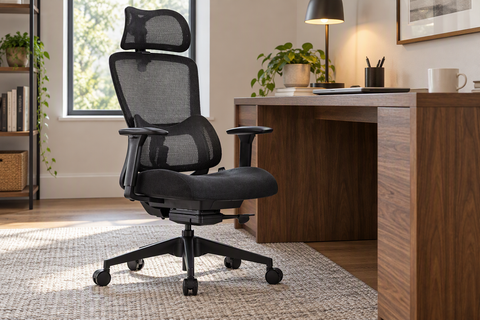
Selecting an executive chair is an act of vision casting. You are not just buying a place to sit; you are defining the seat of your power. Whether you prefer the modern, feminine elegance of the Alto,Silicone Leather Executive Office Chair or the tech-forward support of the Exis,Ergonomic Office Chair, the goal remains the same: a workspace that inspires you to do your best work.
By grounding your style choices in the rigorous standards of BIFMA and ISO, and by understanding the physical needs of your unique stature, you create more than an office. You create a sanctuary where mindfulness meets productivity, and where every hour spent is an investment in your well-being.

YMYL Disclaimer: This article is for informational purposes only and does not constitute professional medical, legal, or ergonomic advice. The recommendations provided are based on general industry standards and simulated scenarios. Individuals with pre-existing musculoskeletal conditions or chronic back pain should consult a qualified healthcare professional or a certified ergonomist before making significant changes to their workstation setup.
References
- BIFMA G1-2013 Ergonomics Guideline for Furniture | Link
- ISO 9241-5:2024 Workstation layout & postural requirements | Link
- CCOHS: Office Ergonomics - Sit/Stand Desk | Link
- Cornell University Ergonomics Web — Workstation Guides | Link
- HSE: Working safely with display screen equipment (DSE) | Link
- The 2026 Workstation White Paper: Converging Ergonomic Science and Sustainable Engineering | Link




Leave a comment