

Imagine stepping into a home office that doesn't just house your work, but sparks your limitless creativity. You cross the threshold into a "Workspace Sanctuary," where the morning light catches the rich grain of an oak bookshelf and the soft sheen of a leather chair. Here, the chaos of the outside world dissolves, replaced by a curated ambiance designed for deep work and mindful leadership. This is more than an office; it is a professional theater where your most ambitious visions take center stage.
To achieve this state of flow, a sophisticated office layout must balance two distinct worlds: the high-performance zone of the executive desk and the contemplative comfort of the lounge area. Coordinating these spaces requires more than just matching colors; it demands a deep understanding of ergonomic science, spatial flow, and the emotional resonance of your environment. By pairing your primary task chair with thoughtfully selected lounge seating, you create a cohesive design language that signals both authority and approachability.
The Executive Anchor: Defining Your Primary Workspace
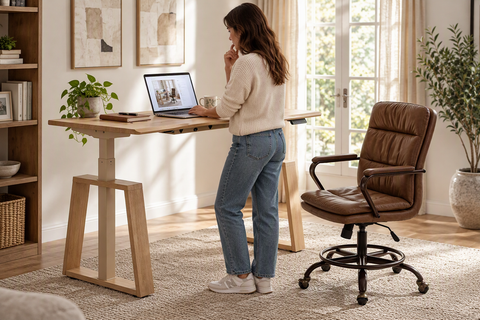
Every sanctuary needs an anchor. In the executive office, this is your primary task chair—the seat from which you direct your enterprise. When selecting this piece, we often look for a blend of presence and performance. A chair like the Royal, Microfiber Leather Executive Office Chair serves as this definitive centerpiece. With its high-back silhouette and "Cloud Cotton" cushioning, it provides the "wrapped" feeling of security that high-level professionals crave during intense strategic sessions.
However, true luxury in the modern age is inseparable from ergonomic integrity. According to the BIFMA G1-2013 Ergonomics Guideline, office furniture should accommodate at least 90% of the population, ranging from the 5th percentile female to the 95th percentile male. For the executive, this means the chair must offer significant adjustability to maintain what the Occupational Safety and Health Administration (OSHA) defines as a "neutral working posture."
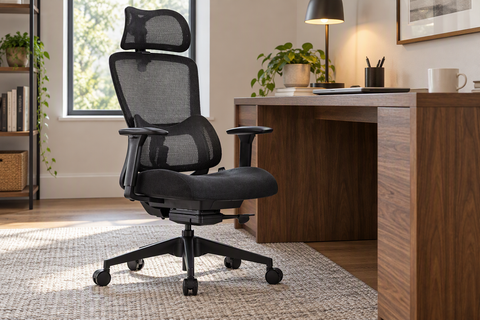
When we look at a "Before & After" transformation of an executive suite, the most striking change isn't just the aesthetic—it's the alignment. A standard chair often leaves the user hunched or overextended. By upgrading to a high-performance model like the Forma, Ergonomic Executive Office Chair, which features a signature aluminum alloy curved back frame and self-adapting headrest, the space transforms from a site of physical strain into a cockpit of precision. This technical foundation is the first step in building a sanctuary that supports your health as much as your ambitions.

The "Complementary Contrast" Rule for Lounge Areas
A common mistake in professional office design is selecting lounge seating that is too similar in scale and formality to the executive chair. This often results in a space that feels stiff, resembling a waiting room rather than a private retreat. To avoid this, we recommend the "complementary contrast" rule.
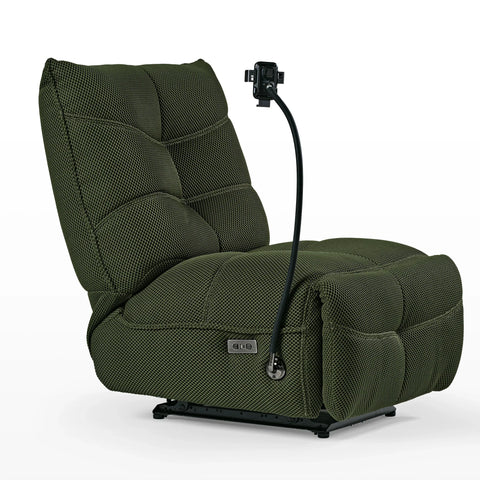
If your primary chair, such as the Royal, Microfiber Leather Executive Office Chair, is bold, high-backed, and upholstered in leather, your lounge piece should offer visual relief. Consider a lower profile with softer curves or a contrasting texture like velvet or textured fabric. This creates a psychological shift: when you move from the desk to the lounge, your brain receives a signal that it is time to shift from "execution mode" to "thinking mode."
Spatial flow is equally critical. To maintain a comfortable conversation zone without feeling cramped, aim for a distance of 6 to 8 feet between the front of the executive desk and the lounge seating. This distance, supported by open office layout standards, ensures that visitors or collaborators feel welcomed rather than confronted. Furthermore, avoid placing lounge chairs directly facing the back of the desk; an angled orientation toward a shared focal point, such as a window view or a piece of art, fosters a more natural and productive interaction.
The Science of the Sanctuary: Ergonomics and Performance
While aesthetics define the "soul" of the room, ergonomic data provides its "skeleton." To truly understand the requirements of a high-level professional, we conducted a simulation for a "Tall Executive Power User"—a 190cm (6'3") male in the 95th+ percentile height range. This demographic often faces the greatest challenges in finding furniture that fits.
Case Study: The 190cm Executive Setup
Based on our theoretical calculations for a user of this stature, standard 29-inch desks are nearly 2 inches too low for optimal sitting. This deficit forces the user into a rounded shoulder posture, leading to chronic discomfort.
| Metric | Recommended Value (190cm User) | Standard Industry Value | Ergonomic Gap |
|---|---|---|---|
| Seat Height | 50 cm (19.7 in) | 43-48 cm | +2-7 cm |
| Sitting Desk Height | 78.5 cm (30.9 in) | 73.6 cm (29 in) | -1.91 in |
| Standing Desk Height | 116.5 cm (45.9 in) | N/A | Calculated for 90° elbow |
| Equipment Load | 82 kg (180.7 lbs) | < 50 kg | +32 kg |
For such power users, the desk itself must be a feat of engineering. The Zen Pro Series, 87"/72" Executive Standing Desk with Cabinets Set is specifically designed for these high-load scenarios. Our analysis shows that a single-motor system would operate at 102.5% capacity when loaded with a heavy executive setup (dual ultrawide monitors, liquid-cooled PC, and sintered stone top). Therefore, a dual-motor system is mandatory to ensure the longevity and safety of the workstation.
As noted in The 2026 Workstation White Paper: Converging Ergonomic Science and Sustainable Engineering, the integration of heavy-duty lifting mechanisms with premium materials like sintered stone represents the future of executive furniture. This isn't just about moving up and down; it's about providing a rock-solid platform that doesn't wobble at the 45-inch height required for a tall user.
Transitioning Between Modes: The Sit-Stand Rhythm
The lounge area is not the only way to find relief during a long day. Modern leadership requires movement. A systematic review by Cochrane concluded that sit-stand desks can significantly reduce sitting time by approximately 84 to 116 minutes per day.
To maximize the benefits of a desk like the Zen Pro Series Executive Standing Desk, we suggest following the "20-8-2" rhythm popularized by Cornell University Ergonomics Web: sit for 20 minutes, stand for 8 minutes, and move or stretch for 2 minutes. This behavioral intervention, combined with a high-performance desk, helps maintain metabolic health and focus.
However, it is important to manage expectations. According to the World Health Organization (WHO) 2020 Guidelines, standing is not a substitute for exercise. The value of a standing desk lies in its ability to interrupt "prolonged static sitting," which the EU-OSHA identifies as a primary risk factor for musculoskeletal disorders. By alternating between your Forma, Ergonomic Executive Office Chair and a standing position, you keep your body engaged and your mind sharp.

Organizing the Sanctuary: Decluttering and Ambiance
A "Workspace Sanctuary" cannot exist in chaos. Visual clutter is a cognitive drain that competes for your attention. To maintain a state of mindfulness, your storage solutions must be as elegant as your seating.
The Ark EL, 71'' Display Bookshelf with Storage Cabinet, Oak offers a sophisticated way to manage this "Space Transformation." By combining open shelving for inspiration—think art pieces or leather-bound journals—with closed cabinets for sensitive documents, you maintain a clean aesthetic. This aligns with the principles of HSE's Working Safely with Display Screen Equipment, which emphasizes that a well-organized workstation is the foundation of a safe and productive environment.
Personal Tip: The Layered Lighting Strategy Lighting is often the most under-budgeted element of an office, yet it has the greatest impact on ambiance. We recommend a layered approach:
- Task Lighting: Focused light on your desk for reading and execution.
- Ambient Lighting: A statement floor lamp in the lounge area to create a warm glow.
- Accent Lighting: Integrated LED strips in the Ark EL Bookshelf to highlight your personal "Inspiration" items.
This psychological separation of "work" and "refresh" zones through lighting helps you transition emotionally between tasks. For more ideas on how to harmonize your furniture with your decor, explore our guide on Home Office Chair Ideas to Match Your Modern Decor.
Materiality and Trust: Sustainable Luxury
For the discerning professional, the materials used in their sanctuary matter as much as the design. High-quality microfiber leather, like that found on the Royal Executive Office Chair, provides the tactile luxury of traditional leather with enhanced durability and breathability.
When investing in wooden elements, such as the oak tones of the Ark EL Bookshelf, look for certifications like FSC (Forest Stewardship Council), which ensures that the wood is sustainably sourced. This commitment to environmental responsibility adds a layer of "Trustworthiness" to your sanctuary, knowing that your professional success is built on a foundation of global stewardship.
Furthermore, ensure your furniture meets safety standards like ANSI/BIFMA X5.1 for chairs and UL 962 for height-adjustable desks. These certifications are the industry gold standard for durability and mechanical safety, providing peace of mind that your investment will stand the test of time.

Designing for Interaction: The Human Element
Ultimately, an executive office is a place of human connection. Whether you are hosting a high-stakes negotiation or a casual brainstorming session with a partner, the layout should facilitate the desired dynamic.
If your goal is collaboration, the lounge area should be the focal point. Moving away from the desk removes the physical barrier between you and your guest, creating a sense of equality and openness. This spatial strategy is supported by research into spatial layout and face-to-face interaction, which suggests that less formal settings can encourage more creative exchanges.
For those moments when you need to switch back to focused execution, the transition back to your Zen Pro Series Executive Standing Desk should be seamless. The presence of integrated storage cabinets ensures that your essential tools are always within reach, maintaining your "Workflow" without interruption. For a deeper dive into choosing the right chair for your specific needs, see our comparison on Executive vs. Ergonomic Chair: Which Is for You?.
Cultivating Your Professional Sanctuary
Creating a sophisticated home or corporate office is a journey of self-expression and scientific application. It begins with a vision of a space that inspires you and ends with a layout that supports your physical well-being. By thoughtfully pairing high-performance executive chairs with inviting lounge areas, you build an environment that caters to the full spectrum of leadership—from the intensity of the "Deep Work" session to the quiet clarity of strategic reflection.
Remember that the most effective sanctuary is one that evolves with you. Regularly assess your posture using tools like the HSE Workstation Checklist, and don't be afraid to adjust your layout as your workflow changes. Whether you are reaching for the clouds in a Royal Executive Chair or standing tall at a Zen Pro Desk, your office should be a testament to your commitment to excellence, comfort, and the art of the professional life.

Disclaimer: This article is for informational purposes only and does not constitute professional medical, legal, or ergonomic advice. Individuals with pre-existing musculoskeletal conditions or chronic back pain should consult a qualified healthcare professional or a certified ergonomist before making significant changes to their workstation setup or adopting new sitting/standing routines.
References
- BIFMA G1-2013 Ergonomics Guideline for Furniture
- ISO 9241-5:2024 Workstation layout & postural requirements
- OSHA eTools: Computer Workstations - Neutral Working Postures
- Cornell University Ergonomics Web — Workstation Guides
- Cochrane: Workplace interventions for reducing sitting at work (2018)
- WHO 2020 Guidelines on Physical Activity & Sedentary Behaviour
- HSE: Working safely with display screen equipment (DSE)
- EU-OSHA: Musculoskeletal disorders and prolonged static sitting




Leave a comment