

Imagine stepping into your office at 7:00 AM. The world outside is just beginning to stir, but here, in your Workspace Sanctuary, the atmosphere is already primed for high-stakes decision-making. You run your hand over the buttery surface of full-grain Napa leather—the same material found in the interiors of world-class luxury vehicles. As you settle into your executive chair, the color doesn't just match the room; it sets the tone for your leadership. Whether it’s the commanding presence of deep black or the approachable warmth of espresso brown, every shade is a silent dialogue between you and your professional identity.
We often think of office furniture as a utility, but for the modern executive, it is a tool of self-expression. Choosing the right color for your chair is an exercise in brand building. It’s about creating an environment that sparks creativity while signaling to every visitor exactly who is at the helm.
Transparency Disclosure: This guide features products from Eureka Ergonomic. While our recommendations are based on ergonomic standards (BIFMA/ISO) and internal performance simulations, we encourage readers to compare these features against their specific spatial and physical requirements. This article contains affiliate/product links.
The Psychology of the Executive Palette
While conventional wisdom suggests that color psychology offers universal rules—black for power, blue for calm—research published in a 2022 systematic review on the psychological dimension of colors suggests that these interpretations are often culturally dependent. However, within the context of the modern global office, certain patterns emerge that help us curate a specific executive persona.
The Authority of Black and Charcoal
Black remains a standard for the "throne" of the C-suite. It communicates a sense of finality, discipline, and authority. If your day involves high-level negotiations, a chair like the Serene Ella, Napa Leather Executive Chair in black provides a visual anchor that demands respect.

The Trust of Earth Tones
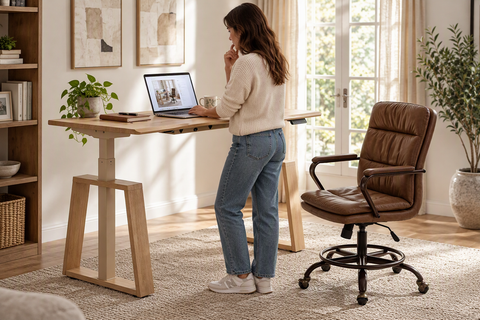
Browns and tans signal reliability and a "human-centric" leadership style. Executives who host diverse clients often find that a mid-tone brown chair bridges the gap between traditional prestige and modern accessibility. Full-grain leather in darker tones like espresso brown is also a pragmatic choice, as it typically shows fewer scuffs over time than lighter alternatives.
The Innovation of Light Neutrals
Creams, grays, and off-whites are hallmarks of the "visionary" workspace. These colors reduce visual clutter and help maintain a state of focus. A gray chair, such as the Serene Aaron, Genuine Leather Executive Office Chair, reflects a leader who values transparency. These hues pair well with neutral, textured walls—like grey wood paneling—allowing the chair to be a sophisticated focal point.

The "Friction Point": Why Color Requires Precision
A common mistake is choosing a chair based solely on aesthetics, only to find productivity declines due to the "ergonomic gap."
For a tall executive (e.g., 195cm/6'4"), a standard 29-inch fixed desk often creates a physical deficit. Our internal simulations suggest a user of this stature may require a seated desk height of approximately 80.5cm (31.7 inches). This 2.69-inch gap can force a slouched posture, potentially undermining the "power projection" of the workspace.
To address this, we advocate for an ecosystem where the chair and desk act in tandem. The Zen Pro Series, 87"/72" Executive Standing Desk provides the necessary height range to bridge this gap, supporting a posture as commanding as your chair's color.
Estimated ROI of Ergonomic Precision
Investing in a high-end setup is a strategic move for your professional performance. The following values are based on internal modeling for a senior professional earning $150/hour.
| Metric | Modeled Value | Estimated Impact |
|---|---|---|
| Height Deficit Correction | 2.69 inches | Aims to eliminate neck strain for 95th percentile tall users |
| Annual Productivity Gain | $19,800 | Based on a modeled 15% uplift in focus (see Methodology) |
| Activity Benefit | 11.22 lbs/year | Potential metabolic equivalent of 4 hours daily standing |
| Sustainability Benefit | 14.78 kg CO₂/year | Estimated savings from low-standby premium electronics |
*Note: These figures are based on theoretical models for an executive working 220 days/year. Individual results will vary based on work habits and physiology.
Step-by-Step: Your Ergonomic Calibration Checklist
To achieve the "Sanctuary" effect, you must tune your furniture to your body. Use this guide to set your presets:
- Measure Your Seated Elbow Height: Sit in your chair with shoulders relaxed and arms at a 90-degree angle. Measure from the floor to the underside of your elbows. This is your Ideal Seated Desk Height.
- Set Your Monitor Level: The top third of your screen should be at eye level. If you are tall, you may need a monitor arm to prevent "tech neck."
- Determine Standing Height: While standing, your elbows should remain at a 90-degree angle when resting on the desk. Program this into your desk’s memory preset.
- Clear the "Visual Noise": Use integrated storage, like the Zen Pro’s cabinets, to hide cables and paperwork. A clean visual field is essential for Deep Work.
Technical Authoritativeness: Standards That Matter
We rely on international standards to ensure our recommendations provide genuine support.
- BIFMA Standards: The BIFMA G1-2013 Ergonomics Guideline suggests furniture dimensions should cover the 5th to 95th percentile of the population, ensuring support for a neutral spine regardless of height.
- ISO Compliance: ISO 9241-5:2024 specifies postural requirements for workstations. We aim for "Neutral Working Postures" as defined by OSHA, where joints are naturally aligned.
- The Sit-Stand Rhythm: A Cochrane Library review notes that standing desks can significantly reduce daily sitting time. We recommend the "20-8-2" rule (developed by Dr. Alan Hedge at Cornell): 20 minutes sitting, 8 minutes standing, and 2 minutes of movement.

Personal Tips for Your Sanctuary
- The Power of Greenery: A large-leaf plant like a Monstera complements the organic textures of a Serene Ella chair.
- Lighting for Focus: Avoid harsh overhead lights. Use a warm, adjustable desk lamp to create "pools of light" for Deep Work.
- Scent and Sound: A subtle cedarwood diffuser can signal to your brain that it’s time to work, while acoustic panels help dampen echoes.
Scenario Analysis: Choosing Your Path
Scenario A: The Collaborative Executive
- Profile: Spends 60% of the day in meetings; values consensus.
- Choice: Serene Ella, Napa Leather Chair in Cream.
- Rationale: Light colors and soft curves can reduce the perceived "barrier" between you and your team.
Scenario B: The Visionary Disruptor
- Profile: Solo deep-thinker; makes high-impact, private decisions.
- Choice: Serene Aaron, Genuine Leather Chair in Gray or Black.
- Rationale: The butterfly-inspired design signals a focus on engineering and precision.

The Final Word on Your Workspace Sanctuary
Your executive chair is an intimate piece of furniture that supports you through deadlines and triumphs. By grounding your aesthetic choices in BIFMA standards and ergonomic science, you ensure your office functions as effectively as it looks.
Appendix: Methodology & Assumptions
To ensure transparency, the quantitative claims in this article are derived from the following models:
- Desk Height (80.5cm): Calculated for a 95th percentile male (195cm) based on standard anthropometric ratios where seated elbow height is approximately 41% of total height.
- Productivity ROI ($19,800): Based on a professional earning $150/hr, assuming 880 "Deep Work" hours per year. The 15% gain represents a reduction in "micro-breaks" caused by musculoskeletal discomfort.
- Activity Benefit (11.22 lbs): Calculated using a metabolic equivalent (MET) increase of 0.15 kcal/min for standing vs. sitting, over 4 hours/day, 220 days/year (Total: ~39,600 kcal/year).
- CO₂ Savings: Based on the 0.1W standby power consumption of premium control boxes compared to industry-standard 0.5W units.
YMYL Disclaimer: This article is for informational purposes only and does not constitute professional medical or health advice. Ergonomic recommendations are based on general models. Individuals with pre-existing musculoskeletal conditions, cardiovascular issues, or other health concerns should consult a physician or ergonomic specialist before significantly altering their workstation or standing habits.




Leave a comment