

Why does your lower back begin to ache after only two hours of work, even in a chair that felt "cloud-soft" when you first sat down? This is a common frustration for professionals who attempt to blend the comfort of a living room with the demands of a high-stakes office. In many home office setups, the most frequent ergonomic error is utilizing a deep-seated lounge chair as a primary workstation seat. While these pieces excel at passive relaxation, they often lack the dynamic lumbar support and adjustability required to maintain a healthy posture during focused tasks. Within weeks, this mismatch typically manifests as localized pain in the lumbar region and tension in the cervical spine.
Understanding the fundamental differences between an executive chair and a lounge chair is not merely a matter of aesthetic preference; it is a clinical necessity for long-term musculoskeletal health. One serves as a precision tool for active sitting, while the other is a sanctuary for recovery. Confusing the two can lead to a significant decline in both physical well-being and professional output.
The Physiology of Seating: Static Load vs. Neutral Posture
To understand why different chairs yield different health outcomes, we must examine the physiological principles of the human body at rest and at work. According to the U.S. Occupational Safety and Health Administration (OSHA), the "neutral body position" is a posture where your joints are naturally aligned, reducing stress and strain on the muscles, tendons, and skeletal system.
When you sit, your body is subject to "static load"—the physical effort required to hold a position for an extended period. In a standard office environment, prolonged static sitting is a primary risk factor for Musculoskeletal Disorders (MSDs). As noted in the World Health Organization (WHO) 2020 Guidelines, reducing sedentary time and interrupting long periods of static behavior is critical for cardiovascular and musculoskeletal health.
The primary difference between executive and lounge seating lies in how they manage this static load:
- Active Sitting (Executive Chairs): These are designed to support the "90-90-90 rule"—where the hips, knees, and ankles are all maintained at approximately 90-degree angles. This alignment, supported by ISO 9241-5:2024 standards, ensures that the spine maintains its natural "S" curve, distributing weight evenly across the intervertebral discs.
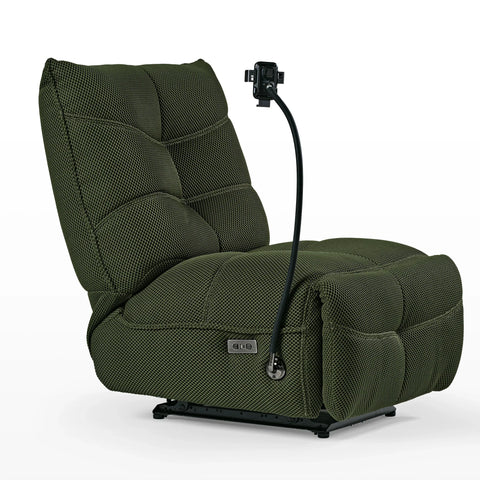
- Passive Relaxation (Lounge Chairs): These prioritize a reclined angle, often between 105 and 135 degrees. While this reduces pressure on the lower back for short periods, it often leads to "slumping" when a user tries to reach forward to type on a laptop, causing the pelvis to tilt posteriorly and flattening the lumbar curve.
Executive Chairs: Precision Engineering for Active Productivity
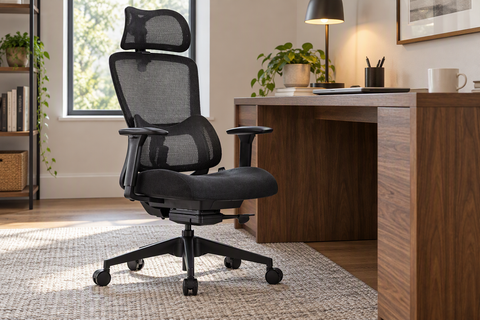
An executive chair is more than a status symbol; it is an engineered solution for high-functioning environments. Unlike standard task chairs, executive models often incorporate premium materials like top-grain leather or polished wood accents, but their true value lies in their adherence to rigorous durability and ergonomic standards.
Industry benchmarks, such as the BIFMA G1-2013 Ergonomics Guideline, provide recommended dimensions that cover the 5th to 95th percentile of the population. This means a high-quality executive chair is designed to be adjustable enough to fit a petite professional or a tall executive with equal precision.
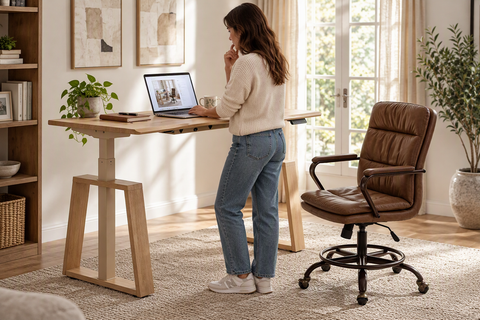
For those managing complex setups, the chair is only one half of the equation. A high-performance seat should be paired with a desk that facilitates movement. The Zen Pro Series, 87"/72" Executive Standing Desk with Cabinets Set provides the necessary height adjustability to complement an executive chair's range, allowing users to transition between sitting and standing without interrupting their workflow.

The "90-90-90 rule" is nearly impossible to achieve in a deep-seated lounge chair. Executive chairs facilitate "active sitting," which involves subtle muscle engagement that promotes blood circulation. Research synthesized in The 2026 Workstation White Paper: Converging Ergonomic Science and Sustainable Engineering suggests that chairs with dynamic lumbar support significantly reduce the "burning" sensation in the trapezius muscles often caused by improper keyboard heights.
Lounge Chairs: The Science of Recovery
If executive chairs are for the "sprint" of the workday, lounge chairs are for the "recovery." Modern lounge seating has evolved to incorporate a hybrid ergonomic approach. The goal is to maintain the spine and neck in an upright, supported position while allowing the lower body to relax.
The Lucia,Swivel Rocking Manual Recliner exemplifies this by offering a 360° swivel and gentle rocking motion. These micro-movements are essential; according to the Health and Safety Executive (HSE), changing posture frequently is a key defense against the development of chronic pain.
Lounge chairs like the Lounge Chair-Red Yellow & Blue Yellow Stripe use weight-distributing seat contours to support users during periods of meditation or casual reading. However, these chairs are intentionally designed with a deeper seat (often 19–22 inches), which can hinder circulation if used for prolonged computer work because the edge of the seat may press against the back of the knees, a common pitfall identified by Cornell University Ergonomics.
Case Study: The High-Stakes Ergonomics of the Tall Professional
To demonstrate the critical nature of chair selection, consider the "Tall Professional" scenario. We analyzed the requirements for a 193cm (6'4") male executive—representing the 95th percentile of the population—operating a high-end workstation.
For a user of this height, standard furniture often fails. A typical 29-inch desk is approximately 2.38 inches too low, forcing a hunch that collapses the lumbar curve. When this user sits in a lounge chair to work, the problem is compounded by a lack of seat-height adjustability.
Quantitative Impact Analysis: The Tall Professional
| Metric | Required Specification | Standard Furniture Gap | Potential Impact |
|---|---|---|---|
| Seated Desk Height | 79.7 cm (31.4") | -6.0 cm (-2.38") | Increased neck/shoulder strain |
| Viewing Distance | 76.8 cm (30.25") | -15.8 cm (-6.25") | Eye strain and forward head posture |
| Seat Height Range | 50–52 cm | Varies (often too low) | Knee and hip discomfort |
| Productivity ROI | 15% Uplift | N/A | Estimated $8,438 annual value gain* |
*Note: Estimated value gain based on a $75/hour wage and 180 minutes of optimized active sitting/standing per day. Individual results vary based on specific workflow and health baseline.
This data confirms that for power users and those at the edges of the height spectrum, the adjustability of an executive chair is non-negotiable. The Grayson, Manual Recliner Chair Rocking Swivel with Storage offers a perfect "break zone" solution for this user, but it should never replace their primary task chair.

The Two-Zone Solution: Designing a Hybrid Workspace
The most effective modern workspaces do not choose between executive and lounge chairs; they integrate both into a "Two-Zone" strategy. This approach recognizes that the brain and body require different environments for different types of labor.
- Zone 1 (The Focus Zone): Centered around a highly adjustable executive chair and a standing desk. This zone is for tasks lasting over 30 minutes, such as deep work, video conferencing, and data analysis.
- Zone 2 (The Refraction Zone): Featuring a lounge chair or recliner positioned away from primary screens. This area is for administrative tasks on a tablet, creative brainstorming, or the "2-minute movement" breaks recommended by the Cornell 20-8-2 sitting rhythm.
Practical Recommendations for Workday Success
To maximize the benefits of your seating investment, follow these authoritative guidelines for setup and behavior:
- Set Your Monitor Height: According to the Canadian Centre for Occupational Health and Safety (CCOHS), the top line of text on your monitor should be at or slightly below eye level. This prevents the "forward head" posture common in lounge chairs.
- The 20-8-2 Rhythm: For every 30 minutes of work, sit for 20 minutes (in your executive chair), stand for 8 minutes, and move for 2 minutes.
- Check Your Seat Depth: Ensure there are 2–3 finger-widths between the front edge of the seat and the back of your knees. If the seat is too deep (common in lounge chairs), it can restrict blood flow to the lower legs.
- Utilize Lumbar Support: Ensure the chair’s lumbar curve fits into the small of your back. As specified in ANSI/BIFMA X5.1, this support is vital for maintaining the spine's natural alignment under load.
Choosing Your Path
Selecting the right chair requires an honest assessment of your daily habits. If your workday involves hours of focused computer interaction, an executive chair is an essential investment in your long-term health and productivity. If you are looking for a dedicated space to decompress and recover from the mental load of high-level decision-making, a lounge chair is the superior choice.
By respecting the distinct roles of these two pieces of furniture, you can create a workspace that supports both the rigor of your professional life and the necessity of your physical recovery.
YMYL Disclaimer: This article is for informational purposes only and does not constitute professional medical advice, diagnosis, or treatment. Always seek the advice of your physician or other qualified health provider with any questions you may have regarding a medical condition or musculoskeletal pain. The ergonomic recommendations provided are based on general industry standards and may not be suitable for individuals with pre-existing spinal conditions.
References
- BIFMA G1-2013 Ergonomics Guideline for Furniture
- OSHA eTools: Computer Workstations - Neutral Working Postures
- WHO 2020 Guidelines on Physical Activity & Sedentary Behaviour
- Cornell University Ergonomics Web — Workstation Guides
- ISO 9241-5:2024 Workstation layout & postural requirements
- CCOHS: Office Ergonomics - Sit/Stand Desk
- HSE: Working safely with display screen equipment (DSE)




Leave a comment