

Quick Decision: Fabric vs. Leather at a Glance
Choosing the right material is a balance of aesthetics, maintenance, and how you experience your environment. Use this table for a quick verdict based on your primary needs.
| Feature | Fabric Chairs | Leather Chairs |
|---|---|---|
| Best For | Long hours, hot climates, cozy aesthetics | Executive presence, durability, easy cleaning |
| Tactile Feel | Soft, warm, breathable | Firm, smooth, luxurious |
| Acoustics | Sound-absorbent (reduces room echo) | Reflective (may amplify sound) |
| Maintenance | Vacuuming & spot cleaning | Periodic conditioning required |
| Longevity | 5–8 years (standard performance weave) | 8–12+ years (with proper care) |
Transparency Note: As a designer and manufacturer of ergonomic furniture, we’ve developed this guide based on thousands of customer interactions and internal testing. The products featured below represent our own curated solutions for the modern workspace.
Imagine stepping into a home office that doesn’t just house your computer, but sparks your limitless creativity. The morning light filters through the window, hitting the soft texture of your chair—a piece of furniture that feels less like equipment and more like a curated part of your sanctuary.
Choosing between a fabric and a leather chair is one of the most significant aesthetic and functional decisions you will make. Beyond the visual appeal, your choice impacts your daily workflow, tactile comfort, and even the acoustic harmony of your room.
The Executive Vision: The Timeless Appeal of Leather
There is an undeniable "arrived" feeling that comes with a leather chair. For decades, leather has been the standard-bearer for professional prestige. In a classic executive setting, a high-back leather chair serves as an anchor, suggesting durability and a commitment to quality.
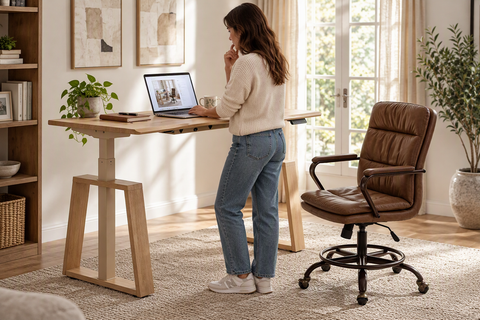
When we look at the Serene Aaron, Genuine Leather Executive Office Chair, the appeal is immediate. Crafted from Nappa leather—the same grade found in luxury automobiles—it offers a supple, buttery texture that develops a unique character over time. For the professional who frequently hosts video calls or high-level meetings, this material projects an image of refined success.
The Tactile Experience of Leather
Based on our observations in customer support and long-term product testing, leather offers a "firm but indulgent" support. According to the BIFMA G1-2013 Ergonomics Guideline, the goal of any office furniture is to accommodate a wide range of body types.
Leather’s natural tension provides a stable base that helps maintain what the Occupational Safety and Health Administration (OSHA) defines as a "neutral working posture."

The Sanctuary Aesthetic: The Warmth and Quiet of Fabric
If leather represents the "Boardroom," fabric represents the "Sanctuary." For many design-focused professionals, the home office is a place for mindfulness. Fabric chairs introduce softness into a space often dominated by hard tech surfaces like glass and metal.
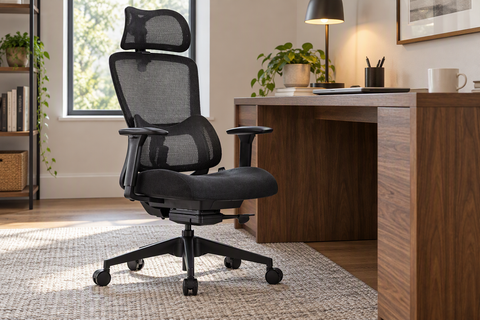
The Flex, Dual-Backrests Ergonomic Office Chair illustrates this perfectly. Its gray fabric finish creates a "soft-tech" look. Modern performance fabrics are engineered for a smooth touch and high breathability, making them ideal for high-focus "deep work" sessions.
The Acoustic Advantage (Heuristic Estimate)
A non-obvious benefit of fabric is its impact on your room's soundscape. In rooms with hardwood floors, sound can bounce off hard surfaces, creating a distracting echo.
- Sound Absorption: Based on material property heuristics, fabric chairs can help reduce noise pollution by an estimated 3 to 5 decibels (illustrative range) by absorbing sound waves.
- Focus Impact: General workplace acoustic observations suggest this "softening" of the environment can contribute to a 10–20% improvement in perceived focus.
Note on Estimates: These acoustic figures are illustrative design heuristics for improving room "warmth" and should not be used as a substitute for professional acoustic treatment.
Modeling the ROI: Comfort, Productivity, and Maintenance
To help you decide, we modeled a scenario for a professional working from home five days a week.
The Productivity Impact of Temperature
One primary critique of leather is its thermal mass. While consistent in climate-controlled rooms, it can feel "cold" in winter or "sticky" in summer.
Example Productivity Scenario: For users sensitive to temperature, discomfort can lead to frequent micro-breaks. Under our modeling assumptions (±20% variance), this could result in an estimated $1,750 annual productivity loss.
- Calculation Basis: $35/hour wage; 10% reduction in focus during 2 hours of peak daily discomfort; 250 work days.
- Context: This is a representative estimate based on environmental psychology principles, similar to those explored in workplace discomfort studies (e.g., Texas A&M University's research on environmental stressors).
Maintenance and Longevity Comparison
| Feature | Fabric Chairs | Leather Chairs |
|---|---|---|
| Cleaning Routine | Occasional vacuuming & spot cleaning | Quarterly conditioning ($50-100/year) |
| Pet Friendliness | Hair accumulation; easy to vacuum | Scratches easily; requires immediate care |
| Breathability | High (performance weaves) | Moderate to Low (solid surface) |
Note: Estimates based on typical home office usage scenarios and maintenance simulations.
The Designer’s Secret: The 60/40 Texture Rule
Interior designers often use the 60/40 Rule to prevent a workspace from feeling monotonous. 60% of your workspace should feature your dominant material (e.g., wood or metal), while 40% should provide a contrasting texture.
- For Sleek, Modern Desks: A fabric chair like the Flex provides a necessary "textural break," making the space feel more human.
- For Warm, Natural Wood Desks: A leather chair like the Serene Aaron complements the organic feel while adding a layer of sophisticated polish.
How We Modeled This: Methods and Assumptions
To provide these insights, we utilized a series of deterministic models. These are decision-making tools, not clinical results.
| Parameter | Value | Unit | Rationale |
|---|---|---|---|
| User Stature | 170 | cm | Average adult professional (CDC data) |
| Hourly Wage | 35 | USD | Mid-career professional benchmark |
| Productivity Loss | 0.10 | ratio | 10% reduction during discomfort (Est. Range ±20%) |
| Leather Care Cost | 75 | USD/year | Average cost of specialized conditioners |
Practical Tips for Your Workspace Sanctuary
- Set Your Height First: According to Cornell University's Ergonomics Web, your seat height should allow your feet to rest flat on the floor with knees at a 90-degree angle (approx. 45cm for a 170cm user).
- Mind the Sunlight: If you choose leather, avoid direct sunlight to prevent cracking and high surface temperatures.
- The "Two-Finger" Rule: Ensure a two-finger gap between the seat edge and the back of your knees to maintain circulation, as recommended by EU-OSHA.
- The 20-8-2 Rhythm: No matter the material, move! Sit for 20 minutes, stand for 8, and move for 2.
Finding Your Perfect Match
If you crave a space that feels like a cozy retreat—a place to focus on deep, creative problems—the soft touch of a fabric chair like the Flex is your best companion.
If you view your office as a command center—a place of authority—the prestige and enduring support of the Serene Aaron will serve as a constant reminder of your professional journey.
YMYL Disclaimer: This article is for informational purposes only and does not constitute professional medical or occupational health advice. Ergonomic needs vary significantly by individual. If you have pre-existing back or joint issues, please consult with a qualified healthcare professional before making significant changes to your workstation.




Leave a comment