

You've Got the Screens, But Have You Got the Space?
Author Note & Disclosure: By the Setup Testing & Customer Experience Team. To help illustrate our layout concepts, we’ve included links to specific Eureka Ergonomic desks and accessories. However, the measurement formulas, stability rules, and component weights provided below are based on our team's hands-on workshop tests and apply to any desk brand you choose.
Let's be real. Building a multi-monitor battlestation is a rite of passage. That feeling of expanding your digital world, wrapping yourself in the game, or just having Discord, your stream, and the main event all visible at once is a game-changer. But in our customer support experience, we see a common pattern: dropping a fortune on high-refresh-rate panels only to cram them onto a desk that’s too small. The result? Monitors hanging off the edge, your mouse hand hitting your keyboard, and your neck cranked at an uncomfortable angle.
This isn't just about plopping monitors on a plank of wood. It's about creating an immersive, ergonomic command center. We're going to dive deep into the nitty-gritty of gaming desk dimensions. We'll move beyond the marketing fluff and give you the practical, hands-on advice you need to choose a desk that fits your gear, your body, and your gaming style perfectly.
A Common Trap: Why Monitor Diagonal Size is Misleading
We have to start by clarifying the most common misconception we see: choosing a desk based solely on your monitor's diagonal screen size. The "27-inch monitor" label is a panel specification, not a physical footprint you can use for layout planning.
Here's the reality based on our workshop measurements: the diagonal measurement tells you nothing about the monitor's actual horizontal width, the bezels surrounding the screen, or the footprint of its stand.
For example, we took a tape measure to several popular 27-inch gaming monitors. While the screen measures 27 inches diagonally, the physical width is roughly 24.2 inches. Put two of these side-by-side flat, and you’re looking at 48.4 inches of screen real estate. Even if you angle them inward at a standard 15 degrees, the footprint only shrinks slightly to about 46.5 inches of linear width. And that is before you even think about leaving space for your PC tower or your mouse.
This is where we need to shift our thinking from screen size to usable surface area. You must account for the physical width of your monitors, the space they occupy when angled, and the critical "wing space" for your mouse.

The "W + M + B" Sizing Calculator
To help you skip the guesswork, we use a simple formula in our shop to match users with the right desk size. Grab a tape measure and use this quick calculation:
Total Monitor Width (W) + Mouse Space (M) + Edge Buffers (B) = Minimum Desk Width
- W (Width): Measure the actual horizontal width of your monitors side-by-side in your preferred angled setup. (e.g., Dual 27" monitors angled = ~46.5 inches).
- M (Mouse Space): We recommend a generous 10 to 12 inches of free space on your primary mouse side for low-DPI gaming.
- B (Buffers): Add about 4 inches of buffer space on the opposite edge so your monitors don't sit precariously on the rim.
Example Calculation for Dual 27-inch Monitors: 46.5" (W) + 10" (M) + 4" (B) = 60.5 inches. This is exactly why a 60-inch desk is our standard recommendation for a dual-27" setup.

Desk Width Heuristics: Our Sizing Chart
Based on assembling and testing hundreds of customer configurations, here is our practical sizing chart. These are based on real-world clearances, not theoretical minimums.
| Monitor Configuration | Minimum Desk Width | Recommended Desk Width | Real-World Notes from Our Tests |
|---|---|---|---|
| Single 24" - 27" Monitor | 40" (102 cm) | 48" (122 cm) | Leaves about 20 inches of usable space for a mid-tower PC and a large mousepad. |
| Single 34" Ultrawide | 48" (122 cm) | 60" (152 cm) | Ultrawides need depth as much as width. The 60" option prevents the setup from feeling cramped. |
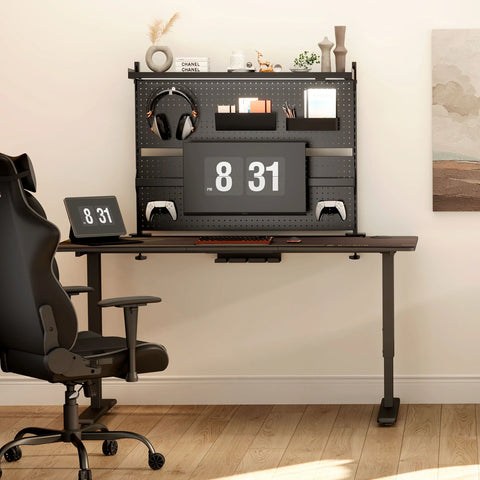
| Dual 24" Monitors | 48" (122 cm) | 60" (152 cm) | A 48" desk is tight but doable if the PC is on the floor. A 60" desk like the Full-Surface Mousepad Gaming Desk (60"x27") is the sweet spot for comfort. |
| Dual 27" Monitors | 60" (152 cm) | 72" (183 cm) | The power-user standard. As our calculator shows, a 60" desk is the practical minimum here. |
| Triple 27" Monitors | 72" (183 cm) | 72"+ or L-Shape | At this point, linear width becomes unwieldy. An L-shaped desk is often the best solution to avoid extreme viewing angles. |
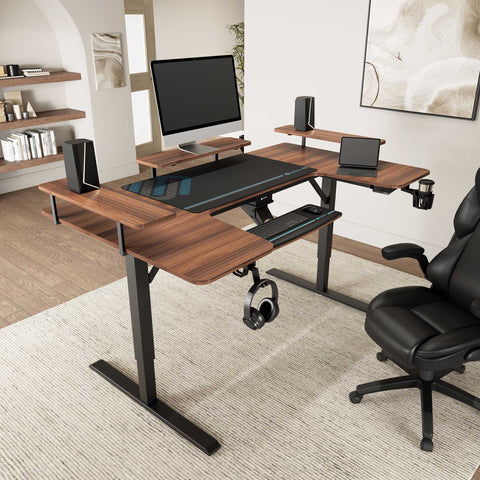
For massive setups, especially with three monitors or a mix of horizontal and vertical screens, a standard rectangular desk can feel limiting. A model like the GTG-L60 Pro, L shaped Glass Gaming Standing Desk (60"x23") gives you a dedicated wing for your primary gaming monitors and a secondary surface for a streaming PC or work laptop.

Beyond Width: The Critical Role of Desk Depth
Width gets all the attention, but desk depth is the unsung hero of a clean, comfortable setup. Depth directly impacts your viewing distance, which is crucial for reducing eye strain. The U.S. Occupational Safety and Health Administration (OSHA) recommends your monitor should be at least an arm's length away (typically 20 to 24 inches for most adults).
Here are our practical depth rules based on standard monitor stands:
- 24 inches (60 cm): The practical minimum for a single monitor. In our tests, a standard monitor stand takes up about 8-10 inches of depth. On a 24-inch desk, this leaves roughly 14-16 inches for your keyboard and hands, putting the screen right at that minimum arm's-length distance.
- 30-36 inches (76-91 cm): The gold standard for multi-monitor or immersive ultrawide setups. This extra depth gives you room to position speakers, use deep monitor bases, and maintain a comfortable viewing angle without feeling crowded.
Monitor arms are a fantastic way to reclaim desk space. While they can push your monitors back and free up 4-10 inches of surface depth, you must ensure your desk is thick enough and has a clear edge for the clamp.
If you're working with a standard-depth desk and can't use a clamp arm, a riser can help optimize your space. A product like the Carbon Fiber Dual Monitor Stand lifts your screens to a more ergonomic height and creates a storage cubby underneath for your keyboard.
The Stability Factor: Sit-Stand Desks and Weight Limits
Standing desks are fantastic for promoting a healthier routine. The World Health Organization's guidelines emphasize the importance of reducing sedentary time. However, when you load a standing desk with a heavy multi-monitor rig, new factors come into play: lifting capacity and structural stability.
The 1.5x Load Heuristic and The Wobble Test
A wobbly desk can be highly frustrating during an intense match. For standing desks, a frame that’s stable when lowered can sometimes exhibit lateral sway at full height.
In our workshop, we use the 1.5x load heuristic. Why? Based on our internal stability tests of various standing desk frames, we've observed that when desk motors operate near their maximum rated capacity, they strain more, move slower, and the frame is more prone to wobble at standing heights. By ensuring your total gear weight is no more than 66% of the desk's maximum capacity (hence, multiplying your gear weight by 1.5 to find your target desk capacity), you maintain a rigid surface.
Let’s look at some average component weights from our test bench:
| Component | Average Measured Weight |
|---|---|
| 27" Gaming Monitor (with stand) | 12 - 16 lbs |
| Mid-Tower PC (Fully built) | 30 - 45 lbs |
| Heavy-Duty Dual Monitor Arm | 8 - 12 lbs |
| Peripherals (Keyboard, mouse, speakers) | 5 - 10 lbs |
Quick Math for a Typical Dual-Monitor Setup: Two 27" monitors (30 lbs) + Dual arm (10 lbs) + Mid-tower PC (35 lbs) + Peripherals (10 lbs) = 85 lbs total.
Using our heuristic (85 lbs x 1.5), you should look for a desk with a rated lifting capacity of at least 127.5 lbs. Most quality dual-motor gaming desks handle 200+ lbs, making them well-suited for this, but it's a critical check if you are considering budget single-motor options.
Another consideration for sit-stand desks is cable management. As the desk moves, you need enough slack to avoid pulling your expensive PC off its stand. An under-desk CPU holder, like the Knob-operated Adjustable CPU Holder, attaches your PC tower to the underside of the desk so it moves up and down with the surface, removing the risk of cable tension.
The Ultimate Pre-Purchase Checklist
Run through this final checklist before you buy to save yourself from common layout mistakes:
- Measure Your Monitors: Don't guess. Measure the full physical width of each monitor, including the bezels.
- Use the W+M+B Formula: Add your monitor width, desired mouse space (10-12"), and edge buffers (4") to find your minimum desk width.
- Decide: Stands or Arms? If using included stands, ensure you have at least 24-30 inches of desk depth. If using arms, verify your desk's edge is compatible with clamps.
- Calculate Total Weight: Add up the weight of your monitors, PC, arms, and peripherals. Multiply by 1.5 to find your ideal standing desk lifting capacity for maximum stability.
- Plan Your PC Placement: Will your PC go on the desk, on the floor, or in an under-desk holder? If it goes on the desk, add another 8-10 inches to your width requirement.
- Confirm Cable Length: If getting a standing desk, verify your display and power cables are long enough to reach full height without pulling taut.
- Check Viewing Distance: Ensure your chosen desk depth allows you to sit at least an arm's length from your screens to align with Cornell University's Ergonomics guidelines for visual comfort.
Wrapping Up: Your Blueprint for the Perfect Battlestation
Choosing the right gaming desk is about making an informed decision based on your specific equipment. By moving beyond misleading diagonal measurements and focusing on real-world width, depth, and the 1.5x stability rule, you can build a setup that’s not only impressive but also comfortable for those marathon gaming sessions. Measure twice, plan your layout, and build your dream setup with confidence.
Frequently Asked Questions (FAQ)
How high should my monitors be for gaming?
According to the Canadian Centre for Occupational Health and Safety (CCOHS), your monitor should be placed so that the top of the screen is at or slightly below eye level. This helps you maintain a neutral neck posture, often reducing strain during long sessions.
Is an L-shaped desk better for a multi-monitor setup?
For three or more monitors, or for users who want to separate their gaming and work setups, an L-shaped desk is highly practical. It allows for a more ergonomic viewing angle across all screens and provides distinct zones for different tasks.
How much weight can a typical gaming desk hold?
A standard fixed-height desk might hold 150-200 lbs. For height-adjustable standing desks, quality dual-motor models typically have a capacity ranging from 200 to 350+ lbs. Always check the manufacturer specifications and apply the 1.5x heuristic to ensure smooth, stable operation.
Disclaimer: This article is for informational purposes only and does not constitute professional medical advice. Always consult a qualified healthcare professional if you have pre-existing health conditions or experience discomfort. The ergonomic guidelines referenced are based on established standards but may need to be adapted for individual needs.




Leave a comment