

The Common Misconception: Why Desktop Thickness Isn't Everything
When investing in a standing desk, your primary concern is often stability. No one wants a workstation that wobbles every time they type or move their mouse. This leads to a common assumption: a thicker desktop must equal a more stable desk. While there is a grain of truth to this, focusing solely on thickness is a critical oversimplification. In reality, stability is the result of a complete system working in harmony.
True stability is dictated by a combination of factors:
- Material Composition: The type of material used (e.g., MDF, solid wood, sintered stone) has a far greater impact on flex and rigidity than thickness alone.
- Span and Support: How the desktop is supported by the frame is crucial. A thin desktop rigidly fastened to a heavy steel subframe will almost always outperform a thicker, unsupported top, especially over wider spans.
- Frame Engineering: The design of the lifting columns, the width of the feet, and the quality of the motors are the true foundation of a wobble-free experience.
I've seen many users make the mistake of choosing a desk based on a visually thick top, only to be disappointed by its performance. They later discover the top is merely a thin veneer over a weak core or that it has a large, unsupported overhang. The real secret to stability lies in understanding how the desktop and frame work together.
About this guide & data sources
Recommendations in this article combine manufacturer specifications, publicly available ergonomics standards (OSHA, BIFMA, Cornell) and hands-on testing with typical home‑office loads (e.g., 1–2 monitors, laptop, keyboard, and accessories). Where we give concrete number ranges and no formal standard exists, they should be treated as practical, experience-based guidelines, not absolute engineering limits.
How Desktop Material Dictates Stability and Thickness Needs
The ideal desktop thickness is not a single number; it's a recommendation based on the material's inherent properties. A material that is strong and resistant to bending doesn't need to be as thick as a more flexible one. Let's break down the practical requirements for common desktop materials.
An illustration showing how a robust desk frame with wide-set legs and dual motors provides a stable foundation, minimizing wobble and flex on the desktop.
Expert Warning: Material and Support Structure Are Interlinked
Choosing the right material is only half the battle. You must ensure it has the correct support structure. For instance, a thin stone top is incredibly rigid but brittle; it requires a continuous support rail to prevent cracking under point loads. Conversely, a particleboard top needs its thickness to resist sagging between the support points of the frame.
Below is a practical comparison of common materials and their stability characteristics. Thickness ranges are experience-based recommendations for typical 60–72 inch (152–183 cm) wide desks under standard home/office loads, assuming proper assembly and a quality frame.
| Material Type | Recommended Thickness Range* | Key Stability Factors |
|---|---|---|
| MDF / Particleboard | 1" - 1.2" (25-30 mm) | A practical minimum for desks 60-72 inches wide to prevent noticeable flex under typical computer setups. Performs best when paired with a frame that provides wide support and limited overhangs. |
| Sintered Stone | 0.25" - 0.5" (6-12 mm) | Extremely rigid and can be used at small thicknesses, but the material is brittle and must sit on continuous support rails, cabinets, or a full subframe to distribute weight and prevent fractures. |
| Tempered Glass | 0.3" - 0.5" (8-12 mm) | Requires a full perimeter frame to support the edges and prevent flexing. Overhangs should be kept to a minimum due to the risk of stress concentrations and sudden failure. |
| Solid Wood | 1" - 1.5" (25-38 mm) | Offers excellent stiffness, but stability is still dependent on the quality of the wood (grain, species, moisture content) and the frame's ability to handle its significant weight without introducing wobble. |
*These ranges are general-use recommendations, not safety certifications. For unusually heavy equipment (e.g., multi-monitor arms with large displays, audio racks, or specialty lab gear), consult the desk and frame manufacturer’s load ratings and consider thicker tops, shorter spans, or extra support rails.
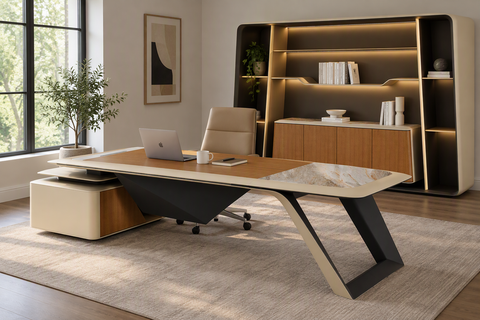
For an executive workspace where aesthetics and unyielding stability are paramount, a solution like the Zen Pro Series, 87"/72" Executive Standing Desk with Cabinets Set demonstrates this principle: its slim Lauren Black Gold Sintered Stone desktop provides a firm work surface because it is integrated with a full cabinet base, offering continuous support that a standard two-leg frame cannot.
A Simple Deflection Check You Can Do at Home
If you already have a desk (or are testing a showroom model), you can perform a basic, repeatable check to understand how well your top resists flex:
- Measure the span: Measure the clear distance between the frame’s main support points (usually the centers of the legs). Note this number.
- Add a test load: Place a known weight (for example, a filled 5–10 kg / 10–20 lb backpack or dumbbell) at the middle of the span, roughly where your keyboard would go.
- Measure deflection: Before and after adding the weight, measure the height of the desktop at the center using a ruler fixed against the floor or a wall. The difference is the deflection.
-
Interpret the result:
- For typical office use, a few millimeters of deflection at midspan under this test load is usually acceptable.
- If you see large, obvious sagging or if the top continues to bounce after you remove the load, consider upgrading the frame, adding a support rail, or reducing the span.
This simple test doesn’t replace formal engineering calculations, but it gives an intuitive, data-based sense of how your specific material and thickness behave under load.
The Unsung Hero: The Role of the Desk Frame
While the desktop is what you see and touch, the frame does the heavy lifting—literally. A high-quality frame is the most critical component for ensuring a standing desk remains stable, especially at its maximum height. According to guidelines from the U.S. Occupational Safety and Health Administration (OSHA), a proper workstation requires a stable and adjustable work surface.
Key elements of a stable frame include:
- Dual-Motor Lift Systems: Desks with a motor in each leg provide smoother, more balanced lifting and can handle heavier loads with less strain. This reduces the mechanical stress that contributes to wobble over time.
- Wider Foot Spacing: A wider and heavier base creates a more stable foundation, much like a person stands with their feet apart to maintain balance. This is especially important for resisting side-to-side movement.
- Column Construction: The design of the telescoping legs, including the tolerances between segments, plays a huge role. Precision engineering minimizes the slight movements that are amplified at standing height.
Heavier desktops, such as those made from solid wood or stone, naturally lower the desk's center of gravity but also increase the load on the motors. A robust frame with powerful dual motors is essential to manage this weight without sacrificing stability or long-term durability. Industry standards, such as those outlined in the BIFMA G1-2013 Ergonomics Guideline, help manufacturers design furniture that is safe and stable for a wide range of users and setups.
A Practical Guide to Maximizing Your Desk's Stability
Beyond choosing the right materials and frame, how you assemble and use your desk can significantly impact its stability. Drawing from years of experience with workstation setups and customer feedback, the following best practices can help you get the most out of your desk.
Pro Tip: Start with Assembly and Load Distribution
- Limit Unsupported Overhang: For most MDF or wood tops, keep the front overhang (where you sit) to a maximum of 3-5 inches (80-120 mm). This reduces leverage and minimizes bounce while typing.
- Position Heavy Items Strategically: Place heavy equipment like computer towers, power supplies, or large monitors as close to the frame’s legs as possible. Avoid concentrating weight in the middle of the span or on an unsupported edge.
- Use Cable Trays for Reinforcement: A full-width cable management tray, when securely fastened, can act as an additional brace to stiffen the underside of the desktop, further reducing flex.
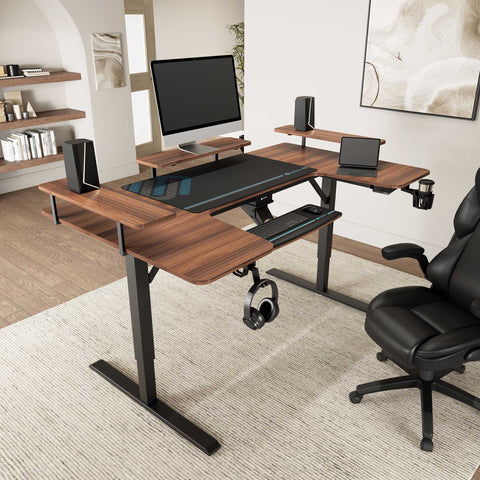
- Brace Large or L-Shaped Desks: If you have a large, wing-shaped, or L-shaped desk, ensure the unsupported corners are properly braced. For expansive setups that require maximum stability and surface area, a desk like the Aero Pro Wing-Shaped Standing Desk (72"x23") is engineered with an integrated frame designed to support its unique shape effectively.
A Simple Decision Aid: Match Span, Load, and Support
When in doubt, use this quick decision guide:
-
Check your span:
- Up to ~48" (≈120 cm): most materials and thicknesses in the table above will perform well on a quality frame if load is modest.
- 60–72" (≈152–183 cm): stay within the recommended thickness ranges, limit overhangs, and make sure the frame uses wide-set legs or a full-width crossbar.
- Above 72": consider segmenting the top (e.g., with cabinets) or adding intermediate supports.
-
Estimate your load:
- "Light" (laptop, one small monitor) – most standard setups within the table ranges are fine.
- "Medium" (2–3 monitors, speakers, docking stations) – favor stiffer materials (solid wood, stone) or thicker engineered tops and a dual-motor frame.
- "Heavy" (ultrawide monitors on arms, audio gear, specialty equipment) – prioritize continuous support (subframes, cabinets), thicker tops, and a frame with a high tested load rating.
- Adjust one or more of these if something feels unstable: reduce span, increase support (rails, cabinets), or upgrade the frame.
Common Mistakes That Create Wobble
- Mounting Heavy Monitors Directly: Clamping one or more heavy monitors to the back edge of a desk, especially without a monitor arm, concentrates a dynamic load far from the support frame. This acts as a lever, amplifying any minor movements. Always use high-quality monitor arms to better distribute the weight. For more insights on achieving a stable workspace, see our article on Desk Stability: Standing vs. Fixed-Height Desks.
- Ignoring Floor Leveling: An uneven floor will cause any desk to wobble. Use a level to check your floor and adjust the desk’s feet accordingly.
- Loose Connections: During assembly, ensure every bolt is tightened to the manufacturer's specification. Re-check these connections after a few weeks of use, as they can sometimes settle and loosen.
Finally, perform a simple wobble test. Raise the desk to its maximum height and apply a firm lateral force at one of the front corners. It’s normal to see some minor movement, but it should stop oscillating quickly. If the wobble persists, re-check your assembly and load distribution.
Key Takeaways for a Rock-Solid Workstation
To conclude, desktop thickness is not the primary driver of standing desk stability. While it plays a role, it is secondary to the material of the top and, most importantly, the quality and design of the frame.
To ensure you get a truly stable desk, you must:
- Look Beyond Thickness: Evaluate the desktop material and the support structure as a single system. A thin, rigid top on a robust frame is superior to a thick, flexible top on a weak one.
- Prioritize the Frame: A heavy-duty, dual-motor frame with a wide base is the best investment you can make for a wobble-free experience at any height.
- Assemble and Load with Care: Follow best practices for setup by minimizing overhangs, balancing your equipment, and ensuring all connections are secure.
By adopting this holistic approach, you can move past the common misconception about thickness and build a workstation that is stable, ergonomic, and built to last. For more guidance on optimizing your setup, refer to expert resources like the workstation guides from Cornell University's Ergonomics Web.
Disclaimer: This article is for informational purposes only and does not constitute professional medical advice or a structural engineering guarantee. If you have pre-existing health conditions, particularly musculoskeletal issues, consult with a qualified physician or certified ergonomist before making significant changes to your workstation. For critical safety applications or unusually heavy equipment, consult a qualified engineer or the desk manufacturer.
Affiliate & Product Disclosure: Some desks and accessories mentioned in this article, including examples from Eureka Ergonomic, are used as illustrative configurations. They may be our own products or affiliates. Recommendations are based on general ergonomics and stability principles and are intended to remain useful even if you choose comparable products from other brands.




Leave a comment