

The Three Critical Desk Dimensions: Width, Depth, and Height
Choosing the right desk is the foundation of a productive and comfortable workspace. While aesthetics matter, the core dimensions—width, depth, and height—are what truly dictate a desk's functionality. Getting these right helps prevent musculoskeletal strain and ensures you have the space you need to perform at your best. Let's break down each dimension based on ergonomic principles and our own workshop testing.
Desk Width: Your Horizontal Workspace
Desk width (often called length) determines your side-to-side working area. The ideal width is directly related to the equipment you use and the nature of your tasks.
- Compact Desks (Under 120 cm / 48 inches): These are best suited for minimalist setups, such as a single laptop or a small monitor in a tight space. They fit well in apartments or multi-purpose rooms but offer limited room for peripherals or paperwork.
- Standard Desks (120-150 cm / 48-60 inches): This is the most popular range for home and corporate offices. A 140 cm (55-inch) desk can comfortably accommodate a single large monitor with a laptop, or two smaller monitors, along with space for a keyboard, mouse, and a notepad.
- Large Desks (160-180 cm / 63-72 inches): If you're a developer, designer, or gamer running a dual-monitor or ultrawide setup, this range is often the sweet spot. It provides ample space to spread out multiple inputs and reference materials without feeling cramped.
- Executive & Specialist Desks (Over 180 cm / 72 inches): These expansive desks are for power users who require a massive command center for three or more monitors, streaming gear, and large-format documents. Desks like the Zen Classic Executive Standing Desk (86"x39") fall into this category, offering a vast surface for demanding workflows.
Desk Depth: The Key to Ergonomic Viewing
A common mistake is choosing desk depth based purely on looks rather than function. Desk depth is a critical factor for managing eye and neck comfort. According to the Occupational Safety and Health Administration (OSHA) Computer Workstations eTool, your monitor should be placed at a viewing distance between 20 and 40 inches (50 to 100 cm) from your eyes to reduce visual fatigue.
The Shallow Desk Challenge
Many standard desks come with a depth of 60 cm (24 inches). While this works for a simple laptop setup, it often becomes an ergonomic challenge with larger monitors. A 27-inch or 32-inch monitor on a shallow desk can force you to either sit too close or push the monitor so far back that its stand hangs off the edge.
Based on our team's workshop tests with various monitor stands, we use the following practical rule of thumb for matching monitor size to desk depth:
| Monitor Size | Stand Type | Recommended Minimum Desk Depth |
|---|---|---|
| Up to 24" | Standard Base | 60 cm (24") |
| 27" - 32" | Standard Base | 70 - 80 cm (28" - 32") |
| 34"+ Ultrawide | Heavy-Duty Base | 80 cm+ (32"+) |
| Any Size | Desk-Mounted Monitor Arm | Can deduct ~10 cm (4") from required depth |
This extra space allows you to position your monitor at a healthy viewing distance while still leaving plenty of room for your keyboard, wrists, and other tools
.

Desk Height: The Foundation of Good Posture
Desk height plays a massive role in your daily comfort. A desk that is too high or too low can force your body into awkward postures, which is a common contributor to shoulder, back, and wrist fatigue. The goal is to achieve a "neutral posture," where your joints are naturally aligned and under minimal stress.
According to the BIFMA G1-2013 Ergonomics Guideline, office furniture should be designed to accommodate individuals ranging from the 5th percentile female (roughly 5'0" or 152 cm) to the 95th percentile male (roughly 6'2" or 188 cm). Because fixed-height desks (usually around 29 inches / 73 cm) rarely fit everyone, height-adjustable desks have become essential.
To put this into perspective, during our recent office setup trials, a 5'2" (157 cm) team member found her neutral seated desk height to be exactly 24.5 inches (62 cm). Conversely, a 6'1" (185 cm) colleague needed his desk raised to 28.5 inches (72 cm) to keep his forearms parallel to the floor.
- Seated Height: Adjust your chair first so your feet are flat on the floor and your knees are at roughly a 90-degree angle. Then, lower or raise your desk until the surface is at or slightly below your resting elbow height, allowing your forearms to be parallel to the floor.
- Standing Height: Stand with your shoulders relaxed and adjust the desk to that same 90-degree elbow angle. Your wrists should remain straight, not bent up or down, when typing.
A Practical Framework for Choosing Your Perfect Desk Size
Selecting the right desk isn't a guessing game. By systematically evaluating your space, workflow, and ergonomic needs, you can make a confident decision. Here is a structured approach to guide you.
Step 1: Assess Your Physical Space
Before you fall in love with a desk, measure your room. Account for door swings, window locations, and access to power outlets. As a general heuristic, you should leave at least 1 meter (3 feet) of clear space behind your desk for your chair to move freely. Don't forget vertical space—ensure a standing desk has enough clearance to rise to its maximum height without hitting shelves or window sills.
Step 2: Define Your Workflow and Equipment
Your daily tasks and gear are the primary drivers of your surface area needs. Use this table as a starting point to match your profile to a recommended size.
| User Profile | Primary Equipment | Recommended Width | Recommended Depth |
|---|---|---|---|
| The Minimalist | Laptop or Single Monitor (<24") | 100-120 cm (40"-48") | 60-70 cm (24"-27") |
| The Home Office Professional | 1-2 Monitors, Laptop, Dock | 140-160 cm (55"-63") | 70-80 cm (27"-32") |
| The Creative/Developer | 2+ Monitors or 1 Ultrawide | 160-180 cm (63"-72") | 80 cm (32") |
| The Hardcore Gamer | Ultrawide Monitor, Large Mousepad | 160 cm+ (63"+) | 80 cm (32") |
Step 3: Prioritize Your Ergonomic Profile
Your desk must fit your body. While an adjustable-height desk solves the height equation, width and depth depend on your setup. If you use monitor arms, you can afford a slightly shallower desk, as the arms allow you to float the monitor over the back edge, freeing up surface area. If you use the monitor's default stand, prioritize a deeper desk.
Standard Dimensions for Common Desk Types
Different desk styles are optimized for different spaces and functions. Understanding these archetypes can help narrow your search.
L-Shaped Desks
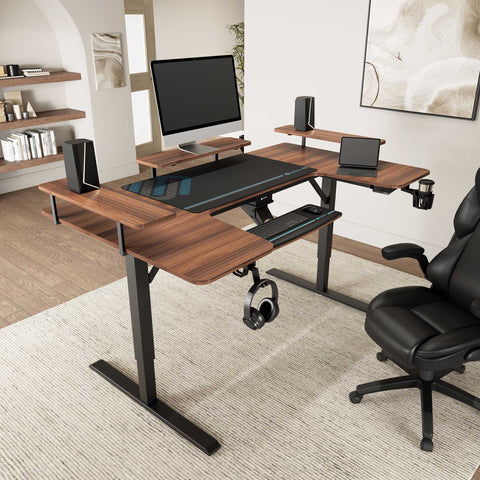
L-shaped desks are brilliant for maximizing corner space and creating distinct work zones. You can dedicate one wing to computer-based tasks and the other to analog work like sketching or reviewing documents. When choosing an L-shaped desk, ensure both sections offer sufficient depth. A model like the Ark Pro L-Shaped Standing Desk provides an expansive, ergonomic surface that adapts to complex workflows while creating a powerful aesthetic centerpiece for an office.

Executive Desks
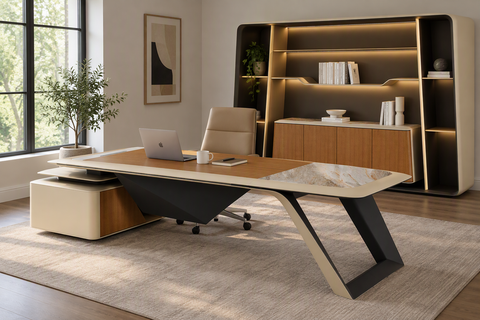
Traditionally, executive desks are defined by their large footprint, premium materials, and integrated storage. Modern executive desks have evolved to include height adjustability, combining classic aesthetics with practical ergonomics. Their generous dimensions provide more than enough room for any task, making them ideal for managers or anyone who needs a commanding workspace.

Gaming Desks
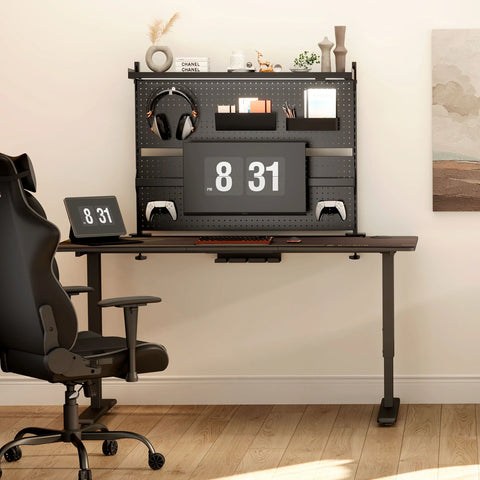
Gaming desks are built to house extensive tech setups. They often feature greater depth to accommodate large, curved monitors and oversized mousepads. Width is also a key consideration to support multiple monitors and streaming equipment. Many also include built-in cable management systems and other gamer-centric features.
Fine-Tuning Your Setup for Optimal Ergonomics
Once you have the right desk, the final step is arranging your equipment correctly. A few small adjustments can make a significant difference in your daily comfort.
Create a "Primary Work Zone"
Arrange your workspace based on frequency of use. Your keyboard and mouse should be in the "Primary Work Zone," an area easily reached without leaning or stretching—roughly a 40-50 cm (16-20 inch) radius from your seated position. Less-frequently used items like a phone, notepad, or beverage should be in a secondary zone, requiring only a slight arm extension.
A Step-by-Step Guide to Neutral Posture
Follow this checklist to dial in your workstation. It's a process best done in order, as each step builds on the last.
- Adjust Your Chair First: Sit with your back against the backrest. Adjust the chair height until your feet are flat on the floor and your knees are at roughly a 90-degree angle. If your feet dangle, use a footrest. The Adjustable Ergonomic Footrest is an excellent tool for providing stable support.
- Set Your Desk Height: Whether sitting or standing, adjust the desk's height until your forearms are parallel to the floor when your shoulders are relaxed. Your elbows should form a 90-100 degree angle.
- Position Your Monitor: The top line of text on your screen should be at or slightly below eye level. You shouldn't have to tilt your head up or down to see it. It should also be within the 20-to-40-inch viewing distance recommended by OSHA.
- Align Your Keyboard and Mouse: Place them at the same height and close enough that your elbows remain near your body. Avoid reaching forward or outward.
For those with standing desks, it's important to vary your posture. A widely referenced heuristic developed by Dr. Alan Hedge at the Cornell University Ergonomics Web is the "20-8-2" rule: for every 30 minutes of work, aim to sit for 20 minutes, stand for 8 minutes, and perform gentle stretches or walk for 2 minutes.
Adjustments for Specific Groups and When to Consult a Pro
While standard dimensions work for the majority of users, certain situations require a tailored approach. If you fall into one of these categories, consider these adjustments:
- Pre-existing Shoulder or Back Conditions: Standard desk setups might still cause discomfort even when "technically" correct. If you experience persistent pain, consult a physical therapist or certified ergonomist. They may recommend specific micro-adjustments, split keyboards, or a keyboard tray that allows for negative tilt.
- Pregnancy: As your body changes, your center of gravity and comfortable reach zones shift. You may need to frequently adjust your desk height and monitor distance. A deeper desk (80 cm / 32") provides more flexibility to push equipment back to accommodate a changing posture.
- Children and Teens: Standard 29-inch fixed desks are usually far too high for kids, leading to "shrugging" postures that strain the neck. For younger users, prioritize a height-adjustable desk that lowers to at least 22 inches (56 cm), or use a sturdy, adjustable footrest and a higher chair draft cylinder to compensate.
Wrapping Up: Dimensions Are a Starting Point
While this guide provides a thorough overview of standard desk dimensions, remember that they are a starting point, not a final prescription. The ideal desk fits your unique body, your specific workflow, and your available space. Width and depth are determined by your equipment and tasks, while height is determined by your body. By investing in a desk with the right dimensions—especially one with height adjustability—you are securing a long-term tool for better comfort and enhanced productivity.
Disclaimer: This article is for informational purposes only and does not constitute professional medical advice. If you have pre-existing health conditions or experience persistent pain, please consult a qualified physician or certified ergonomist to address your specific needs.




Leave a comment