

The Paradox of the Ergonomic Headrest
For many professionals and gamers, the addition of a headrest to an office chair is perceived as the ultimate upgrade for comfort. However, a common observation in workplace ergonomics assessments is that a poorly positioned headrest can actually exacerbate neck strain rather than alleviate it. Many users mistakenly set the headrest too low, transforming it into a "neck prop." This placement often forces the cervical spine into unintended extension, straining the suboccipital muscles and contributing to what is colloquially known as "tech neck."
The primary goal of an ergonomic headrest is not to hold the head up during active work, but to provide a rest point for the skull during periods of recline or micro-breaks, maintaining the spine's neutral position. When the headrest is misaligned, it disrupts the kinetic chain of the spine, leading to a cascade of postural compensations. Understanding the physiological principles behind cervical support is the first step in transforming a potential health hazard into a tool for long-term well-being.
The Biomechanics of Cervical Support
The human head weighs approximately 10 to 12 pounds in a neutral position. For every inch the head tilts forward, the effective weight on the neck muscles doubles. This phenomenon, often linked to Forward Head Posture (FHP), places an immense static load on the cervical vertebrae and surrounding soft tissues.
According to ISO 11226:2000 Evaluation of static working postures, maintaining a static position for extended periods, even if that position appears "comfortable," can lead to musculoskeletal disorders (MSDs). The cervical spine possesses a natural inward curve known as lordosis. An effective ergonomic setup must respect this curvature without forcing it into hyper-extension (leaning too far back) or flexion (leaning too far forward).
The Pathophysiological Mechanism of Strain
When a headrest is placed too low—directly in the curve of the neck—it acts as a fulcrum. The weight of the head remains unsupported, while the neck is pushed forward. This triggers the suboccipital muscles at the base of the skull to overwork to keep the eyes level with the monitor. Chronic contraction of these muscles is a leading cause of tension headaches and localized neck pain. Furthermore, OSHA eTools: Computer Workstations - Neutral Working Postures emphasizes that a neutral posture requires the head to be balanced directly over the shoulders, a state that is difficult to maintain if a headrest is actively pushing the cervical spine out of alignment.
Logic Summary: The "Neck Prop" error occurs because users seek a tactile sensation of support in the neck's void. Biomechanically, support should be directed at the skull to stabilize the head's weight, allowing the neck muscles to relax.
Why "Neck Support" is Often a Misnomer
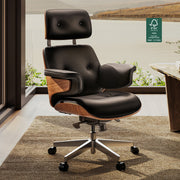
One of the most significant misconceptions in seating ergonomics is that the headrest should "cradle the neck." In reality, the benchmark for correct positioning is the external occipital protuberance—the firm bony bump at the back of the skull.
The Occipital Benchmark
The firmest point of the headrest should make contact with the back of the skull, not the soft tissue of the neck. When the skull is supported at this pivot point, the cervical spine can maintain its natural lordotic curve without external pressure forcing it forward. For chairs equipped with angle-adjustable headrests, a useful practitioner heuristic is to align the angle so it is parallel to the natural backward curve of the upper cervical spine when the user is looking straight ahead. If the user feels any pressure pushing their chin toward their chest, the angle is too aggressive.
Addressing Forward Head Posture
For individuals already experiencing straightened or reversed cervical lordosis (a common result of years of poor posture), the standard "nape" point is biomechanically recessed. In these cases, the headrest must contact the posterior skull even more deliberately to prevent the head from drifting forward during deep focus. This may initially feel "too high" to the user, but it is necessary to counteract the habitual forward lean.

The Hierarchy of Adjustment: Why the Headrest Comes Last
A headrest cannot be adjusted in isolation. Its effectiveness is entirely dependent on the configuration of the components below it. In professional ergonomic assessments, the adjustment protocol follows a strict sequence to ensure each component supports the next.
- Monitor Height and Distance: If the monitor is too low, the user will naturally tilt their head forward to see, nullifying even a perfectly positioned headrest.
- Seat Height and Depth: Proper foot placement and thigh support establish the foundation of the pelvis.
- Lumbar Support: The lower back must be stabilized to prevent slouching, which would otherwise pull the neck away from the headrest.
- Headrest Height and Angle: Only after the torso is stabilized and the visual plane is set should the headrest be positioned.
The Interdependence of Components
As noted in The 2026 Workstation White Paper: Converging Ergonomic Science and Sustainable Engineering, modern workstations must be viewed as integrated systems. For instance, if the seat pan is too deep for the user's leg length, they will slide forward to reach the floor. This "perching" behavior creates a gap between the backrest and the spine, making the headrest unreachable or forcing the neck into a strained reaching position.
| Component | Priority | Ergonomic Goal |
|---|---|---|
| Monitor | 1 | Align top third of screen with eye level to prevent neck flexion. |
| Seat Pan | 2 | Ensure 2-3 fingers of space behind the knees to maintain circulation. |
| Lumbar | 3 | Fill the natural curve of the lower back to prevent sacral slouching. |
| Headrest | 4 | Support the occipital bone to allow suboccipital muscle relaxation. |
Methodology Note: This hierarchy is based on common patterns observed in customer support and workplace audits. It assumes that visual intent (the monitor) dictates the final position of the head, and therefore must be addressed first.
Practical Guide to Optimal Headrest Positioning
Achieving the correct setup requires a combination of objective measurements and subjective "feel." Follow these steps to calibrate your workstation for maximum musculoskeletal health.
Step 1: Establish the Visual Plane
Before touching your chair, ensure your monitor is at the correct height. According to OSHA eTools: Computer Workstations - Monitors, your eyes should be level with a point on the screen about 2-3 inches below the top of the monitor casing. This allows for a slight downward gaze (15-20 degrees) which is natural and reduces eye strain.
Step 2: The Vertical Alignment
Sit back in your chair so your lumbar is fully supported. Raise or lower the headrest until the most prominent curve of the cushion fits into the base of your skull (the occipital bone).
- The Self-Check: Reach back and feel where the headrest ends. If it is pressing into your shoulder blades, it is too low. If it is pushing the top of your head forward, it is too high.
Step 3: The Angle Adjustment
If your chair allows for tilt or depth adjustment of the headrest, set it so that it just touches your head when you are in an upright, neutral working posture. It should not be "pushing" your head. Its role is to be there as a backstop. When you recline to take a call or read, the headrest should then take the full weight of your head, allowing your neck muscles to go completely slack.
Step 4: The Sit-Stand Rhythm
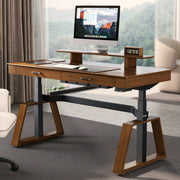
Even with a perfect setup, static posture is the enemy of health. The WHO 2020 Guidelines on Physical Activity & Sedentary Behaviour emphasize the need to interrupt long periods of sitting. Incorporating a sit-stand desk can help. The Cornell University Ergonomics Web suggests a "20-8-2" rhythm: 20 minutes of sitting, 8 minutes of standing, and 2 minutes of moving/stretching. When you transition between sitting and standing, remember that your headrest needs may change if your monitor height isn't perfectly synchronized in both positions.

Scenario Analysis: Tall vs. Petite Users
Ergonomics is rarely "one size fits all." Standards like the BIFMA G1-2013 Ergonomics Guideline provide dimensions intended to fit the 5th to 95th percentile of the population, but individual proportions often require specific tweaks.
Scenario A: The Tall User (P95)
Users over 6'2" often find that standard headrests hit them in the upper back or lower neck. In this case, a chair with a dedicated "tall" cylinder and an extra-high headrest adjustment range is essential. A common mistake for tall users is to recline the chair to "fit" under a low headrest, which leads to a collapsed lumbar spine. If the headrest cannot reach the occipital bone, it is better to remove it entirely than to use it as a shoulder-blade prop.
Scenario B: The Petite User (P5)
Users under 5'4" frequently struggle with headrests that are too high, even at their lowest setting. This can push the head forward into a permanent "chin-down" posture. For these users, seat depth is the critical first adjustment. If the seat is too deep, they cannot sit far back enough to reach the headrest. Using a footrest to ensure the feet are supported can help stabilize the pelvis and allow the user to utilize the full height of the backrest.
Safety and Standards in Ergonomic Seating
When selecting or adjusting a chair, it is important to look for certifications that guarantee structural integrity and safety. ANSI/BIFMA X5.1 General-Purpose Office Chairs is the North American standard for safety and durability. A chair meeting this standard has undergone rigorous testing for tilt mechanism longevity, backrest strength, and headrest stability.
Furthermore, for those concerned with indoor air quality, UL GREENGUARD Certification ensures the materials used in the chair (like foams and adhesives) have low chemical emissions. This is particularly relevant for home office environments where ventilation may be less robust than in commercial buildings.
Long-Term Health Outcomes
Investing time in the correct adjustment of your headrest is a proactive measure against chronic pain. A meta-analysis by Santos et al. (2025) confirmed that ergonomic interventions significantly reduce work-related musculoskeletal pain. By aligning your headrest with the occipital bone and maintaining a neutral visual plane, you reduce the risk of cervical kyphosis and long-term degenerative changes in the spine.
Remember that ergonomics is a dynamic process. As your tasks change—from intensive typing to relaxed reading—your support needs will shift. A high-quality chair with a self-adapting or highly adjustable headrest provides the flexibility to maintain health across all work modes.
YMYL Disclaimer: This article is for informational purposes only and does not constitute professional medical advice, diagnosis, or treatment. Always seek the advice of your physician or another qualified health provider with any questions you may have regarding a medical condition or musculoskeletal pain. If you have pre-existing spinal conditions, consult a physiotherapist before making significant changes to your workstation setup.
Sources
- BIFMA G1-2013 Ergonomics Guideline for Furniture
- OSHA eTools: Computer Workstations - Neutral Working Postures
- ISO 11226:2000 Evaluation of static working postures
- WHO 2020 Guidelines on Physical Activity & Sedentary Behaviour
- Cornell University Ergonomics Web — Workstation Guides
- Santos et al., 2025 – Ergonomic Interventions & Musculoskeletal Pain
Leave a comment