

The Bio-Mechanical Necessity of Dynamic Seating
Modern professional environments often demand eight to twelve hours of focused cognitive labor, much of which is performed in a seated position. While the concept of ergonomics is widely recognized, many users overlook the physiological consequences of static loading. When a person sits perfectly still, the muscles responsible for stabilizing the spine remain in a state of constant, low-level contraction. This "static load" restricts blood circulation, leading to a buildup of metabolic waste products like lactic acid and a decrease in oxygen delivery to the tissues.
According to the World Health Organization (WHO) 2020 Guidelines on Physical Activity & Sedentary Behaviour, reducing sedentary time and interrupting long periods of static behavior is critical for long-term musculoskeletal health. One of the most effective ways to introduce these "micro-movements" without leaving the workstation is through a well-calibrated recline mechanism. However, the effectiveness of this mechanism depends entirely on a single, often misunderstood component: the tilt tension adjustment.
If the tension is not matched to the user’s specific body weight, the chair becomes either a rigid cage that discourages movement or an unstable platform that fails to provide support. Achieving a "spinal neutral position"—where the natural curves of the neck, mid-back, and lower back are maintained—requires a chair that responds dynamically to the user's center of gravity.
Defining Tilt Tension: The Mechanism of Resistance
The tilt tension knob, typically located underneath the seat pan, is the primary control for the resistance of the chair's backrest. As defined by OSHA eTools: Computer Workstations - Chairs, adjustability features like tilt tension are essential for achieving a neutral posture across a diverse range of body types.
Technically, the tilt tension mechanism controls the amount of force required to compress the internal springs or torsion bars within the chair's chassis. When the user leans back, they are essentially fighting against this mechanical resistance.
The Weight-Tension Conflict
The primary challenge in ergonomic design is that gravity acts differently on individuals based on their mass and height. A user weighing 110 lbs (approx. 50 kg) exerts significantly less force on the backrest than a user weighing 250 lbs (approx. 113 kg).
- For Lightweight Users: If the tension is set too high, the chair feels "stiff." The user may find themselves straining their core muscles or pushing off the floor with their feet just to initiate a recline. This defeats the purpose of an ergonomic chair, as it increases muscle fatigue rather than relieving it.
- For Heavyweight Users: If the tension is too loose, the chair may recline too easily, shifting the user's weight backward abruptly. In some cases, this can even trigger the gas lift to lower or "sink" as the sudden shift in weight creates a peak pressure load on the pneumatic cylinder. This observation is based on common patterns from customer support and warranty handling regarding chair stability (not a controlled lab study).
Scientific Principles of Spinal Support and Recline
To understand why tilt tension is vital, one must look at the ISO 9241-5:2024 Workstation layout & postural requirements, which emphasizes that a chair must encourage posture changes. When a user reclines, the pressure on the intervertebral discs in the lumbar region is redistributed. In an upright 90-degree position, the discs experience the highest level of compressive force. A recline of 110 to 135 degrees significantly reduces this pressure, provided the lumbar support remains in contact with the spine.
The Phenomenon of "Fighting the Chair"
When tilt tension is improperly adjusted, users often experience a "fighting" sensation. This occurs when the mechanical resistance of the chair does not match the natural torque generated by the user's upper body.
- The Snap-Back Effect: For lighter users, an overly tight setting can cause the chair to snap back to an upright position when they relax. This jarring movement can lead to minor repetitive strain in the lower back as the muscles react to the sudden change in support.
- The Bottoming-Out Effect: For heavier users, an overly loose setting results in the chair hitting the maximum recline angle too quickly. This lack of controlled deceleration means the spine absorbs the "thud" at the end of the recline range, which is detrimental to long-term musculoskeletal health.

Methodology: Modeling the Ideal Tension Setting
To provide actionable advice, we have modeled the relationship between user weight and the required mechanical resistance. This analysis assumes a standard office chair geometry and a center of gravity located near the mid-torso.
Logic Summary: This model is a hypothetical estimate based on common industry heuristics and BIFMA G1-2013 Ergonomics Guideline parameters. It is intended for self-check purposes and may vary based on specific chair mechanisms.
| User Weight Range | Estimated Tension Level | Primary Mechanical Risk | Recommended Adjustment |
|---|---|---|---|
| < 130 lbs (59 kg) | Low / Minimum | Core muscle strain; lack of movement | Rotate knob counter-clockwise until recline is effortless. |
| 130 - 180 lbs (59-81 kg) | Medium | Balanced support; standard setting | Adjust until the chair holds its position midway through recline. |
| 180 - 230 lbs (81-104 kg) | High | Rapid recline; "bottoming out" | Rotate knob clockwise to increase spring resistance. |
| > 230 lbs (104 kg) | Maximum | Gas lift instability; frame stress | Set to maximum; ensure chair is rated for high-weight capacity. |
Note: These ranges are estimates. Individual height and torso length also affect the leverage applied to the backrest.
Manual vs. Auto-Balance Mechanisms
In the current market, two primary types of tilt mechanisms exist: manual adjustment and auto-balance (or weight-sensitive) systems.
Manual Adjustment: This is the traditional knob system. It offers the highest level of customization, allowing users to "fine-tune" the resistance to their exact preference. For professional users who spend long hours in a single chair, manual adjustment is often preferred because it allows for a "locked-in" feeling that auto-systems cannot always replicate.
Auto-Balance Mechanisms: These systems use the user's weight on the seat pan to automatically calibrate the recline tension. While convenient, these are often a "black box." For users at the extreme ends of the weight spectrum (the 5th or 95th percentile), these mechanisms may fail to provide the nuanced support required. As noted in The 2026 Workstation White Paper: Converging Ergonomic Science and Sustainable Engineering, the integration of manual overrides in high-end ergonomic designs remains a benchmark for professional-grade furniture.
Practical Recommendations for Calibration
Setting the tilt tension is not a "set it and forget it" task. It should be revisited if your weight changes, if you change your typical footwear (which affects your leverage from the floor), or if the chair’s components begin to wear over time.
The "Float" Test: A Step-by-Step Guide
To find your ideal setting, follow this heuristic used by ergonomic specialists:
- Unlock the Recline: Ensure any tilt-lock levers are disengaged.
- Sit in a Neutral Position: Feet flat on the floor, back against the backrest.
- Lean Back Slowly: Do not push off with your feet. Try to use only the weight of your upper body.
- The Goal: You should be able to recline to a 120-degree angle without feeling like you are "falling" and without having to "push" hard.
- The Balance Point: At the ideal tension, you should be able to "float" or hover in a partially reclined position without the chair forcing you back up or dropping you further down.
Integrating the 20-8-2 Rhythm
Calibration of your chair is only half the battle. Cornell University's Ergonomics Web recommends a "20-8-2" rhythm: 20 minutes of sitting (ideally with varied recline), 8 minutes of standing, and 2 minutes of moving or stretching. A properly adjusted tilt tension makes the "20 minutes of sitting" far more productive by reducing the static load on your spine and encouraging small, frequent posture shifts.

Common Pitfalls and "Gotchas"
Even with high-quality equipment, certain mistakes can undermine your ergonomic setup.
- The "Loose Knob" Fallacy: Some users believe that the loosest setting is the most "ergonomic" because it allows for the most movement. However, if the chair does not support your weight, your back muscles must work harder to stabilize your torso in a reclined position. This leads to "postural fatigue."
- Ignoring the Tilt Lock: Many users leave their chair locked in an upright 90-degree position permanently. This is a primary contributor to Musculoskeletal Disorders (MSDs). Use the tilt tension to make the recline safe and comfortable, then keep the chair unlocked during active work to allow for dynamic movement.
- Leverage Issues: If you are shorter, your feet may not reach the floor firmly. This reduces your ability to control the chair’s movement. In this case, a footrest is not just an accessory; it is a critical component that allows you to use the tilt tension mechanism effectively. This is aligned with the Safe Work Australia: Workstation set-up guidelines.
The Role of Lumbar Support in Reclining
When you adjust your tilt tension, you must also consider your lumbar support. As you recline, the relationship between your pelvis and the chair's backrest changes. High-performance chairs often feature "synchro-tilt" mechanisms, where the seat pan tilts at a smaller ratio (e.g., 2:1) than the backrest. This keeps your feet on the floor and your lumbar support in the correct anatomical position.
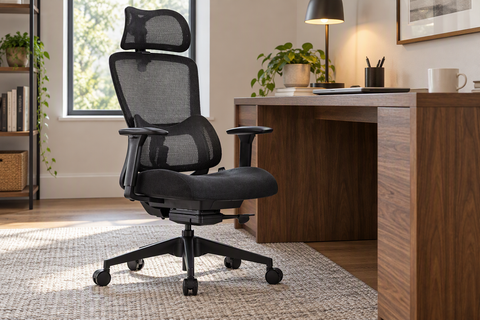
If your chair has a dual-backrest design, the tilt tension is even more critical. These chairs are designed to wrap around the spine and provide lateral support. If the tension is too high, the dual-backrest cannot "pivot" correctly to match your movements, negating the engineering benefits of the design.

Summary of Ergonomic Impact
The tilt tension adjustment is the "engine" of your chair’s ergonomic performance. By matching the mechanical resistance to your body weight, you transform a static seat into a dynamic support system. This reduces the risk of long-term injuries, improves blood circulation, and enhances daily productivity.
According to the Canadian Centre for Occupational Health and Safety (CCOHS), a well-set workstation is the foundation of occupational health. Don't let a simple knob be the reason for your afternoon back pain. Take five minutes to perform the "Float Test" today.
YMYL Disclaimer: This article is for informational purposes only and does not constitute professional medical advice, diagnosis, or treatment. The ergonomic recommendations provided are general guidelines and may not be suitable for individuals with pre-existing musculoskeletal conditions or chronic back pain. Always seek the advice of a qualified physician or physical therapist with any questions you may have regarding a medical condition or before making significant changes to your workstation setup.
Sources
- BIFMA G1-2013 Ergonomics Guideline for Furniture
- ISO 9241-5:2024 Workstation layout & postural requirements
- OSHA eTools: Computer Workstations - Neutral Working Postures
- WHO 2020 Guidelines on Physical Activity & Sedentary Behaviour
- Cornell University Ergonomics Web — Workstation Guides
- The 2026 Workstation White Paper: Converging Ergonomic Science and Sustainable Engineering




Leave a comment