

The High-Stakes Creator Environment: Why Your Desk is Your Most Critical Gear
For a professional content creator, the "New Year, New Venture" resolution often begins with a hardware upgrade. Whether you are transitioning from a hobbyist streamer to a full-time YouTuber or building out a professional videography suite, the investment in high-end cinema cameras, liquid-cooled PC towers, and multi-monitor arrays is significant. However, a common misconception in studio design is treating the desk as a mere surface rather than a piece of precision engineering.
When a standard electric desk begins to groan or tilt during a height transition, it is more than an annoyance; it is a signal of mechanical fatigue that threatens both your expensive equipment and your physical health. Heavy camera rigs, often mounted on long boom arms, create unique leverage and torsional strain that standard office furniture was never designed to handle.
This guide explores the technical requirements for managing heavy creator rigs, grounding every recommendation in the physical principles of load distribution and the ergonomic standards required to prevent long-term Musculoskeletal Disorders (MSDs).
The Biomechanics of the Creative Process: Static Load and MSDs
Content creation is an inherently sedentary profession, often involving hours of "static loading." According to the Canadian Centre for Occupational Health and Safety (CCOHS), static load occurs when muscles are kept in a state of contraction for long periods without the benefit of movement. This restricts blood circulation, leads to rapid fatigue, and is a primary risk factor for Work-related Musculoskeletal Disorders (WMSDs).
The U.S. Occupational Safety and Health Administration (OSHA) identifies three core risk factors for these injuries: excessive force, repetitive tasks, and awkward or prolonged postures. For creators, the "awkward posture" often stems from a desk that cannot reach the correct height to support a Neutral Working Posture, where joints are naturally aligned and stress on muscles and tendons is minimized.
While the World Health Organization (WHO) recommends reducing sedentary time to lower cardiovascular risks, simply standing is not a panacea. Prolonged static standing can be just as detrimental as sitting, leading to lower limb disorders. The solution, as supported by ISO 11226:2000, is the frequent evaluation and change of posture. For a creator with a 100-pound rig, this transition must be fluid and stable; if the desk wobbles, the creator is less likely to change positions, leading back to the cycle of static strain.
Engineering Solutions: The Physics of Heavy Load Management
When selecting a foundation for a high-end studio, the primary technical specification to scrutinize is the motor system and its relationship to "Dynamic Load." In the industry, a "Max Load Capacity" is often a static figure—the weight the desk can hold while stationary. However, for a creator, the dynamic capacity—what the motors can lift safely and repeatedly—is the metric that matters.
The 25% Safety Buffer Principle
In professional studio environments, seasoned managers apply a safety buffer. If your total gear weighs 150 lbs, targeting a desk rated for at least 200 lbs is recommended. This 25-30% buffer ensures the motors operate within their "longevity zone," preventing the desynchronization that occurs when dual-motor systems are pushed to their absolute limit.
Dual Motor vs. Single Motor Systems
For creator setups, a dual-motor system is a baseline requirement, not a luxury. A single-motor desk, often driving a hex rod to the second leg, typically moves at a slower rate (approximately 20mm per second) and has a lower ceiling for weight capacity. In contrast, dual-motor desks provide independent power to each leg, allowing for higher load capacities (often exceeding 120kg) and greater stability during movement.

The GTG - L60, L-Shaped Glass LED Gaming Desk (60"x40") exemplifies the type of robust frame required for multi-monitor setups. Its L-shaped configuration provides the necessary surface depth for large-format displays while maintaining the structural integrity required for heavy peripherals.
The Creator Studio Simulation: Quantitative Load Analysis
To understand the demands of a high-end setup, we modeled a "Professional Creator Persona" involving a cinema camera (RED Komodo level), three 34-inch ultrawide monitors, and a liquid-cooled PC tower.
| Component | Estimated Weight (kg) | Impact on Desk Stability |
|---|---|---|
| PC Tower (Liquid Cooled) | 22.0 | High static load; usually placed on one side. |
| 3x 34" Ultrawide Monitors | 33.0 | Significant leverage if mounted on arms. |
| Heavy-Duty Monitor Arms | 10.5 | Increases torsional strain on the desk edge. |
| Camera Rig & Boom Arm | 7.0 | Shifting weight; requires high dynamic stability. |
| Tabletop (Standard MDF/Glass) | 25.0 | The "dead weight" the motors must always lift. |
| Total System Load | 97.5 kg | Requires Dual Motor System. |
Data context: Values are estimated based on common professional equipment weights and industry-standard desk components.
As shown in the data, a total load of nearly 100 kg rapidly approaches the limit of standard consumer desks. A single-motor desk with an 80 kg capacity would operate at 122% utilization—an unsafe condition that will lead to motor failure. Even a standard dual-motor desk (120 kg capacity) would be at 81% utilization. For long-term reliability, a professional creator should seek frames that exceed these requirements to maintain a healthy safety margin.
The "Center-of-Gravity" Check and Torsional Strain
A common mistake in studio setup is the "One-Side Bias." Creators often mount their heaviest items—the PC tower and the primary monitor arm bases—on a single side of the desk. On an L-shaped desk, this creates torsional strain (a twisting force) on the frame.
To prevent uneven motor wear and the "tilted desktop" syndrome, perform a center-of-gravity check:
- Placement: Distribute heavy items across the frame. If using an L-shape, place the heaviest monitor near the corner vertex where the support is strongest.
- Pressure Test: With the desk at its highest setting, lightly press down on each corner. If one corner dips significantly more than the others, your weight is poorly distributed.
- Calibration: After the initial load-out, run a calibration cycle (usually holding the 'down' button for 5-10 seconds). This ensures the dual motors are perfectly synchronized before they begin daily heavy lifting.

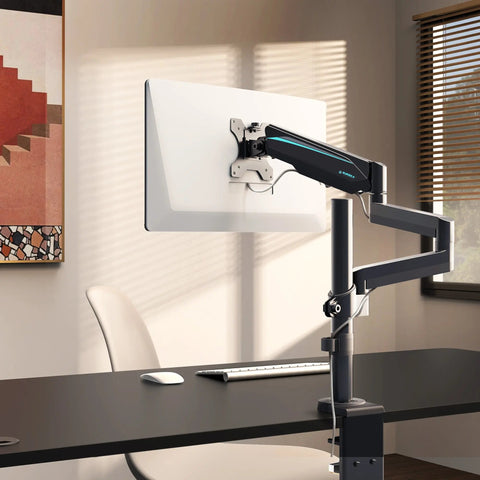
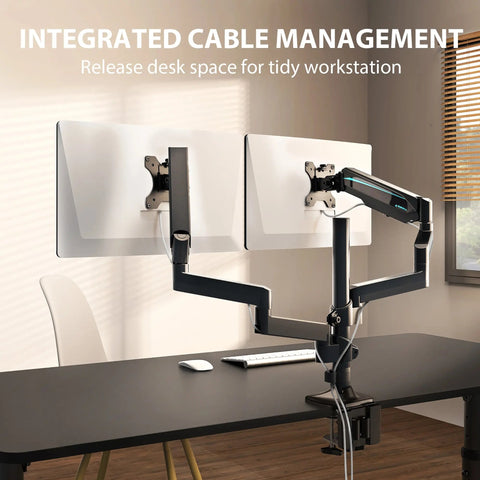
Using a Dual Monitor Arm helps centralize the weight of displays, reducing the leverage effect on the back edge of the desk. By bringing the mounting point closer to the center of the desk's support structure, you minimize the "wobble" often felt at standing heights.
Ergonomic Precision: Viewing Distance and Posture
The technical setup of a desk is only half the battle; the other half is the spatial relationship between the creator and their gear. The BIFMA G1-2013 Ergonomics Guideline provides recommended dimensions to fit the 5th to 95th percentile of the population.
A critical failure point in heavy rigs is Viewing Distance. For creators using 49-inch super-ultrawide monitors, the THX-recommended 40° Field of View (FOV) requires a viewing distance that standard 24-inch or 30-inch deep desks cannot provide. Sitting too close leads to significant eye strain and "forward head posture," a major contributor to cervical spine issues.

To solve this, creators should utilize vertical space and depth-enhancing accessories. The Convertible Desktop Shelves, set of 2 allow for the elevation of secondary monitors or audio gear, clearing the primary surface for deeper monitor placement. Furthermore, adding an Adjustable Keyboard Tray can effectively increase your viewing distance by 6 to 10 inches, allowing your eyes to focus more naturally on large-format screens.
Safety Standards and Longevity
When building a professional studio, compliance with safety standards is a hallmark of a high-quality setup. Look for furniture that adheres to the following:
- ANSI/BIFMA X5.5: This standard defines the safety and durability requirements for desk products, ensuring the frame can withstand the rigors of a professional environment.
- CPSC STURDY / 16 CFR Part 1261: While originally designed for storage units, the principles of anti-tip-over safety are vital for desks holding top-heavy camera rigs. Ensure your desk has a wide enough foot-base to prevent tipping when extended to its maximum height.
- UL 962: This certification covers the electrical safety of the height-adjustment motors, ensuring they won't overheat or pose a fire risk under heavy load.
Building Your Studio: A Step-by-Step Checklist
- Audit Your Gear: Weigh every item that will sit on the desk, including the tabletop itself. Add a 25% safety buffer to this total.
- Select a Dual-Motor Frame: Prioritize frames with high-torque motors and synchronized control systems.
- Plan Your Depth: Ensure your desk depth (plus any keyboard tray extensions) allows for a viewing distance appropriate for your monitor size.
- Distribute the Load: Avoid clustering heavy gear on one side. Use monitor arms to centralize weight.
- Implement the 20-8-2 Rule: As recommended by Cornell University Ergonomics, aim for 20 minutes of sitting, 8 minutes of standing, and 2 minutes of moving/stretching every half hour.
- Cable Management: Ensure all cables have enough "slack" to reach the desk's maximum height without pulling on ports or creating tension that could tilt the desk.

Professional Responsibility and Health
Investing in a high-capacity electric desk is an investment in your career's longevity. By choosing equipment that meets rigorous standards like ISO 9241-5:2024 for postural requirements, you are protecting yourself from the chronic pain that sidelines many talented creators.
A professional studio is more than a collection of gadgets; it is a synchronized system where the furniture provides the stability and flexibility required for peak creative performance. By understanding the physics of load and the biology of posture, you can build a workspace that supports your vision for years to come.
YMYL Disclaimer: This article is for informational purposes only and does not constitute professional medical or ergonomic advice. Individuals with pre-existing musculoskeletal conditions or chronic back pain should consult a qualified physiotherapist or ergonomic specialist before adopting a new workstation routine or purchasing heavy equipment.
References
- BIFMA G1-2013 Ergonomics Guideline for Furniture
- CCOHS: Office Ergonomics - Sit/Stand Desk
- Cornell University Ergonomics Web — Workstation Guides
- ISO 9241-5:2024 Workstation layout & postural requirements
- OSHA eTools: Computer Workstations - Neutral Working Postures
- WHO 2020 Guidelines on Physical Activity & Sedentary Behaviour
- The 2026 Workstation White Paper: Converging Ergonomic Science and Sustainable Engineering




Leave a comment