

The Relentless Demand of 24/7 Workstations: Beyond Standard Durability
In high-stakes environments—emergency dispatch centers, healthcare command hubs, and 24/7 corporate security offices—the workstation is never vacant. Unlike a standard office chair that sees 40 hours of use per week, a chair in a 24/7 shift environment endures over 160 hours of weekly compression, friction, and mechanical adjustment. This continuous cycle represents a catastrophic stress test for traditional upholstery and structural components.
The most common failure in these environments is not a sudden mechanical break, but a gradual degradation of the material system. When upholstery thins or seams split, the ergonomic integrity of the chair vanishes. This leads to the "hammock effect," where the user sinks into the frame, creating a static load on the lower back and restricting blood circulation in the lower limbs. For facility managers and procurement officers, selecting the right heavy-duty upholstery is not a matter of aesthetics; it is a critical strategy to mitigate Musculoskeletal Disorders (MSDs) and manage the Total Cost of Ownership (TCO).
The Physiology of Material Failure: Static Load and MSDs
Ergonomics is often discussed in terms of "neutral position" and "lumbar support," but these features depend entirely on the resilience of the materials. According to the U.S. Occupational Safety and Health Administration (OSHA), poor posture and repetitive tasks are core risk factors for MSDs. In a 24/7 environment, material fatigue accelerates these risks.
When a chair's foam or fabric loses its tensile strength, the user can no longer maintain a neutral spinal position. The ISO 11226:2000 standard specifies that static working postures should be evaluated based on duration and joint angles. If the upholstery fails to provide consistent resistance, the body compensates by engaging small muscle groups to maintain stability. This leads to localized fatigue, reduced blood flow, and eventually, chronic pain.
Furthermore, the World Health Organization (WHO) emphasizes reducing sedentary time and interrupting static behavior. Heavy-duty workstations must support these transitions. If the upholstery is too soft or lacks breathability, the user is less likely to engage in the micro-movements necessary for vascular health.
Decoding Durability: The Science of Heavy-Duty Upholstery
In commercial procurement, "durability" is often quantified through the Wyzenbeek or Martindale "double rub" tests. While a standard office chair might require 30,000 double rubs, a 24/7 workstation requires a significantly higher threshold.
The Double Rub Baseline and Beyond
For true high-frequency commercial use, a 100,000 double-rub rating is the baseline. However, in environments with constant ingress and egress, such as dispatch centers, facility managers should target fabrics rated to 200,000+ double rubs.
Expert Observation: Based on pattern recognition from warranty claims and repair bench observations (not a controlled lab study), seam failure often precedes fabric failure. While the fabric may withstand 100,000 rubs, standard overlock stitching at stress points often fails under the torsional stress of 24/7 use.
Seam Construction and Thread Strength
To ensure longevity, look for flat-felled or double-stitched seams. The choice of thread is equally vital; bonded nylon thread is preferred for its high tensile strength. However, a common "gotcha" in procurement is ignoring chemical degradation. Industrial cleaners used for daily disinfection can degrade nylon faster than the fabric substrate itself.
Foam Density: The Foundation of Support
Upholstery is only as good as the foam beneath it. A frequent mistake is specifying a high-durability fabric but pairing it with low-density foam (under 1.8 pcf). Low-density foam compacts rapidly under 24/7 loads, causing the fabric to overstretch and tear. High-resiliency (HR) foam with a density of 2.5 pcf or higher is recommended to maintain the chair's ergonomic profile over multiple years.
Material Comparison: Mesh vs. Leather vs. Fabric for B2B
Choosing the right material requires a "durability-comfort-cleanability" matrix. No single material is optimal for every scenario; the choice depends on shift patterns and environmental contaminants.
| Material Type | Primary Benefit | Durability Rating | Maintenance Requirement |
|---|---|---|---|
| High-Tensile Mesh | Breathability/Cooling | High (if elastomeric) | Low (Vacuum/Wipe) |
| Napa Leather | Luxury/Longevity | Very High | High (Conditioning required) |
| Microfiber Leather | Cleanability/Softness | High | Medium (Wipeable) |
| Heavy-Duty Fabric | Texture/Warmth | Extreme (200k+ rubs) | High (Deep cleaning needed) |
1. High-Tensile Mesh: Thermal Regulation
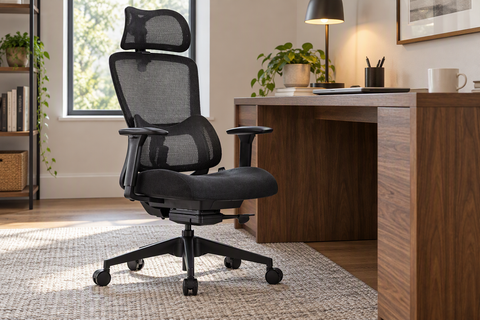
Mesh is the preferred choice for environments where thermal comfort is a priority. Products like the Onyx, Ergonomic Office Chair utilize airy mesh to maintain blood circulation and prevent heat buildup during long shifts. According to BIFMA G1-2013 Ergonomics Guidelines, furniture should accommodate the 5th to 95th percentile of the population; mesh's ability to contour to various body shapes makes it a versatile tool for shared workstations.

2. Genuine Napa Leather: The Executive Standard
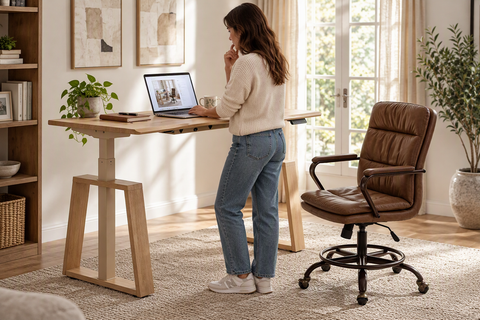
For executive environments or dedicated workstations where longevity is paramount, full-grain Napa leather is the gold standard. The Serene, Napa Leather Executive Office Chair offers a material that actually improves with age, provided it receives consistent conditioning. Unlike corrected-grain or bicast options, Napa leather maintains its structural integrity under heavy use without cracking.
3. Microfiber Leather: The Hybrid Solution
In 24/7 shared environments where disinfection is frequent, microfiber leather offers a superior balance. It provides the soft hand of leather but with enhanced chemical resistance. The Royal, Microfiber Leather Executive Office Chair is designed for long days, featuring a perforated seat for better air circulation—addressing the common "heat retention" complaint associated with non-porous materials.

Modeling the Impact: Healthcare Command Center Scenario
To demonstrate the value of investing in heavy-duty ergonomic workstations, we modeled a Healthcare Operations Command Center environment. In this scenario, operators work 12-hour shifts in a 24/7 monitoring capacity.
Modeling Note: Method & Assumptions
This analysis uses a deterministic parameterized model to estimate the ROI of ergonomic interventions. This is a scenario model, not a controlled lab study.
| Parameter | Value | Unit | Rationale |
|---|---|---|---|
| Shift Length | 12 | Hours | Standard healthcare/emergency rotation |
| Hourly Wage | 45 | USD | Average for certified operations specialists |
| Productivity Gain | 15 | % | Estimated range based on ergonomic studies |
| Equipment Load | 68 | kg | 4 monitors + medical computing hardware |
| Motor Configuration | Dual | Type | Required for 80% utilization safety margin |
Key Findings:
- Productivity ROI: A 15% improvement in operator efficiency (due to reduced fatigue and discomfort) generates approximately $7,884 in annual productivity value per operator.
- Metabolic Impact: Operators utilizing a sit-stand rhythm (e.g., the Cornell University 20-8-2 rule) burn an estimated 45,800 extra calories annually compared to static sitting.
- Load Reliability: For workstations supporting heavy medical equipment, dual-motor systems operate at ~57% load capacity, significantly extending the lifecycle compared to single-motor systems pushed to their 80% limit.
Logic Summary: We calculate the productivity value by taking the daily standing minutes (360) across 292 work days, applying a 0.15 efficiency coefficient against a $45/hour wage.
Total Cost of Ownership (TCO) in B2B Procurement
When evaluating heavy-duty upholstery, the upfront price is often misleading. Procurement managers must look at the lifecycle cost, which includes maintenance, downtime, and replacement frequency.
- Chemical Resistance vs. Antimicrobial Treatments: In shared environments, antimicrobial treatments are often prioritized, but our research suggests that a robust, chemical-resistant finish is more critical. The ability to use standard disinfectants without degrading the material's color or "hand" (feel) reduces long-term maintenance costs.
- Consolidation of Fleet: Maintaining a mixed fleet of chairs with varying upholstery types increases labor costs. Consolidating to a single, highly durable model like the Serene Aaron, Genuine Leather Executive Office Chair simplifies the repair and cleaning protocols.
- The Labor of Replacement: The cost of a chair includes the administrative and labor hours required to swap units. A chair that lasts 5 years instead of 2 years in a 24/7 environment effectively halves its TCO, even if the initial price is 30% higher.

Practical Recommendations for Facility Managers
To ensure your 24/7 workstations meet the highest standards of durability and ergonomic health, follow this selection checklist:
- Verify Certifications: Ensure products meet ANSI/BIFMA X5.1 for safety and structural adequacy.
- Specify Foam Density: Demand a minimum of 1.8 pcf foam density; for 24/7 use, 2.5 pcf is preferred to prevent bottoming out.
- Assess Seams: Prioritize double-stitched or flat-felled seams with bonded nylon thread.
- Check the "Sit-Stand" Ratio: For workstations including desks, follow the Safe Work Australia setup guides to ensure the range of motion supports the 5th to 95th percentile of your staff.
- Air Quality: Look for UL GREENGUARD Gold Certification to ensure the heavy-duty materials aren't off-gassing harmful VOCs in enclosed 24/7 environments.
For a deeper dive into the intersection of material science and workplace health, refer to The 2026 Workstation White Paper: Converging Ergonomic Science and Sustainable Engineering.
Conclusion: Investing in Operational Continuity
In a 24/7 workstation, the upholstery is the primary interface between the human body and the machine. Choosing heavy-duty materials is an investment in operational continuity. When staff are comfortable and supported, error rates drop, and productivity rises. By focusing on verifiable standards like BIFMA and ISO, and understanding the nuances of foam density and seam construction, facility managers can build a workspace that withstands the relentless demands of round-the-clock operations.
Disclaimer: This article is for informational purposes only and does not constitute professional medical, legal, or occupational health advice. Always consult with a qualified ergonomic specialist or healthcare provider regarding specific workplace injuries or pre-existing conditions.
Sources
- BIFMA: Ergonomics Guideline for Furniture (G1-2013)
- ISO 9241-5:2024 Workstation Layout & Postural Requirements
- OSHA: Computer Workstations - Neutral Working Postures
- Cochrane Library: Workplace interventions for reducing sitting at work
- UL GREENGUARD Certification for Indoor Air Quality
- Cornell University Ergonomics Web — Workstation Guides




Leave a comment