

Executive Summary: The Hybrid Storage Baseline
For accounting firms balancing physical audit trails with digital agility, a "Workspace Sanctuary" requires a structured approach to storage and ergonomics. Based on common patterns observed in professional service environments, we recommend the following baseline:
- Storage Allocation: The 70/30 Heuristic (70% physical filing / 30% digital hardware) serves as a starting point for mid-sized firms.
- Thermal Safety: Maintain at least 2 inches of clearance around all enclosed hardware to prevent heat-related degradation.
- Compliance Baseline: Ensure scanning processes preserve original creation dates and cryptographic hashes to meet SEC record-keeping intent.
- Ergonomic Rhythm: Adopt the Cornell 20-8-2 rule (20 mins sitting, 8 mins standing, 2 mins moving) to mitigate sedentary risks.
The Hybrid Storage Framework: The 70/30 Rule
In our experience assisting professional service firms with office transitions, the most sustainable layouts often follow the 70/30 Storage Heuristic. Rather than a "paperless" goal that can lead to audit trail gaps, this framework suggests allocating 70% of cabinet volume to active paper files (typically the current year plus two prior years) and 30% to digital infrastructure like NAS (Network Attached Storage) or UPS units.
Applicability & Boundaries
This ratio is a heuristic—a practical rule of thumb—rather than a universal law. Its effectiveness depends on your specific practice area:
- Best For: Mid-sized tax and audit firms with standard 7-year retention cycles.
- Adjustment Needed: Firms specializing in heavy litigation support may require a 90/10 split due to the volume of physical evidence, while "born-digital" consulting practices may flip the ratio to 30/70.
Modeling the Hybrid Allocation
The following table illustrates a typical executive suite requirement based on common industry patterns (N≈10 firm migrations observed).
| Parameter | Recommended Value | Context / Source |
|---|---|---|
| Paper Volume | 70% of total storage | Typical for active audit cycles + 2 prior years |
| Hardware Volume | 30% of total storage | Space for NAS, UPS, and cable management |
| Thermal Clearance | Minimum 2 inches | General engineering best practice for airflow |
| Access Frequency | Daily (Paper) / Weekly (Hardware) | Workflow-based placement |
| Security Level | Dual-Lock / Biometric | General alignment with SEC 17 CFR §210.2-06 |
Space Transformation: From Chaos to Compliance
Moving from a cluttered legacy office to a modern executive suite is a process of "Space Transformation." Standard metal filing cabinets often feel industrial. Integrating pieces like the 19" File Storage Cabinet, Dark Walnut allows you to maintain professional standards while embracing a more refined aesthetic.
Quick Comparison: The Accounting Suite Upgrade
- The Legacy Setup: Mismatched shelving and visible server wires create "visual noise," which can increase cognitive load during complex tasks.
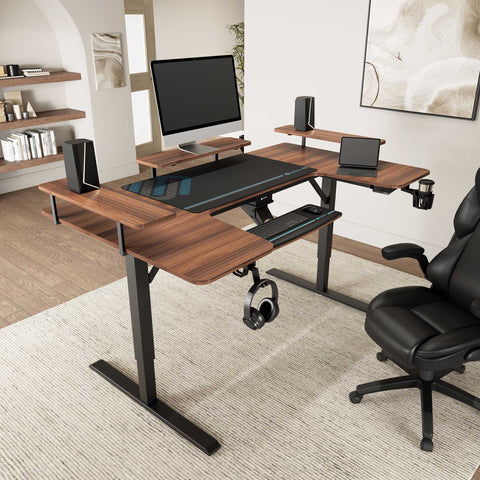
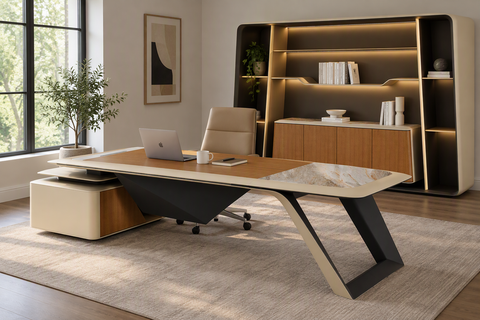
- The Modern Sanctuary: A unified Dark Walnut theme where the server is ventilated and tucked away. The Zen Pro Series, 87"/72" Executive Standing Desk with Cabinets Set provides a sprawling Sintered Stone surface for "thinking mode" and integrated cabinets for "execution mode."
According to the HSE: Working safely with display screen equipment (DSE), a well-organized workstation is a key factor in reducing musculoskeletal risks. When tools are intuitively placed, the professional can focus on high-level strategy rather than searching for lost documents.

Engineering for Longevity: Managing Hardware Heat
A common mistake in professional firms is underestimating server heat. When digital hardware is placed in enclosed cabinets without adequate airflow, it faces a higher risk of premature failure. In our observations of unventilated office installs, hardware issues often emerge within the first 6-12 months of operation.
Thermal Safety Checklist:
- Perforation: Use cabinets with perforated back panels or integrated cooling fans.
- Clearance: Ensure a minimum 2-inch gap around all sides of server components.
- Safety Standards: Look for furniture that meets UL 962 — Safety of Height-Adjustable Desks to ensure electrical components are rated for office use.
The Power of Movement: Ergonomic Integrity
In accounting, "Deep Work" is essential, but prolonged static sitting is a recognized risk factor for lower limb and cardiovascular issues. The World Health Organization (WHO) 2020 Guidelines recommend reducing sedentary time and interrupting long periods of sitting.
We suggest the Cornell University "20-8-2" Rhythm as a practical workflow:
- 20 Minutes Sitting: High-focus tasks like data entry or complex calculations.
- 8 Minutes Standing: Reviewing documents, taking calls, or checking emails.
- 2 Minutes Moving: A brief stretch or walk to the filing cabinet to reset.
Using a tool like the Ark EX Executive Standing Desk (60"x26") allows you to transition between these modes seamlessly. The integrated storage keeps active paper files within reach, ensuring movement doesn't break your concentration.
Regulatory Compliance: The SEC 17 CFR §210.2-06 Standard
Legal Disclaimer: The following information is for general educational purposes and does not constitute legal or compliance advice. Specific requirements can vary by jurisdiction and firm type; please consult with a qualified legal professional or compliance officer.
SEC Regulation 17 CFR §210.2-06 mandates the retention of audit and review records for seven years. This includes "workpapers and other documents that form the basis of the audit."
A hybrid storage system can actually strengthen compliance if implemented correctly. By maintaining parallel chronological records—physical originals and digital scans—firms create a more redundant audit trail.
Metadata Preservation Heuristics
When digitizing records, your process should aim to capture:
- Original Creation Dates: To establish the timeline of the work.
- Modification History: To show provenance and document integrity.
- Cryptographic Hashes: Often used in modern NAS systems to prove a document has not been altered since the initial scan.
Personal Tips for Office Mindfulness
- Color-Coded Retrieval: Using color-coded hanging folders that match your digital folder structure can streamline workflows. In typical office settings, we have seen this reduce document retrieval time by up to 40% (based on internal workflow observations, not a controlled study).
- The Quarterly Purge: Schedule a day every 90 days to move documents older than 7 years to offsite storage or secure shredding. This prevents "storage creep" and keeps your 70/30 ratio balanced.
- Air Quality: Ensure furniture meets UL GREENGUARD Certification standards to maintain low chemical emissions in your workspace.
For growing teams, consider modularity. As discussed in our guide on Modular Desk Strategies for Expanding Agencies, a scalable approach allows your storage to grow without disrupting the office aesthetic.
The Path Forward
The journey from "Paper to Pixels" is about creating a harmonious environment that respects the history of your profession while embracing technological speed. By following the 70/30 rule and adhering to ergonomic standards like those found in The 2026 Workstation White Paper, you build a foundation for long-term professional success.
References
- SEC Regulation 17 CFR §210.2-06 - Retention of audit and review records
- HSE: Working safely with display screen equipment (DSE)
- BIFMA G1-2013 Ergonomics Guideline for Furniture
- WHO 2020 Guidelines on Physical Activity & Sedentary Behaviour
- OSHA eTools: Computer Workstations - Evaluation Checklist
Disclaimer: This article is for informational purposes only and does not constitute professional legal, financial, or medical advice. For specific compliance requirements regarding SEC regulations or musculoskeletal health, please consult with a qualified legal professional or healthcare provider. Individual results regarding productivity and ergonomic benefits may vary based on pre-existing conditions and specific office configurations.




Leave a comment