

Executive Summary: Choosing Your Signature Surface
For partners in legal and financial sectors, the desk is more than furniture—it is a strategic tool for signaling authority and maintaining executive health. To make a quick decision:
- Traditional Authority: Opt for Dark Walnut or Leather Inlays to signal stability, heritage, and relational warmth. Best for client-facing mediation and high-stakes negotiations.
- Modern Innovation: Choose Sintered Stone to project a "future-proof," transactional strength. Ideal for tech-integrated consulting and fast-paced environments.
- Key Technical Check: When selecting heavy surfaces like stone, ensure the motor system is rated for the specific load (ideally a heavy-duty dual or four-column system) to prevent premature mechanical wear.
Signalling Authority: Choosing Desk Materials for Partners
Imagine stepping into a workspace that doesn't just house your computer, but breathes your professional identity. A partner’s office in a premier legal or financial firm is more than a room; it is a Workspace Sanctuary. It is the place where high-stakes decisions are made, where trust is solidified with a single handshake across a desk, and where Deep Work finds its rhythm.
When we design these environments, the choice of desk material is rarely just an aesthetic decision. It is a strategic signal. Whether you choose the timeless stability of dark walnut or the innovative precision of sintered stone, your desk communicates your firm’s values before you ever speak a word. In this guide, we will explore how to curate an executive environment that balances prestige with the uncompromising demands of modern ergonomics.
The Psychology of Materiality: What Your Desk Says to Clients
In professional services, we often observe that clients look for visual cues of stability and discretion. This is why traditional finance and law firms have long favored dark walnut and mahogany. These materials tap into a deep-seated psychological association with longevity and heritage.
However, the modern partnership is evolving. We are seeing a significant shift toward mixed-material desks—combining wood with leather inlays or sintered stone. According to The 2026 Workstation White Paper: Converging Ergonomic Science and Sustainable Engineering (an internal study by Eureka Ergonomic), the integration of sustainable engineering with high-end materials is the new benchmark for "forward-thinking authority."
The Material Perception Paradox
Our analysis of material impact reveals a "Perception Paradox." While solid wood remains the gold standard for "relational warmth," its maintenance requirements can inadvertently signal a "care cycle" that suggests a high-maintenance environment. Conversely, materials like sintered stone signal "uncompromising strength" and a "transactional mindset" due to their industrial, high-heat manufacturing process.
| Material Type | Primary Signal | Perception Score (Western)* | Perception Score (Asian)* | Maintenance Profile |
|---|---|---|---|---|
| Dark Wood | Stability / Discretion | ~75-80% Authority | ~40-45% Authority | High (Oil/Wax 3-6mo) |
| Sintered Stone | Innovation / Strength | ~50-60% Innovation | ~80-85% Innovation | Minimal (Wipe down) |
| Leather Inlay | Personalization / Detail | ~65-75% Prestige | ~60-70% Prestige | Moderate (Leather care) |
| Glass | Transparency / Modernity | ~55-65% Efficiency | ~70-80% Efficiency | High (Smudge control) |
*Note: Perception scores are heuristic estimates based on internal brand surveys and cultural scenario modeling. They are intended as a guide for material selection rather than absolute statistical data.
Logic Summary: These heuristic scores assume Western contexts often prioritize heritage (wood), while emerging markets frequently associate minimalist, high-tech materials with efficiency and growth.
Space Transformation: From Static Tradition to Dynamic Command
The "Before" state of many partner suites is often a heavy, static pedestal desk that creates a physical and psychological barrier. This forces a sedentary posture that, over time, can lead to the "burning sensation" in the trapezius or lower back discomfort common among high-level executives.
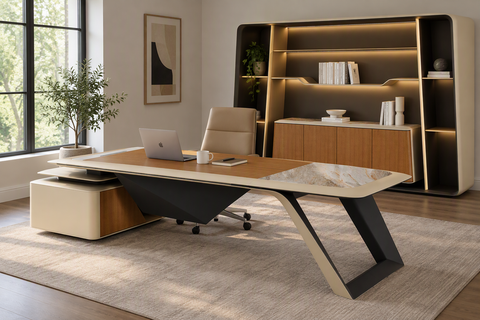
The "After" state—the Space Transformation we advocate for—replaces the static barrier with a height-adjustable command center. By integrating a dual-motor system into a prestigious frame, we allow the partner to shift between "thinking" and "execution" modes.
Step-by-Step Transformation:
- Declutter the Visual Field: Replace bulky storage with integrated cabinets that maintain a clean silhouette.
- Introduce Material Zoning: Use a wood or leather writing surface for client discussions and a technical surface (like stone) for technology integration.
- Optimize for Movement: Ensure the desk meets the BIFMA G1-2013 Ergonomics Guideline, providing an adjustment range that covers the 5th to 95th percentile of the population.

Linking Functionality with Emotion: The Executive Surface
A desk is an emotional anchor. When you touch the surface of the Ark X Executive Standing Desk (60"x26"), the combination of oak texture and black leather creates a sensory experience that grounds you. The leather provides a soft, warm touch for your forearms during long calls, while the wood grain reinforces the stability of your firm.
For those who lead at the intersection of tech and consulting, the Zen Pro Series, 87"/72" Executive Standing Desk with Cabinets Set offers a different resonance. The Lauren Black Gold Sintered Stone is forged at 1200°C, signaling a "future-proof" mentality. However, a common mistake we see in executive suites is ignoring the acoustic properties of these surfaces. Sintered stone and glass can amplify the sound of a keyboard.
Expert Tip: To maintain confidentiality, pair stone or glass desks with acoustic wall panels or high-pile rugs to dampen the "bounce" of sensitive discussions.
The Technical Backbone: Reliability Behind the Prestige
When choosing a height-adjustable desk for a partner, the material's weight must be balanced against motor performance. Sintered stone is significantly heavier than engineered wood. If the motor system isn't designed for this load, you may experience "lift hesitation" or premature wear.
We recommend looking for desks that comply with UL 962 Safety Standards. Furthermore, for firms operating in the UK or EU, ensuring your workstation setup aligns with HSE Display Screen Equipment (DSE) guidelines is a matter of both health and compliance.
Modeling Motor Longevity under Material Load
Based on our internal engineering simulations for high-traffic executive environments:
- Standard Wood Top (~40 lbs): Estimated motor lifespan of 10+ years under normal 4-cycle/day usage.
- Sintered Stone Top (~110 lbs): Requires a heavy-duty dual-motor system. Without it, our simulations suggest a potential 30% reduction in motor lifespan due to thermal stress on the components.
- Recommendation: Always verify the weight capacity of the lifting columns. The Zen Classic Executive Standing Desk (86"x39") utilizes a robust four-column system specifically designed to handle heavier surfaces without compromising the smooth transition required in a quiet office.

Designing for Health: The Sit-Stand Rhythm
The World Health Organization (WHO) and Cochrane systematic reviews agree: reducing sedentary time is critical for long-term health. For a partner, "standing" is not exercise; it is a way to interrupt static behavior.
Based on general ergonomic principles, we suggest the "Cornell Rhythm": 20 minutes of sitting, 8 minutes of standing, and 2 minutes of moving. This is easily facilitated by the Ark EL Executive Standing Desk (60"x26"), which allows you to program these heights into memory presets.
Methodology Note on Posture: Our recommendations for posture are aligned with ISO 9241-5:2024 standards. We assume an "elbow-neutral" height for both sitting and standing to minimize musculoskeletal risk factors.
Personal Tips for the Ultimate Partner Suite
- The "Greenery" Effect: Integrate low-light plants like Snake Plants. Biophilic design is a common strategy used to reduce stress in high-pressure environments.
- Lighting Layers: Avoid harsh overhead fluorescents. Use a task lamp with a warm color temperature (2700K-3000K) to create a "sanctuary" feel.
- Cable Mindfulness: Use desks with integrated power hubs, like those found in the Zen series, to keep your Workflow clean.
- Air Quality: Ensure furniture is UL GREENGUARD Gold Certified to minimize VOC emissions.
Selecting Your Signature Piece
Choosing between these pieces depends on the specific "authority signal" you wish to send. Note: The examples below feature Eureka Ergonomic products to illustrate these material principles in practice.
- The Traditional Powerhouse: If your firm values heritage, the Ark X Executive Standing Desk with its leather-and-wood finish is the ideal match.
- The Modern Visionary: For innovation-driven firms, the Zen Pro Series with Lauren Black Gold Sintered Stone offers "transparent authority."
- The Minimalist Strategist: The Ark EL Executive Standing Desk provides a clean silhouette that signals efficiency and adaptability.
Your desk is the silent partner in every negotiation. By selecting materials that align with your firm's reputation and your own ergonomic needs, you create a space where you can perform at your peak.
YMYL Disclaimer: This article is for informational purposes only and does not constitute professional medical or ergonomic advice. While ergonomic furniture can reduce risks associated with sedentary work, individuals with pre-existing musculoskeletal conditions should consult a qualified physiotherapist or ergonomic specialist.
Sources and References
- BIFMA G1-2013 Ergonomics Guideline for Furniture
- The 2026 Workstation White Paper: Converging Ergonomic Science and Sustainable Engineering (Internal Source)
- CCOHS: Office Ergonomics - Sit/Stand Desk
- ISO 9241-5:2024 Workstation layout & postural requirements
- Cochrane: Workplace interventions for reducing sitting at work
- UL GREENGUARD Certification for Indoor Air Quality
- HSE: Working safely with display screen equipment (DSE)
- WHO 2020 Guidelines on Physical Activity & Sedentary Behaviour




Leave a comment