

The Physiological Cost of the Executive Slump: Understanding Static Load
Many executives find that despite having a premium office suite, back pain intensifies as the afternoon progresses. This phenomenon is rarely a result of a single movement; rather, it is the cumulative effect of what ergonomists call "static load." When you remain in a seated position for hours, your muscles must maintain a constant state of contraction to hold your torso upright. This prevents the natural "muscle pump" that facilitates blood circulation, leading to localized fatigue and the buildup of metabolic byproducts.
According to the Occupational Safety and Health Administration (OSHA), poor posture and prolonged static positions are primary risk factors for Musculoskeletal Disorders (MSDs). In a seated position, the pressure on the lumbar discs can be up to 40% higher than when standing. Over time, this pressure can lead to disc compression, reduced flexibility, and chronic pain. The "executive slump"—where the shoulders round forward and the neck protrudes to meet a low monitor—further exacerbates cervical strain, potentially leading to tension headaches and reduced cognitive focus.
The World Health Organization (WHO) 2020 Guidelines emphasize that adults should reduce sedentary time and interrupt long periods of static behavior. However, for a busy manager, simply "taking a walk" isn't always feasible during back-to-back meetings. This is where the engineering of the workstation becomes a critical health intervention.

Beyond Aesthetics: The Mechanics of an Ergonomic Executive Desk
Traditional executive desks have long been symbols of status, often featuring heavy mahogany and fixed heights. While aesthetically pleasing, these desks often fail to meet the requirements of modern musculoskeletal health. A modern adjustable executive desk, such as the Opal Executive Standing Desk (66"x29"), bridges the gap between professional gravitas and physiological necessity.
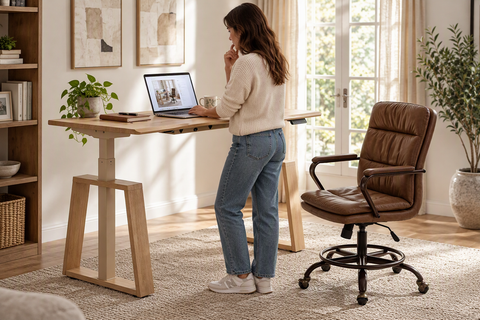
The core benefit of an adjustable desk is the facilitation of movement. By allowing a seamless transition between sitting and standing, these desks help maintain a "spinal neutral position." This position keeps the natural curves of the spine aligned, minimizing the stress on ligaments and muscles. As noted in the BIFMA G1-2013 Ergonomics Guideline, furniture should be designed to fit the 5th to 95th percentile of the population, which requires significant adjustability ranges.
Furthermore, the 2026 Workstation White Paper: Converging Ergonomic Science and Sustainable Engineering highlights that the integration of electric dual-motor systems is no longer a luxury but a functional requirement for high-end setups. These systems provide the stability needed to support heavy executive equipment—such as multiple ultrawide monitors and premium desktop hardware—without the "monitor wobble" that can cause visual fatigue.
Logic Summary: We categorize the transition from fixed to adjustable desks as an "Engineering Control" under the OSHA hierarchy of hazards. This is considered more effective than "Administrative Controls" (like reminding oneself to stand) because it removes the barrier to movement.
The Tall Executive Scenario: A Modeling Analysis
To demonstrate the precision required in executive ergonomics, we modeled a scenario for a 195cm (6'5") male executive. This demographic often faces the most severe ergonomic mismatches, as standard 29-inch desks are significantly too low, leading to a predictable "tall person slump."
Modeling Transparency (Inputs & Assumptions)
This is a deterministic parameterized scenario model used to quantify ergonomic deficits. It is not a controlled lab study.
| Parameter | Value | Rationale |
|---|---|---|
| User Height | 195 cm | 95th percentile US male height |
| Sitting Desk Height (Ideal) | 80.5 cm | Calculated via ANSI/HFES 100-2007 ratios |
| Standing Desk Height (Ideal) | 119.5 cm | Elbow-to-floor measurement including shoes |
| Equipment Load | 81 kg | Dual 34" ultrawide monitors + Liquid-cooled PC |
| Hourly Wage | $150 | Executive compensation benchmark |
Quantitative Findings
Our analysis revealed that a standard fixed-height desk creates a 2.7-inch deficit for this user when sitting. This forces the shoulders to hunch forward to reach the keyboard. When standing, the Opal Executive Standing Desk (66"x29") can reach the required 119.5 cm height, whereas many standard adjustable desks cap at 110 cm, leaving the tall user in a semi-slumped standing position.
Furthermore, the load of a premium "battlestation" (81 kg) exceeds the capacity of many single-motor desks (typically rated for ~80 kg). Operating at 101% capacity risks motor burnout. A dual-motor system, like that found in the Ark X Executive Standing Desk (60"x26"), operates at a comfortable 68% load, ensuring longevity and smooth transitions.
ROI of Movement
Standing for 4 hours during a 10-hour workday results in an estimated 199.5 extra calories burned per day. Over a 250-day work year, this equates to approximately 14.2 lb of fat loss equivalent. From a financial perspective, assuming a conservative 15% productivity gain due to reduced fatigue (based on Texas A&M research), the annual productivity value is estimated at $22,500. For a high-earning executive, a premium ergonomic desk pays for itself in roughly one month.

Strategic Setup: Establishing Your High-Performance Rhythm
Simply owning an adjustable desk is insufficient; the benefit lies in the rhythm of use. A common mistake we observe in workplace assessments is setting the desk height once and remaining in that position for the entire day.
The 20-8-2 Rule
Cornell University Ergonomics Web recommends a "20-8-2" sit-stand cycle:
- 20 Minutes Sitting: Use a chair with robust lumbar support, like the Royal II, Silicone & Leather Executive Ergonomic Office Chair, to maintain the neutral curve of the lower back.
- 8 Minutes Standing: Transition to your standing height. Ensure your elbows are at a 90-110 degree angle.
- 2 Minutes Moving: Stretch or take a short walk to stimulate blood flow.
Precision Adjustments
When sitting, your feet must be flat on the floor. If your desk height requires you to raise your chair to a point where your feet dangle, you are placing immense pressure on the underside of your thighs, which can impede circulation. In these cases, an Adjustable Ergonomic Footrest is a necessity, not a luxury. It allows you to maintain a neutral pelvis and supports the "rocking" motion that keeps lower limb muscles active.
When standing, the top of your monitor should be at or slightly below eye level. Our modeling suggests that for large 34-inch monitors, a slight downward gaze of 10-20 degrees is optimal to reduce neck extension. We often see executives neglect foot positioning while standing; using a supportive mat or the footrest to shift weight periodically can prevent pressure from concentrating in the lower back.
Logic Summary: These recommendations are based on the ISO 9241-5:2024 standards for workstation layout and postural requirements, which emphasize that no single posture is ideal for prolonged periods.

Integrating Premium Ergonomic Tools for Executive Health
The transition to a healthier workspace requires a holistic approach. The furniture must work as a system to support the body's natural mechanics.
The Foundation: The Desk
The Opal Executive Standing Desk (66"x29") provides the structural integrity required for an executive environment. Its 66-inch width ensures that even with dual monitors, there is ample space for "deep work" materials. The electric lifting legs allow for micro-adjustments that can be saved into memory presets, removing the friction of manual adjustment.
For those who prefer a more traditional aesthetic with modern utility, the Ark X Executive Standing Desk (60"x26") combines leather and wood finishes with integrated storage. This addresses the common executive complaint that standing desks lack the "drawers and cabinets" of a traditional pedestal desk.
The Support: The Chair
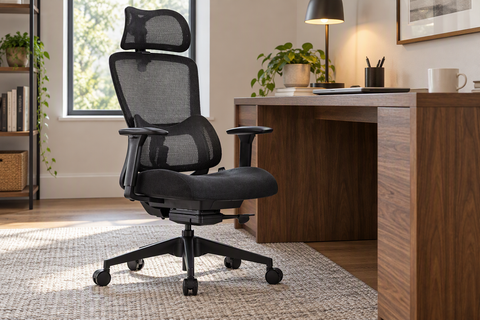
While the goal is to stand more, the time spent sitting must be of the highest quality. The Royal II, Silicone & Leather Executive Ergonomic Office Chair is designed for the "High-Back" support that executives prefer. Unlike many plush chairs that offer minimal adjustment, the Royal II focuses on lumbar alignment. As discussed in our guide on what makes an office chair truly ergonomic, the ability to tilt and lock the backrest is vital for shifting weight off the spine during long calls.
The Essential Accessory: The Footrest
The Adjustable Ergonomic Footrest serves a dual purpose. While sitting, it corrects the "short leg" problem for users who need a higher chair for their desk. While standing, it can be used to elevate one foot, which tilts the pelvis and relieves tension in the psoas and lower back muscles—a technique often used by professionals who stand for long periods.

Summary of Ergonomic Principles for Executives
To maximize the benefits of your adjustable workstation, consider the following checklist derived from Safe Work Australia's 2023 Guidelines:
- Monitor Alignment: The screen should be roughly an arm's length away. For ultrawide monitors, ensure the desk depth (like the 29-inch depth of the Opal) allows for a sufficient viewing distance to prevent eye strain.
- Elbow Angle: Whether sitting or standing, your forearms should be parallel to the floor. Avoid "reaching up" to a desk that is too high.
- Keyboard Placement: Keep the keyboard and mouse close enough that your elbows stay tucked near your torso. Overreaching can lead to rotator cuff strain.
- Movement Frequency: Set a timer for every 45-60 minutes to change your position. The Cochrane (2018) review confirms that sit-stand desks significantly reduce sitting time, but their effectiveness is amplified when paired with behavioral reminders.
By investing in a workstation that prioritizes musculoskeletal health, you are not just purchasing furniture; you are investing in your long-term productivity and well-being. The modern executive desk is no longer just a place to work—it is a tool for professional longevity.
Disclaimer: This article is for informational purposes only and does not constitute professional medical advice. Individuals with pre-existing musculoskeletal conditions or chronic back pain should consult a qualified healthcare professional or physiotherapist before making significant changes to their workstation setup or activity levels.
References
- BIFMA G1-2013 Ergonomics Guideline for Furniture
- CCOHS: Office Ergonomics - Sit/Stand Desk
- Cochrane: Workplace interventions for reducing sitting at work (2018)
- Cornell University Ergonomics Web — Workstation Guides
- ISO 9241-5:2024 Workstation layout & postural requirements
- WHO 2020 Guidelines on Physical Activity & Sedentary Behaviour
- OSHA eTools: Computer Workstations - Neutral Working Postures
- The 2026 Workstation White Paper: Converging Ergonomic Science and Sustainable Engineering




Leave a comment