

Imagine stepping into your home office and instantly feeling both grounded and energized. Raw wood, dark metal, and concrete set a bold industrial frame—yet the lighting is soft on your eyes, the decor calms visual noise, and every beam of light seems to guide you into deep work.
That balance is the heart of an industrial-style office that actually works for real-world tasks, not just photos.
This guide walks you through how to design industrial office lighting and decor that look stunning and still support healthy, productive work. You will learn how to layer light, avoid glare, choose decor that supports focus, and weave in smart tech and ergonomic furniture that feel like a natural part of your workspace sanctuary.
How Industrial Style Changes the Way You Think About Lighting
Industrial style is more than exposed brick and metal cages around bulbs. In an office, every surface becomes an optical component: it reflects, absorbs, or amplifies light.
Raw materials = powerful reflectors
In most industrial home offices, you will see a mix of:
- Brick or concrete walls
- Dark-painted ceilings or beams
- Metal fixtures and conduit
- Sintered stone or wood desktops
According to office lighting design research summarized by LED Lighting Supply, hard and irregular surfaces can create harsh contrast and glare if light is not diffused properly. Our field experience confirms this: when you place a bright point-source pendant directly over a glossy desktop, you often get a hot spot that reflects straight into your eyes or onto your monitor.
Pro Tip (Optical Reality Check)
A common misconception is that the more dramatic the industrial contrast—dark walls with bright pendants—the more stylish and “focused” the space feels. In reality, high contrast between task surfaces, walls, and ceilings increases eye fatigue and slows visual scanning. Practitioners see fewer complaints when mid-tone walls and matte finishes are paired with wide-beam, diffused lighting that keeps contrast gentler, just as emphasized in visual comfort guidance for office and industrial spaces.
Light levels that support deep work
While interior photos often exaggerate shadows for drama, real workspaces need consistent, comfortable brightness. Practical experience and engineering guides such as the office lighting design guide point toward:
- 300–500 lux on the desk surface for reading, typing, and sketching
- 150–300 lux as general ambient light in the room
- A uniformity ratio around 0.6 or better across the desk (no bright pool in the center and dark edges)
Our measurements in home offices show that a typical single ceiling fixture often produces only 80–150 lux on the desk—well below that range. Adding a dimmable task lamp and/or an LED strip under a shelf usually raises the desk surface into the comfort zone while keeping the industrial mood.
Why industrial offices need smarter posture thinking
Lighting is only one side of a healthy industrial office. The other is how your body interacts with the desk, chair, and screens.
The OSHA computer workstation guidance on neutral working postures emphasizes keeping joints near 90° angles, shoulders relaxed, and the head balanced over the spine. Similarly, the CCOHS sit-stand desk guide explains that the top of your screen should sit at or slightly below eye level to reduce neck strain.
Industrial-style materials don’t change these fundamentals—but poor lighting can hide bad posture cues. If your desk is too dim, you tend to lean forward; if your monitor reflects a pendant, you crane your neck. Good lighting and ergonomic furniture work together to prevent this.
To learn more about matching an adjustable desk to your home office aesthetic, you can pair this guide with the style-focused tips in How to Match a Standing Desk to Your Home Office Style.
Building Your Industrial Lighting Framework
Think of your lighting design as three layers: ambient, task, and accent. Industrial style looks its best when all three work together.
1. Ambient light: the base layer that protects your eyes
Ambient light is your overall brightness. In an industrial office, this often comes from track lighting, linear LEDs along beams, or large metal dome fixtures.
Practical targets:
- Aim for 150–300 lux measured at desk height when only ambient lighting is on.
- Use dimmable LEDs with 90+ CRI (color rendering index) so materials like leather, wood, and sintered stone look true to color.
- Choose 3000–3500K for a warm-but-crisp industrial feel. This range keeps the space cozy without muddying paper documents or product samples.
Lighting professionals consistently find that people report fewer headaches and less eye strain when ambient light is uniform and soft rather than sharply directional, a pattern echoed in workplace comfort guidance from SAIF’s office and industrial lighting recommendations.
Common mistake: relying on a single overhead pendant centered in the room. It looks good on camera but leaves the wall behind your monitor dark and creates a bright “hot circle” on the desk. Instead, use 2–3 sources: a linear fixture along the room’s long axis plus one or two offset pendants or wall sconces.
2. Task lighting: sharpening the work zone
Task lighting focuses on what your hands and eyes are doing: typing, sketching, reading, editing.
According to office lighting design guidance, task zones benefit from 300–500 lux of even light. Rather than blasting the entire room to that level, use a dedicated desk lamp or integrated LED along the desktop edge.
Placement heuristics from designers:
- Place task lamps 12–18 inches behind your dominant hand, angled so the beam crosses the keyboard and notebook but does not hit the monitor directly.
- For pendants over the desk, hang the bottom edge 28–34 inches above the desktop so they stay out of your sight line when seated or standing.
This is where a height-adjustable desk shines. On a wing-shaped workstation like the Aero Pro Wing-Shaped Standing Desk (72"x23"), you can slide your chair or stool slightly and still keep everything in reach while maintaining the same relative position between task lamp, keyboard, and screen.

Because the Aero Pro’s desktop wraps toward you, you can keep task lighting closer and more focused without losing elbow room, which helps maintain brightness while avoiding light spill onto surrounding walls.
3. Accent lighting: turning industrial into inviting
Accent lighting creates visual hierarchy and mood. In an industrial home office, this often means:
- LED strips in wall niches
- Warm spots on artwork or shelving
- Backlighting behind a monitor or wall panel
The key is to treat these lights as background rhythm, not the main performer.
An RGB wall fixture set, such as the Soho Art Lighting, is well-suited for this. It delivers sculptural geometry during the day and soft backlighting for video calls at night.
Expert Warning (On RGB and Color Chaos)
A lot of creative professionals assume saturated RGB lighting boosts productivity all day. In practice, lighting consultants and research summarized by Edward Martin’s office lighting guidance see better comfort and color perception when the main work plane stays in a neutral 3500–5000K range with high CRI, while colored light is used sparingly as an accent. Use RGB for short creative bursts or ambient glow behind your monitor, but keep your desk surface and documents under neutral white light.
Designing Lighting Scenes for Different Workflows
An industrial office is rarely used for just one task. You might write, design, join calls, and relax in the same space. Instead of one static lighting setup, create scenes.
Scene 1: Deep-focus solo work
Goal: Minimal distraction, clear visibility, comfortable posture.
Lighting recipe:
- Ambient: dimmed to the lower end of the 150–300 lux range.
- Task: strong, focused desk lamp delivering 300–500 lux on keyboard and notebook.
- Accent: minimal—perhaps a soft backlight behind the monitor.
This ratio keeps the work area slightly brighter than the surroundings, pulling your focus to the desk without creating a harsh contrast.
Pair this with a sit-stand rhythm like the “20–8–2” model described by Cornell University’s ergonomics guide: in each 30-minute block, sit for 20 minutes, stand for 8, and walk/stretch for 2. Lighting stays unchanged as you move between sitting and standing, which is easier when your fixtures are positioned based on the desk surface rather than your eye height.
Scene 2: Video calls and presentations
Goal: Flattering, clear face lighting and calm background.
Lighting recipe:
- Add a soft, diffuse light source slightly above and behind your monitor.
- Keep ambient lights at mid-level so your face is brighter than the background but not washed out.
- Use warm accent lights (2700–3000K) on shelving or art to create depth.
Avoid overhead spotlights directly above your head—they create dark eye sockets and sharp shadows. In industrial spaces with exposed beams, small track heads aimed at the wall behind you often look more professional than a single overhead downlight.
Scene 3: Creative sessions and after-hours ambiance
Goal: Relaxed atmosphere that still allows light note-taking or sketching.
Lighting recipe:
- Dim ambient lights to the lower end of their range.
- Use warm accent lights and RGB elements (like Soho Art Lighting) for mood.
- Keep at least one neutral-white task light available for reading or drawing.
This is where industrial decor—art, books, and objects—really comes alive.
Decor That Supports Focus in an Industrial Office
Industrial decor can quickly drift into visual clutter. The trick is to select pieces that anchor the room and organize the visual field, rather than compete with your work.
Anchor pieces: desk, coffee table, and storage
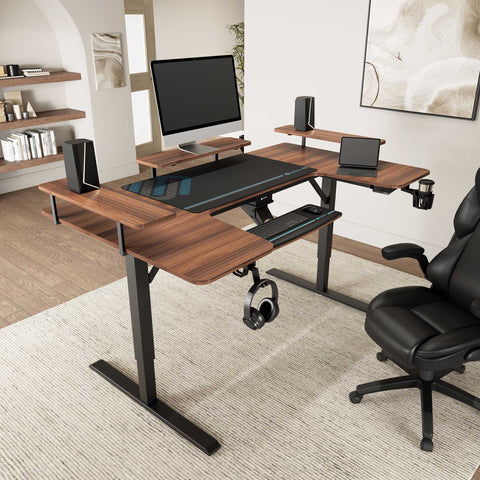
Start with a strong anchor: your primary desk. For executives or homeowners who want an elevated industrial aesthetic, a sintered-stone L-shaped workstation like the Ark Pro L-Shaped Standing Desk (Sintered Stone, 63"x23") sets a powerful tone.
The Ark Pro combines black and gold sintered stone with wood and metal elements, so it pairs naturally with matt-black fixtures and warm, neutral walls. Because sintered stone can be slightly reflective, designers often:
- Choose matte or low-gloss finishes for overhead fixtures.
- Offset pendants behind and to the side of monitors, rather than centering them above the desk, to reduce screen reflections—an approach reinforced by office reflection guidance from Office Principles’ lighting insights.
In a lounge corner of your office, an organic piece like the 41" Irregular Round Solid Wood Walnut Coffee Table adds warmth and breaks up rectilinear lines. Its walnut-and-marble veneer combination creates a natural focal point for a reading nook or informal meeting zone.
Wall art: softening hard surfaces
Exposed brick and concrete look striking, but as highlighted in office design analyses, these surfaces can increase visual and acoustic harshness. To soften them:
- Install large, matte-finished art prints to absorb some reflections and reduce visual “noise.”
- Use picture lights or small adjustable spots with 90+ CRI so artwork colors stay accurate.
- Keep frames thin and dark (black or deep bronze) to stay within the industrial palette.
The goal is to create a calm background field so your desk and task area feel visually organized.
Shelving, objects, and plants
On shelving, think in clusters rather than a dense grid:
- Group 3–5 objects per shelf: a stack of books, a sculptural object, a small plant.
- Leave negative space between clusters so the eye can rest.
- Use low-voltage LED strips or small spotlights inside cabinets (with CRI ≥ 90) to highlight these groupings without over-illuminating the room.
Plants make an especially strong counterpoint to industrial materials. Their soft forms break up hard edges and subtly absorb sound. Place them where they catch side-light from windows or accent fixtures, not blocking your monitor or work surface.
Practical Configuration Template: From Blank Room to Industrial Sanctuary
To make this actionable, here is a step-by-step framework you can follow.
Step 1: Define your zones
Divide your room into work, meeting/reading, and display/storage zones.
- Work zone: your main desk, chair, and monitor array.
- Meeting/reading zone: a lounge chair plus coffee table.
- Display/storage zone: shelving, cabinets, and decorative walls.
A wing-shaped workstation such as the Aero Pro works well in a corner, giving you clear separation between keyboard space and writing/drawing space. An L-shaped executive desk like the Ark Pro can define the work zone in a larger room while leaving space for a lounge corner.
Step 2: Plan circuits and controls early
Designers frequently see costly rework when lighting is planned after furniture. Instead:
- Plan for at least two circuits: general ambient + accent/task.
- Use dimmable LED drivers for all fixed fixtures.
- Decide which lights you want controllable from your chair vs. the room entrance.
Practice shows that separating desk-adjacent lights from the rest of the room allows you to change scenes with minimal effort, which increases the likelihood you will actually use different modes throughout the day.
Step 3: Choose color temperatures intentionally
Use this as a simple decision guide:
| Zone / Function | Recommended CCT | Why it works in an industrial office |
|---|---|---|
| Primary work surface | 3500–4000K, high CRI | Neutral white keeps text and color accurate while feeling crisp. |
| General ambient (room) | 3000–3500K | Warm-neutral glow softens raw materials without feeling dim or yellow. |
| Accent on art and shelves | 2700–3000K, 90+ CRI | Warmer tone adds depth and intimacy; high CRI reveals textures and colors. |
| RGB / dynamic accent | Neutral base + short RGB | Protects visual comfort while still offering creative, brand-focused effects. |
This aligns with findings from office productivity-focused lighting guidance, which notes that neutral white light in the main task zone supports alertness and color rendering, while warmer tones in the periphery help relaxation.
Step 4: Position fixtures relative to your desk
Use your desk surface—not your ceiling—as the main reference plane.
- Pendants: bottom edge 28–34 inches above the desk, slightly behind and off to the side of your monitor to avoid screen reflections.
- Task lamps: 12–18 inches behind your dominant hand, tilted so the brightest part of the beam falls just in front of your keyboard.
- Wall washers: aim them at mid-height on the wall, not directly at glossy stone or glass surfaces.
When you use an L-shaped stone desk like the Ark Pro, treat each segment separately. You may place a task light on the primary leg and a softer accent lamp on the return, using the stone’s subtle reflectance to bounce light gently across the work surface.
Step 5: Test and tune for 48–72 hours
Before committing to permanent mounts:
- Use temporary lamps and clamp lights to simulate your planned layout.
- Work through a normal schedule: email, design, video calls, evening reading.
- Notice where glare, shadows, or dark spots appear.
- Adjust heights and angles until your eyes feel relaxed at the end of the day.
Designers consistently observe that spending just two to three days in this mockup phase prevents most regrets—especially in industrial spaces where moving conduit or anchored fixtures later is expensive.
Ergonomic & Health Considerations: Standing, Sitting, and Light
Although this article focuses on aesthetics and lighting, industrial offices are still work environments, and health considerations matter.
Sit-stand rhythm and static postures
The World Health Organization’s 2020 guidelines on physical activity and sedentary behaviour recommend 150–300 minutes of moderate activity per week and emphasize reducing prolonged sedentary time. They specifically note that long periods of static sitting—or static standing—should be interrupted regularly.
Similarly, ISO 11226 on static working postures explains that even acceptable positions become problematic if held too long; both posture angle and duration matter. This is where height-adjustable desks like the Aero Pro and Ark Pro become especially useful: they offer an engineering control that makes position changes easy, rather than relying solely on self-discipline.
Lighting’s role in healthy posture
The OSHA guidance on computer workstation positions illustrates ideal seated and standing postures and notes that poor viewing angles encourage leaning and twisting. In practice, we often see lighting interacting with these factors in three ways:
- Too-dim desks cause people to lean forward, rounding their back.
- Screen glare from a pendant or window leads to awkward head tilting.
- Overly bright backgrounds around a monitor increase eye strain and encourage squinting.
By keeping the desk in the 300–500 lux range, controlling glare with matte finishes and pendant placement, and ensuring the wall behind the monitor is softly lit, you reduce the need for compensatory postures.
For a broader overview of how ergonomic furniture contributes to wellness, including standing desks and chairs, you can cross-reference this guide with the wellness-oriented analysis in The Business Case for Standing Desks: A Boost to Employee Wellness.
Common Myths About Industrial Office Lighting & Decor
Myth 1: Vintage filament bulbs are ideal for productivity
Traditional filament-style bulbs are popular in industrial decor, but technical data gathered by the U.S. Department of Energy’s solid-state lighting program shows that classic incandescent-style sources often deliver less than 15 lumens per watt, while quality LED fixtures exceed 120 lumens per watt.
The result:
- More glare per unit of useful light
- Higher heat and energy consumption
- Shorter life and more frequent replacements
In offices we’ve measured, swapping exposed filament pendants for diffused LED fixtures with similar aesthetics but wide-beam lenses improved maintained lux levels on the desk by 30–40% while reducing reported glare.
Myth 2: Exposed conduit always has to be “real”
Exposed conduit feels authentic, but electrical codes like those summarized in the National Electrical Code (NEC) guidance impose specific requirements on mounting heights, clearances, and enclosure ratings. In practice, designers often run code-compliant conduit where needed and supplement with decorative dummy runs that maintain the industrial look without compromising safety.
Myth 3: One big statement pendant is all you need
A dramatic industrial pendant makes a strong visual statement, but as workplace lighting specialists highlight in the LED office lighting guide, uniformity across the work surface influences comfort more than the exact shape of the fixture.
Our field observations show that upgrading from a single statement pendant to a layered system—ambient + task + accent—typically improves usable desk illumination by 50–70% while maintaining or even enhancing the industrial aesthetic.
Wrapping Up: Turning Contrast into Comfort
An industrial home office does not have to choose between beauty and usability. By treating brick, concrete, metal, and stone as part of your lighting system—not just background texture—you can craft a workspace that looks sharp, feels calm, and supports long, focused sessions of deep work.
Key moves to remember:
- Target 300–500 lux on the desk and 150–300 lux in the room, using dimmable, high-CRI LEDs.
- Layer ambient, task, and accent lighting instead of relying on one overhead source.
- Position pendants and task lights relative to your desk surface, not the ceiling.
- Use decor—art, shelving, plants, and sculptural anchors like sintered-stone desks and solid-wood tables—to soften hard surfaces and organize the visual field.
- Treat RGB and saturated colors as accent tools, not your main work light.
Industrial style thrives on contrast, but your eyes and body thrive on balance. When you get both right, your office becomes more than a place to work—it becomes a sanctuary where raw materials, refined light, and thoughtful decor pull you back into flow, day after day.
Disclaimer
This article is for informational purposes only and does not constitute medical, electrical, or safety advice. Industrial office setups involve ergonomic considerations and, in many cases, electrical work. Always consult a qualified healthcare professional regarding posture or pain, and a licensed electrician for any wiring or fixture installation, especially when modifying walls, ceilings, or circuits.




Leave a comment