

Industrial home offices often start with a single design decision: should the main desk be metal or wood?
The answer is rarely obvious. Metal looks tough and architectural. Wood feels warm and timeless. Both can fit an industrial-style workspace, and both can be engineered for excellent ergonomics. The real difference lies in how each material behaves under daily use, how it works with a sit-stand frame, and how much maintenance you are prepared to accept.
This guide walks through those trade-offs in depth, drawing on ergonomic standards and field-tested installation experience to help you choose the right surface for your industrial office.

What “Industrial Style” Really Means for a Desk
Beyond the Loft Aesthetic
A common misconception is that an industrial-style office requires an all-metal desk: heavy steel slab, exposed bolts, and nothing else. In practice, the most resilient industrial workspaces use a metal frame for structure and pair it with a wood, veneer, or stone surface on top.
Experienced office installers see this pattern repeatedly: steel provides stiffness, while a replaceable surface handles wear, coffee spills, and pen scratches. This hybrid approach turns the desk into a system rather than a single object.
How Ergonomics Shapes Material Choice
Industrial style should not undermine ergonomics. Standards such as ISO 9241-5:2024 and the OSHA computer workstation guidance on desks focus on height range, clearance, and neutral posture — not on whether the surface is metal or wood.
From an ergonomic standpoint, your material choice affects three things:
- Edge comfort at wrists and forearms
- Glare and visual comfort across the surface
- Compatibility with a stable, height-adjustable frame
A metal surface with a sharp edge and high gloss can undermine a well-designed frame, while a matte veneer with a softly radiused front edge can feel comfortable all day, even if the core beneath is engineered wood.
Metal vs. Wood Desks: Core Trade-Offs
The table below summarizes how metal and wood perform on the key criteria that matter in an industrial-style home office.
Comparison Table: Metal vs. Wood for Industrial Desks
| Factor | Metal Desktop (Steel/Aluminum) | Wood / Veneer Desktop |
|---|---|---|
| Aesthetic | Cooler, more “machine-room” industrial; works with exposed beams, concrete, and dark hardware. | Warmer, vintage or warehouse feel; pairs well with brick, leather, and plant textures. |
| Structural Contribution | Very stiff as a material, but thin-gauge sheet tops add surprisingly little stiffness to a sit-stand system. Frame design matters more. | Dense hardwood or MDF core with good mounting can contribute noticeable rigidity, especially on wide desks. |
| Daily Durability | Resists crushing and deep dents; powder coat can chip to bare metal if struck or scraped. Fingerprints show on darker finishes. | Commercial-grade veneer or laminate over stable core resists scratches and hides minor wear; solid wood can dent but is repairable. |
| Glare & Visual Comfort | Gloss or semi-gloss metal can increase reflected glare dramatically, especially near windows. | Matte veneer or low-sheen finish significantly reduces reflections and visual fatigue. |
| Thermal Feel | Feels cooler to the touch in air-conditioned rooms; some users perceive this as “cold.” | Veneer over MDF or hardwood feels warmer at the wrist and more inviting for long typing sessions. |
| Maintenance | Needs gentle cleaners to protect the coating; touch-up of chips is visible. | pH-neutral cleaners and occasional refinishing keep wood and veneer looking fresh; small scratches often blend with the grain. |
| Weight on Sit-Stand Frame | Light to moderate for sheet metal; heavier for thick steel plate. Weight is usually manageable on dual-motor frames. | Medium to heavy; stone or very thick hardwood tops require checking frame capacity with a safety margin. |
| Perceived “Industrial” Score | High in minimalist, tech-heavy spaces. | High in vintage, loft, or “factory-converted” interiors, especially with visible grain and knots. |
This comparison already hints at a key insight from engineering data: steel is roughly three to four times as stiff as most hardwoods (Young’s modulus), but in a desk, what matters is where that steel sits. A thick metal frame under the desk contributes far more to stability than a thin metal sheet on top.
The Physics Behind Industrial Desks
Stability: Why the Frame Matters More Than the Surface
According to structural data compiled by the Engineering Toolbox, steel’s stiffness advantage over wood means it deflects far less under the same load. For sit-stand desks, our analysis shows this stiffness matters most in the legs and crossbeam, not the desktop itself.
In real installations, the biggest differences in wobble at standing height come from:
- Leg profile and wall thickness
- Crossbar geometry and fastener layout
- How rigidly the top is fastened to the frame
A thin metal or wood top adds only marginal stiffness compared with the frame. This is why many industrial-style desks combine a steel underframe with wood, veneer, or stone on top. You get the stability benefits of metal without committing to a cold, reflective work surface.
Weight, Motors, and Heavy Tops
With industrial aesthetics, users often gravitate toward stone, glass, or thick wood slabs. Installers routinely see one recurring problem: heavy tops mounted on frames that were designed for lighter loads.
Field experience gives a clear rule of thumb: for a motorized sit-stand desk, aim for a frame whose rated lifting capacity is at least 20–30% above the combined weight of the desktop and equipment. This buffer protects motor life, keeps lift speeds consistent, and reduces the risk of overload in everyday use.
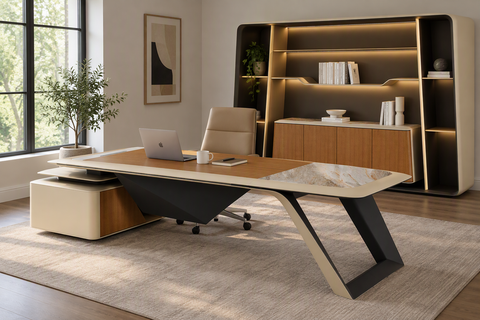
A system like the Zen Pro Series, 87"/72" Executive Standing Desk with Cabinets Set, which combines a steel frame with a large sintered-stone top and integrated storage, illustrates the point. Its industrial look is driven as much by the trapezoidal metal legs and cabinet massing as by the stone surface. The key is that the frame is engineered around that heavier load rather than upgraded as an afterthought.

Surface Feel, Temperature, and Comfort
Users often assume wood “feels” better only because it’s natural. In practice, perceived warmth at the wrist is driven by thermal conductivity and surface temperature. Reference data on material conductivity from the Engineering Toolbox shows that metals conduct heat away from the skin far more rapidly than wood or MDF cores.
This is why:
- Bare metal can feel noticeably cold during the first hour in a cool office.
- Veneers and laminates over engineered cores feel much closer to solid wood than to metal.
For an industrial office where you may be typing or drafting for long periods, a warm-feeling surface (veneer, matte laminate, or leather inlay) often translates into subtle but meaningful comfort gains.
Aesthetics: Industrial, But Still Professional
Metal-Forward Industrial Desks
Metal desktops work well when the space leans toward:
- Exposed concrete floors
- Minimalist shelving
- Monochrome palettes (black, grey, white)
In these offices, a metal top visually ties the desk to architectural elements like structural beams or ductwork. To keep the space professional rather than harsh:
- Prefer low-sheen powder coats to reduce glare. Research on interior surfaces suggests that semi-gloss finishes can generate over 50% more specular reflection than matte alternatives, increasing visual fatigue in bright spaces.
- Specify a front edge with a radius or applied edge bumper to preserve wrist comfort.
Wood-Forward Industrial Desks
Wood, veneer, and engineered wood are sometimes dismissed as too “domestic” for industrial style. That assumption overlooks how industrial furniture historically looked: factory benches were often heavy wood slabs on metal bases.
Modern industrial offices recreate that feel with:
- Visible grain and knots
- Medium to dark stains
- Contrasting black legs and hardware
The Ark EL Executive Standing Desk (60"x26") is a good example of this approach. It uses a trapezoidal leg in oak veneer with a low-sheen laminate tabletop, blending industrial geometry with a warm, professional finish. The integrated drawers also align with real-world executive needs: hidden storage that doesn’t visually clutter the room.
Hybrid Surfaces: Wood + Leather, Stone + Wood
Some industrial offices call for an executive-level statement piece that still fits the raw-material palette.
- A wood base with a leather inlay creates a visually strong frame while keeping the typing area soft and low-glare. The Ark EX Executive Standing Desk (60"x26"), with its combination of oak veneer and a black faux leather desktop, delivers exactly that blend.
- A stone top with wood cabinets, as seen in the Zen Pro executive setup, anchors a large office and reads as both industrial and high-end.
These hybrid surfaces also give you more control over where your arms rest. The typing zone stays comfortable, while surrounding hard surfaces emphasize the industrial aesthetic.
Durability and Maintenance in Real Offices
Expert Warning: “Metal Is Always More Durable”
A common myth is that metal desktops vastly outlast wood. Field experience and comparative guides show a more nuanced reality.
Analysis of desk materials summarized by Cubicle and Office notes that powder-coated metal can chip to bare steel when hit or dragged against, exposing a visible scar that is difficult to repair invisibly. By contrast, a dense hardwood or high-pressure laminate with a commercial-grade finish often resists everyday scratches better and distributes impact across the surface.
Other comparative reviews echo this: properly finished hardwood with a durable polyurethane or UV-cured coating handles hot coffee mugs and incidental knocks very well, especially in controlled indoor environments.
Veneer Reality: Not the Weak Link People Assume
Veneers carry a reputation as “cheap” and fragile, but industry analysis compiled in sources such as Urban-411’s desk material guide points out that thick commercial veneers over stable cores frequently outlast budget solid-wood tops that are prone to warping and cracking in dry, HVAC-heavy offices.
Installer feedback confirms this:
- Solid wood and thin veneers expand and contract 2–6 mm across seasons.
- Leaving a 3–5 mm perimeter gap at fixed supports and using vacuum-formed MDF cores improves dimensional stability.
In a home office with heating and cooling cycles, a veneer or laminate over a stable core is often the practical choice for an industrial look without the risk of seasonal movement.
Daily Cleaning and Finish Choices
Metal and wood both benefit from simple, consistent care:
- Avoid ammonia or abrasive cleaners on sealed veneers; pH-neutral cleaners preserve coatings.
- Dark metal finishes can highlight fingerprints, especially near drawer pulls and edges.
- Matte oiled or low-sheen wood hides fine scratches more effectively than high-gloss surfaces, and minor flaws can often be buffed out or spot-sanded.
These maintenance realities should feed directly into your material decision. If the desk sits in a high-traffic executive office where every mark is visible, a lower-sheen wood or leather-like surface may present better over time than a glossy metal top.
Ergonomics: How Surface Choice Affects Comfort
Edge Design and Neutral Posture
The OSHA eTool on neutral working postures defines a comfortable posture as one where shoulders are relaxed, elbows are roughly at a right angle, and wrists remain straight. Whether your desktop is metal or wood, the front edge can support or undermine this posture.
Look for:
- A front edge with a soft radius or applied edge band.
- A keyboard plane roughly 5 cm below seated elbow height, which enables neutral wrist alignment.
- A desktop thickness that allows monitor arms and clamps to mount securely without flexing.
Thick stone or metal tops with sharp machined edges look dramatic but can pressure the forearm over long sessions. Hybrid surfaces with a softer inlay or rounded wood edge often solve this without compromising style.
Glare and Visual Fatigue
Research on interior surface gloss suggests that semi-gloss and glossy finishes can increase reflected glare significantly — often by more than 50% compared with matte surfaces. For desk users, this matters because reflections from windows, lamps, and monitors can force subtle, constant posture adjustments.
Industrial offices often feature large windows, exposed bulbs, and dark materials. To avoid visual fatigue:
- Favor matte or low-sheen finishes on both wood and metal tops.
- Position the desk so the main light source is to the side, not directly behind or in front of the monitor.
- Consider a darker, matte inlay in the primary work zone, even if other parts of the desk are more reflective.
Sit-Stand Rhythm and Material Impact
Material does not change the basic ergonomic guidance for sit-stand work. According to the Canadian Centre for Occupational Health and Safety – CCOHS sit/stand desk guide, workers should alternate sitting and standing and keep the keyboard at approximately elbow height to maintain neutral posture.
Cornell’s ergonomics team goes further with its “20-8-2” recommendation: in each 30-minute period, a useful pattern is 20 minutes sitting, 8 minutes standing, and 2 minutes moving. This rhythm is supported by broader guidance from the World Health Organization’s 2020 sedentary behavior guidelines, which encourage adults to reduce and break up prolonged sedentary time.
In practice, a sit-stand industrial desk with a stable metal frame and a comfortable surface allows you to:
- Start with 30–60 minute alternating intervals.
- Aim for 2–4 hours of standing distributed across the workday.
- Adjust over a 2–4 week adaptation period.
Users with existing musculoskeletal disorders or circulation issues should consult a clinician before radically changing their work pattern.
Practical Decision Framework: Which Desk Is Right for You?
Step 1: Clarify Your Industrial Style
Ask yourself where on the industrial spectrum your home office sits:
- Minimalist industrial: white walls, concrete or pale floors, metal shelving, few decorative elements → a metal-forward or stone-topped desk with slim framing fits well.
- Loft / warehouse: brick, wood floors, large windows, visible ceiling structure → a wood or veneer top on a robust metal frame emphasizes warmth while staying industrial.
- Executive industrial: corner office, high ceilings, built-in storage, guest seating → a hybrid desk (wood + leather, stone + wood) balances authority and comfort.
Step 2: Match Material to Usage Pattern
Use the checklist below to align your material choice with how you work.
Choose a metal-focused desktop if:
- You primarily use laptops and light peripherals (low risk of surface scratching from heavy equipment).
- You prefer a cooler, technical feel under the wrists and are comfortable with a desk pad when needed.
- The space is visually dominated by metal and concrete, and you want the desk to disappear into that architecture.
Choose a wood or veneer-focused desktop if:
- You type for several hours a day and value a warmer, more forgiving surface.
- You expect the board to encounter notebooks, samples, or hardware that may scuff the finish.
- You want visible grain, knots, or texture to soften the industrial look.
Choose a hybrid surface if:
- You need executive-level presence and integrated storage.
- You want industrial materials without sacrificing wrist comfort (for example, leather inlays or soft-touch sections for typing).
- You are willing to invest in a more complex piece that combines wood, metal, and possibly stone.
Step 3: Check Your Sit-Stand Frame Compatibility
Before committing to a thick slab or stone top, verify:
- Total top + equipment weight: Include monitors, arms, PCs, and cabinets if they move with the desk.
- Frame capacity vs. weight: Aim for that 20–30% safety margin above total load.
- Cable and accessory clearance: Leave 80–120 mm under the desktop for cable trays and CPU holders on height-adjustable frames.
Avoid mounting heavy drawers directly under the desktop on single-stage legs; concentrate weight closer to the frame and consider side cabinets, such as the Ark EL, 29" Display File Storage Cabinet, Oak, to keep storage static while the desktop moves.
Case-Based Recommendations
Scenario 1: Remote Professional in a Loft Apartment
- Space: Exposed brick, tall windows, mixed vintage and modern furnishings.
- Work: 6–8 hours of computer work daily, with occasional sketching or writing.
Recommended approach:
- Wood or veneer desktop in a medium tone on a metal sit-stand frame.
- Rounded front edge and matte finish to manage wrist comfort and glare.
- Integrated drawers (as on the Ark EL desk) or a separate file cabinet to keep frequently used items within reach without cluttering the surface.
Scenario 2: Executive Industrial Corner Office
- Space: Large private office, visitors’ chairs, display shelves, and a view.
- Work: Mix of screen time, paper documents, and in-person meetings.
Recommended approach:
- Hybrid executive desk such as a stone-top or leather-inlay surface over a steel frame.
- Matching side cabinets to keep equipment and files off the main desktop.
- Height adjustability to support both focused solo work and standing conversations.
Scenario 3: Creative Professional in a Metal-Heavy Studio
- Space: Polished concrete floor, metal shelving, equipment stands.
- Work: Design, light assembly, laptop work, and sketching.
Recommended approach:
- Metal or stone-topped desk with a desk mat or separate wood inlay in the primary typing zone.
- Rug or acoustic treatments to keep the space from feeling overly cold.
- Reinforced frame capacity to accommodate heavier samples or equipment.
Wrapping Up: How to Make a Confident Choice
The “best” industrial office desk is not defined by metal or wood alone. It emerges from how the surface, frame, and workspace work together.
For most home offices and executive spaces, a metal frame combined with a wood, veneer, or hybrid surface offers the most balanced solution: industrial character, ergonomic comfort, and manageable maintenance.
When you evaluate options, focus on:
- Structural stability: Look at the frame design and capacity before obsessing over the surface.
- Surface ergonomics: Prioritize edge comfort, low glare, and a warm-feeling work zone.
- Real-world durability: Consider how finishes respond to scratches, heat, cleaning products, and seasonal humidity.
- Storage strategy: Decide which items move with the desk and which stay fixed (cabinets, wall units, shelves).
Approaching the decision with this framework helps you move beyond the metal vs. wood debate and select a desk that fits your industrial style, your body, and your work.
Health & Safety Disclaimer
This article is for informational purposes only and does not constitute medical, safety, or occupational health advice. Ergonomic needs vary widely between individuals. Readers, especially those with existing musculoskeletal, cardiovascular, or other health conditions, should consult a qualified healthcare or ergonomics professional before making significant changes to their workstation setup or daily activity patterns.
Sources
- ISO 9241-5:2024 Workstation layout and postural requirements
- OSHA eTools: Computer Workstations – Desks and Neutral Working Postures
- Canadian Centre for Occupational Health and Safety – Sit/Stand Desk
- World Health Organization – Guidelines on Physical Activity and Sedentary Behaviour
- Engineering Toolbox – Modulus of Elasticity for Wood and Steel
- Engineering Toolbox – Thermal Conductivity of Materials
- Cubicle and Office – Best Desk Materials: Wood, Metal, or Laminate?
- Urban-411 – Desk Material: Wood vs. Metal vs. Laminate




Leave a comment