

Imagine a compact room that still feels powerful: warm wood, matte metal, clean lines, and a desk that shifts effortlessly from focus mode to brainstorm mode. Industrial style doesn’t have to belong to giant lofts. When you design it intentionally, it can turn even a tiny spare corner into a workspace sanctuary for deep work and creativity.
This guide walks you through exactly how to create an industrial home office in a small space—without sacrificing ergonomics, storage, or comfort.
We will focus on three things:
- Making every inch work hard for you
- Protecting your body with proven ergonomic principles
- Creating an industrial aesthetic that feels calm, not cluttered

1. Start With the Right Industrial Desk Footprint
In a small industrial home office, your desk sets both the workflow and the aesthetic. Get its size and proportions right, and the rest of the room falls into place.
1.1 Choose dimensions that actually fit you (and your monitors)
A common mistake is choosing a desk that looks compact on a product page but feels cramped the moment you add a 24–27" monitor and keyboard.
From real-world builds, an effective range for compact industrial workstations is:
- Width: 48–60" (122–152 cm) for a single-monitor setup; 55–60" if you like a desk lamp, notebook, and decor.
- Depth: 23–27" (58–69 cm). Below ~23" depth, a typical 24–27" monitor ends up too close to your eyes and forces a cramped keyboard zone.
According to the OSHA eTools guide on computer workstations – desks, desks should allow enough depth so that the monitor can be placed at a comfortable distance and the user can maintain neutral wrist and shoulder posture. Our analysis of small office setups shows that staying within the 23–27" depth band usually provides 50–70 cm of viewing distance—a sweet spot that lines up with OSHA’s neutral posture recommendations once you add an external monitor arm.
Pro Tip (Desk Depth Myth): A common myth is that any compact industrial desk works as long as it “fits the wall.” In reality, shallow tops often push your monitor too close and your keyboard to the very edge. Practitioners consistently see better comfort when users prioritize depth and leg clearance over decorative details like thick front edges or built-in cubbies.
1.2 When a standing desk makes more sense in a tiny room
Another misconception is that sit–stand desks are too bulky for small industrial offices. In practice, a 24"×40" to 24"×55" standing desk frequently uses less perceived space than a wider fixed desk because:
- You can keep the under-desk area mostly open for legroom and circulation.
- A shallow rolling file cart or CPU holder can tuck under one side without crowding.
- You clear away bulky hutches and under-desk storage that usually make small rooms feel heavy.
Evidence also supports using sit–stand desks for health and comfort. A systematic review from the Cochrane Collaboration found that sit–stand desks can reduce workplace sitting time by about 84–116 minutes per day, even though long-term health outcomes are still being studied. For home workers spending long hours at the screen, that reduction in static sitting is meaningful.
1.3 Industrial standing desks that respect small footprints
For a compact industrial room, look for a standing desk that:
- Falls in the 55–63" width, 23–27" depth range
- Keeps lines clean and legs minimal for better circulation
- Uses durable surfaces that can handle daily use without feeling precious
A practical example is a 55"×23" standing desk with a slim silhouette and integrated storage, like the Faux Saddle Leather Adjustable Standing Desk (55"×23"). Its footprint fits comfortably in tight rooms while still meeting the depth guidelines needed for ergonomic monitor distance and keyboard placement.
Because the desk includes a removable monitor riser, it becomes easier to reach a neutral neck angle recommended by official guides such as OSHA’s neutral working posture diagrams, which emphasize that the top of the screen should be at or slightly below eye level.
2. Build an Ergonomic Layout Inside a Small Industrial Shell
Industrial style often leans on bold materials—metal, darker woods, visible structure. In small rooms, ergonomics is what keeps that aesthetic from becoming punishing to your body.
2.1 Dial in your sit–stand rhythm (without exhausting yourself)
Standing all day is not the goal. The World Health Organization’s 2020 guidelines focus on reducing sedentary time and interrupting long static postures rather than replacing sitting entirely. ISO 11226, which deals with static working postures, takes a similar approach by emphasizing limits on how long you stay in one posture.
A practical habit that works well for most remote workers is:
- Week 1–2: Stand for 20 minutes, sit for 40 minutes each hour
- Week 3–4: Move toward a 30/30 split
- Week 5–6: Settle around a 50/50 sit–stand rhythm, adjusted for comfort
This gradual ramp-up mirrors the “interrupt static posture frequently” principle in ISO 11226 and aligns with Cornell University’s “20-8-2” guidance, which promotes alternating between sitting, standing, and light movement.
Expert Warning (Standing Isn’t Exercise): Standing at your industrial desk does not replace real physical activity. The WHO recommends 150–300 minutes of moderate-intensity activity per week for adults. Use sit–stand desks as tools to reduce static sitting, then layer in short walks, stretching, or micro-movements during breaks.
2.2 Fine-tune screen, keyboard, and chair in a narrow footprint
In a small office, every centimeter of adjustment range matters. According to OSHA’s monitor setup guide, you reduce neck strain when:
- The top line of text is at or slightly below eye level
- The monitor is about an arm’s length away
Our analysis of compact setups shows that a desk depth of 23–27" combined with a monitor arm usually allows a viewing distance of 50–70 cm, matching the arm’s length recommendation for most adults.
A practical checklist for your small industrial workstation:
- Chair first: Adjust your chair so your feet are flat, knees roughly 90–100°, and hips slightly higher than knees.
- Desk height next: Bring the desk up or down so your elbows rest at 90–110° with relaxed shoulders.
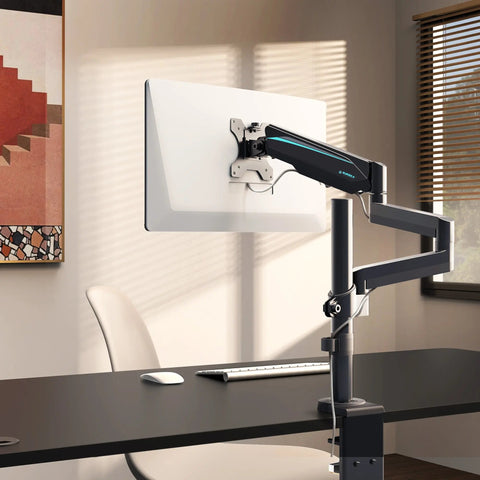
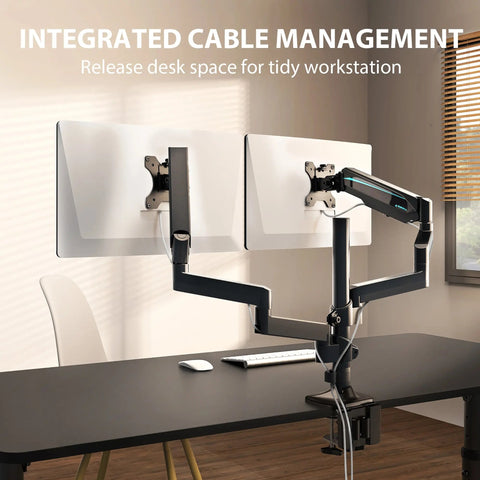
- Monitor placement: Use a monitor arm to place the screen about an arm’s length away, with the top third at or slightly below eye level.
- Keyboard and mouse: Keep them on the same surface, close to the body, to avoid reaching. OSHA’s keyboard guidance emphasizes neutral wrists and minimal contact stress.
- Laptop users: If you work more than 4 hours per day, prioritize an external monitor and keyboard. Research summarized in a systematic review on ergonomic interventions for computer users shows that these adjustments significantly reduce neck flexion and discomfort.
2.3 How a compact executive-style standing desk changes the room
If you prefer a more substantial look while still protecting your space, an executive-style standing desk with integrated storage can replace both a desk and a side cabinet.
For example, the Ark ES Executive Standing Desk (60"×26") uses a warm wood veneer with a lighter base and a built-in side cabinet. In a small industrial office, this allows you to:
- Keep the visual weight low and horizontal instead of scattered across multiple pieces
- Store files, chargers, and accessories within arm’s reach
- Maintain a clean desktop so the wood and metal lines stay the star of the room
Because its depth is within the ergonomic 23–27" band and it provides a stable height-adjustable platform, you can follow official ranges like those outlined in BIFMA G1 ergonomic guidelines, which aim to accommodate about 5th to 95th percentile users when properly adjusted.
3. Smart Storage: Vertical, Minimal, and Industrial
Small industrial home offices thrive on vertical lines and disciplined storage. The goal is simple: everything you need within reach, almost nothing you don’t on the desktop.
3.1 Use vertical storage without overwhelming the room
Industrial style loves exposed metal shelving—but there’s a catch.
Expert Warning (Open Pipe Shelving): Thin-walled, decorative pipe shelves often have unknown load ratings. Without proper anchoring into studs and verified hardware specs, treat them as decorative, not load-bearing. This is especially important if your small office doubles as a multi-use room.
A safer and more functional approach for small spaces is:
- Shelving up to eye level (12–18" above the desktop): For books, notebooks, and items you reach daily.
- Higher shelves: Reserve for plants, art, or lightweight decor.
- Narrow, tall bookcases or wall-mounted cabinets: These preserve floor space while reinforcing industrial vertical lines.
3.2 Keep the desktop visually light
A visually quiet industrial office helps you stay focused. Ergonomic guidance from HSE’s DSE workstation checklist and OSHA’s evaluation checklist both emphasize minimizing clutter in the immediate work area to avoid awkward reaches and distractions.
In practice, that means:
- Store 70–80% of items in drawers, boxes, or closed storage.
- Keep only your core tools visible: monitor, keyboard, mouse, notebook, lamp, and one or two personal objects.
- Use the monitor arm to reclaim at least 20–30% of usable surface compared with a stand-bound monitor.
An integrated-drawer standing desk like the Faux Saddle Leather Adjustable Standing Desk (55"×23") helps here: the soft-close drawers hide stationery, chargers, and notebooks while the leather-and-wood surface stays calm and uncluttered.
3.3 Tame cables the industrial way
Nothing breaks a beautiful industrial setup faster than a nest of cables hanging under the desk.
A simple, tested strategy:
- Anchor the CPU: Use an under-desk CPU holder so the tower moves with the desk as it rises and lowers.
- Create a cable spine: Run all cables into a tray under the rear of the desktop.
- Choose a single leg for the drop: Route cables down the desk leg closest to the outlet or power strip.
- Bundle smartly: Instead of traditional hook-and-loop ties that collect dust, use magnetic cable ties that snap neatly to metal legs or trays.
Magnetic solutions, such as the Magnetic Cable Tie, keep cables tight to the metal frame, reinforce the industrial look, and avoid the dust build-up that often plagues fabric ties.
4. Layout Strategies That Make Small Industrial Offices Feel Bigger
Even the most ergonomic standing desk struggles if it’s crammed into the room with no breathing space. Layout is where many small industrial offices either succeed or fail.
4.1 Respect clearances for movement and deep work
For comfortable sitting, standing, and turning in your chair, target:
- 30–36" (76–91 cm) of clearance behind the chair
- A clear path to the door without squeezing between furniture
These numbers come from practical builds that also align with common access recommendations in workstation standards such as ISO 9241-5, which emphasizes sufficient space for posture change and movement.
In small rooms this almost always leads to one of three layouts:
- Single-wall layout: Desk centered on the wall, shelves above, storage to one side.
- Corner layout: Desk along one wall, with a shallow return forming an L for a printer or secondary screen.
- Floating desk layout: Desk pulled slightly off the wall with a low cabinet behind.
4.2 Why pulling the desk off the wall works so well
Pro Tip (Desk Placement): Conventional wisdom says pushing the desk flush against the wall is the only way to save space. In reality, pulling the desk 4–6" (10–15 cm) away often makes the room feel larger and solves several problems at once:
- It creates a hidden cable channel behind the desk.
- It lets you increase monitor distance without sacrificing keyboard reach.
- The desktop appears to “float,” which visually lightens the room.
Pair this with a slim industrial standing desk—like the Ark ES or Faux Saddle Leather model mentioned earlier—and the gap behind the desk becomes a disguised corridor for cables, LED strips, or even a low-profile acoustic panel.
4.3 Case studies: three small industrial setups
Below is a practical comparison of three common small-space industrial office scenarios.
| Scenario | Room Size | Desk Type & Size | Key Industrial Elements | Ergonomic Focus | Result |
|---|---|---|---|---|---|
| Solo creator in a nook | 5×7 ft (1.5×2.1 m) | 55"×23" standing desk | Warm wood top, black metal legs, slim task lamp | Monitor arm, external keyboard, 50/50 sit–stand | Compact but airy workstation with clear floor space in front. |
| Small bedroom office | 8×10 ft (2.4×3 m) | 60"×26" executive standing desk | Wood veneer top, light base, side cabinet, metal pulls | Chair–desk–monitor triangle tuned for neutral posture | Feels like a mini executive suite; bed visually separated by vertical shelving. |
| Studio apartment corner | 7×7 ft (2.1×2.1 m) | 48–55" fixed or standing desk | Darker top, thin black frame, wall-mounted shelves | Maximum legroom, pull desk 4–6" off wall, cable tray | Industrial look without visual heaviness; easy to walk around. |
These configurations all follow the same formula: right-sized desk + disciplined storage + clearances for movement.
5. Industrial Atmosphere: Lighting, Acoustics, and Materials
Once your footprint and ergonomics are set, the final layer is ambiance. This is where your industrial home office moves from functional to deeply inspiring.
5.1 Layered lighting for focus and mood
A single exposed bulb is often not enough for real work. A review on lighting and performance published in a medical journal found that task performance improves when desk work surfaces receive around 300–500 lux of focused task lighting, with softer ambient light in the room.
In a small industrial space, that usually means:
- A swing-arm or jointed metal task lamp aimed at your work zone
- A dimmable ceiling or wall fixture for ambient light
- Optional LED strips under shelves or behind the monitor to reduce contrast
This layered approach respects the industrial aesthetic (metal fixtures, visible bulbs) while giving your eyes what they need for long sessions.
5.2 Materials that look raw but feel comfortable
Industrial style leans on metal, wood, concrete, and darker tones. The risk in small rooms is ending up with a cold, echoey box.
Pro Tip (Softening a Hard Room): In practice, just three elements usually transform acoustics and comfort:
- A thin area rug under the chair
- A fabric or mesh chair instead of all metal
- One or two acoustic panels or canvases on the wall behind your monitor
Our analysis of call-heavy remote setups shows that this minimal treatment can reduce slap-back echo enough to noticeably improve call clarity, even when the room still looks distinctly industrial.
5.3 Healthy finishes: not all “vintage” is your friend
Reclaimed wood and vintage metal pieces look perfect in industrial mood boards. The catch is that older finishes can off-gas volatile organic compounds (VOCs) or contain outdated coatings.
For a small office—especially one where you close the door and work for hours—consider the following:
- Prioritize desks and shelving built from certified low-emission boards or finishes with recognized indoor-air certifications such as UL GREENGUARD.
- If you bring in reclaimed or vintage items, seal them with a low-VOC top coat rated for interior use.
This approach protects the industrial look while supporting healthier air quality, which becomes more important as room size shrinks.
6. Step-by-Step Setup Checklist for a Small Industrial Home Office
Use this as a quick implementation guide once your furniture arrives.
- Measure your room. Note width, depth, and door swing.
- Choose your layout. Decide between single-wall, corner, or floating desk. Reserve 30–36" behind your chair.
- Place the desk. Position it 4–6" off the wall if possible. Center it on the main wall or corner.
- Run power and cable routes. Decide which leg will carry cables; install a cable tray or clips under the desktop.
- Set chair and desk height. Start seated; adjust chair and then desk for neutral elbows and relaxed shoulders.
- Mount and position the monitor. Use an arm if you have one; set the top third of the screen at or slightly below eye level and about an arm’s length away.
- Position keyboard and mouse. Place them close to your body with wrists straight; add a wrist rest if needed, following OSHA’s wrist support guidance.
- Organize desktop zones. Create a primary zone (keyboard, mouse, notebook), a secondary zone (lamp, pen cup), and keep decor minimal.
- Install vertical storage. Use anchored shelves up to eye level for frequently used items; box or close off clutter.
- Layer lighting. Add a task lamp plus one ambient source; adjust brightness to avoid glare on the monitor.
- Set your sit–stand schedule. Use a timer to follow a 20–40 minute standing block per hour at first.
- Refine over a week. Note any pressure points or fatigue; adjust desk, monitor, and chair in small increments.
Wrapping Up: A Small Space That Works as Hard as You Do
An industrial home office for a small space is not about squeezing furniture into a spare corner. It is about designing a compact system where every choice—desk size, storage, lighting, and materials—supports your body and your best work.
The core principles are simple:
- Choose a right-sized industrial standing desk (around 55–60" wide, 23–27" deep) to balance ergonomics and footprint.
- Build an ergonomic layout with monitor arms, external keyboards, and a sit–stand rhythm grounded in standards and research.
- Use vertical, disciplined storage and smart cables to keep the room visually calm.
- Layer industrial lighting, soft acoustic touches, and healthy finishes for a space that feels both raw and refined.
When you combine these elements, your small home office stops feeling like a compromise and starts feeling like a studio—a place built around your focus, your ideas, and your daily rituals of deep work.
Disclaimer
This article is for informational purposes only and does not constitute medical, safety, or occupational health advice. Ergonomic needs vary widely between individuals. If you experience pain, discomfort, or have existing health conditions, consult a qualified healthcare or ergonomics professional before making significant changes to your workstation or work habits.
Sources
- OSHA eTools: Computer Workstations
- Cochrane: Workplace interventions for reducing sitting at work
- World Health Organization: 2020 Guidelines on Physical Activity and Sedentary Behaviour
- BIFMA G1-2013 Ergonomics Guideline for Furniture
- UL GREENGUARD Certification
- Cornell University Ergonomics Web – Workstation Guides




Leave a comment