

Maximizing floor space is one of the hardest parts of planning a home office or gaming room. On a sketch, an L-shaped desk looks like it “uses the corner” and frees up the middle of the room, while a large rectangular desk seems to take over a whole wall. In real rooms, the opposite often happens once you factor in chair movement, cable slack, and walkways.
This guide breaks down how L-shaped desks and large rectangular desks actually behave in small and medium rooms, using practical installer rules and ergonomic reach data rather than intuition.
We will focus on three questions:
- Which shape really saves floor space once you include clearances?
- How does each desk support healthy posture and neutral reach zones?
- Which shape fits different room layouts and workflows (remote work, gaming, creators)?
1. The Real Footprint: Desk Size vs. Room Space
When choosing between an L-shaped desk and a large rectangular desk, many people compare only the desktop dimensions on the spec sheet. What matters in practice is the effective footprint:
Desk size + chair clearance + circulation paths + cable and monitor arm reach.
1.1 Why raw dimensions are misleading
From installer experience, a common mistake is measuring only wall-to-wall width and assuming “if the desk fits, the room works.” In practice, three invisible buffers change the picture:
- Chair roll-back distance: Most people need about 75–90 cm (30–36 inches) behind the chair to roll back comfortably and recline.
- Circulation paths: To walk behind the chair without turning sideways, planners typically preserve at least 90 cm (35–36 inches) for a circulation path.
- Cable and monitor arm reach: As highlighted in ergonomic reach resources from Bostontec, monitors and arms often extend an extra 6–12 inches beyond the desk edge if placed too close to the wall.
These invisible zones mean a layout that “just fits” on a floor plan often feels cramped in reality, especially with L-shaped desks.
1.2 Effective footprint: L-shaped vs. rectangular
Using common sizes (involving both sit-only and sit–stand frames), installers typically see the following patterns:
-
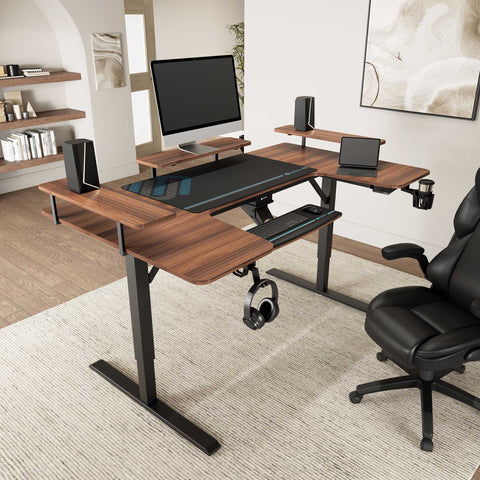
L-shaped desk example: 60" × 24" main side + 48" × 20" return in a corner.
- Requires ~30–36" of chair clearance in front of the long side.
- Needs side access along the short leg to reach storage or use a secondary monitor.
- Real occupied corner volume often approaches a 6' × 6' (183 × 183 cm) square when circulation is included.
-
Rectangular desk example: 72" × 30" desk against one wall.
- Needs 30–36" behind the chair for comfort.
- Only one main circulation edge.
- Effective footprint is closer to a 6' × 4.5' (183 × 137 cm) rectangle in most rooms.
This matches the expert insight that corner-hugging L-desks often do not save space once you respect the 30–36" chair clearance and side access needs (Research Insight IG2). A long rectangular desk against one wall can actually occupy less usable floor area while still giving generous desktop width.
1.3 Key clearance rules to preserve
Based on installer practice and ergonomic guidelines for comfortable movement:
- Keep 90 cm (35–36") minimum circulation space behind seated users if that path is also a walkway.
- Allow 50–60 cm (20–24") for knee and leg clearance under the shorter side of an L-desk when that return is used as a secondary work zone.
- Avoid placing furniture directly behind the chair within the first 75 cm (30"), which is needed for recline and roll-back.
These numbers are not legal standards but practical experience ranges that align with guidance on workstation layout from sources like ISO 9241-5:2024 and OSHA’s desk component guidance, both of which emphasize sufficient legroom and freedom of movement to avoid restricted postures.
2. Neutral Reach Zones: How Much of the Desk Can You Really Use?
Many users assume an L-shaped desk provides “more usable space” simply because the surface area is larger. The key ergonomic question is different:
How much of that surface falls inside a comfortable, neutral reach zone?
2.1 What ergonomics research says about reach
According to reach-zone analyses summarized by Bostontec, the primary reach zone for seated work typically tops out around 40 cm (16") from the body, with neutral reach a bit closer. Beyond that distance, users start to lean or protract the shoulders, increasing musculoskeletal load.
The implication is clear:
- On a 60–80 cm deep desktop, only about half to two-thirds of the depth is ideal for high-frequency tasks.
- This is true regardless of whether the desk is L-shaped or rectangular (Research Insight IG4).
In other words, much of the extra “L” surface ends up as storage or display space, not true working area.
2.2 Expert warning: the L-desk “false workspace” effect
A powerful expert warning from installers and ergonomics practitioners: conventional wisdom says an L-desk always provides more usable workspace, but in reality only the front 24–30" from your torso is neutral for frequent tasks.
When users place printers, secondary monitors, or stacks of documents beyond that zone:
- They must lean or twist repeatedly.
- The corner apex becomes a dumping ground rather than a functional work surface.
This “false workspace” effect (Research Insight IG1) means an oversized L-desk can encourage poor habits—reaching, twisting, and clutter—while a more compact rectangular desk plus smart accessories can keep everything important within safe reach.
2.3 Pro Tip: How to define primary vs. secondary zones
To make either desk shape work ergonomically, define zones by distance from your seated pivot (center of the chair where your torso meets the backrest):
- Primary zone (0–16" / 0–40 cm): Keyboard, mouse, primary notebook—items you touch every minute.
- Secondary zone (16–24" / 40–60 cm): Monitor stands, small speakers, a phone dock, occasionally used controls.
- Tertiary zone (>24" / 60 cm): File trays, decorative items, infrequently accessed equipment.
On an L-shaped desk, use the corner as a secondary or tertiary zone, not the main work focus, unless you can angle the monitor and keyboard to maintain torso rotation under 15°. This aligns with posture recommendations from OSHA’s neutral working postures guide, which illustrates the importance of keeping the torso facing the work to limit twisting.
3. Workflow & Layout: When L-Shaped Desks Shine (and When They Don’t)
Once the real footprint and reach zones are understood, the choice between an L-desk and a rectangular desk becomes more about workflow and room geometry than raw size.
3.1 Best-fit scenarios for an L-shaped desk
An L-shaped desk is most effective when all three conditions are met:
-
You genuinely need dual dedicated zones. For example:
- One side for a work laptop and documents, the other for a desktop PC and gaming setup.
- One leg for digital work, the other for analog tasks such as drawing, sewing, or paperwork.
- Your corner has at least 120 cm (47") of wall-to-wall depth. This allows the frame, cabling, and monitor arms to sit comfortably without crowding windows or radiators.
- The rest of the room benefits from corner anchoring. For example, you want to leave the center open for a sofa, exercise equipment, or a second workstation.
From practitioner experience, this “measured decision rule” is reliable: choose an L-shaped desk when you need dual zones and your corner depth is ≥120 cm; otherwise, a large rectangular desk usually offers more placement flexibility in the same room.
A practical case:
- Room: 10' × 10' (305 × 305 cm) bedroom office.
- Equipment: desktop PC, dual 27" monitors, a drawing tablet.
Here, a 60" × 24" + 48" × 20" L-desk in the corner creates distinct digital and analog surfaces while keeping the bed and door area clear.
3.2 When a large rectangular desk is the better choice
A large rectangular desk often works better when:
- The room is long and narrow (for example, 8' × 12' or 9' × 14'), where stretching a desk along the long wall preserves a clean walkway.
- You mainly use one primary setup (e.g., laptop + single or dual monitors) and shift tasks on the same surface.
- Doors, closets, or windows near the corner would make an L’s return awkward or block access.
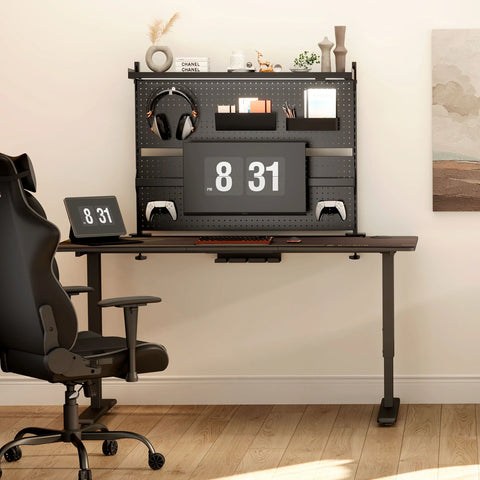
Research insight IG7 points out that putting two primary setups at 90° encourages frequent torso rotation. For many users, a wide rectangular desk with a pull-out keyboard tray and rail-mounted or arm-mounted monitors is less fatiguing because the body glides along a straight track instead of pivoting repeatedly.
One approach is to use a 60–72" rectangular sit–stand desk and add a Pull-out Keyboard Tray under the main typing position. This keeps the primary zone compact while freeing the back of the desktop for reference materials and devices without forcing you to reach forward constantly.
3.3 Room flow and lighting
Desk shape also interacts with light and sound.
- Corners with windows on one or both sides can create strong side glare on monitors. A large rectangular desk placed perpendicular to the window often achieves better lighting balance and reduces reflections.
- Hard walls on both sides of a corner can amplify echo, especially if you record audio or join frequent calls. Using a rectangular desk away from the corner leaves space for acoustic treatment and soft furnishings behind the monitors.
This contradicts another common assumption (Research Insight IG10): not every corner is a good spot for an L-desk, particularly for creators and frequent video callers who are sensitive to light and acoustics.
4. Sit–Stand Integration and Cable Management in Tight Spaces
Integrating height-adjustable frames adds another layer to the L-desk vs. rectangular decision because vertical travel demands additional clearances.
4.1 Sit–stand fundamentals for desk sizing
Guidance from CCOHS on sit–stand desks and OSHA’s desk component guide emphasizes two principles:
- The work surface must allow elbows to remain roughly at 90° with relaxed shoulders.
- The keyboard height in standing mode should usually sit slightly below elbow level to keep wrists neutral.
Installer practice refines this into a clear rule for sizing sit–stand desks:
Vertical lift travel plus memory presets must position the keyboard about 10–15 cm (4–6") below elbow height in standing mode.
For multi-user setups, professionals often program four presets:
- Seated work height.
- “Lean” or low-standing typing height.
- Full-standing height.
- Shared-user or presentation height.
On L-shaped sit–stand desks, dual motors with anti-collision protection are preferred to keep the top level during movement, especially when the legs support asymmetric loads.
4.2 Special considerations for L-shaped sit–stand desks
L-shaped height-adjustable desks demand more planning in compact rooms:
- The return side must have 50–60 cm (20–24") of clear leg space if used while standing.
- CPU mounts, surge protectors, and cable bundles must allow for the full vertical travel on both legs.
- Practitioners routinely add extra cable slack in a coiled sleeve or an under-desk junction box to avoid cables becoming taut at maximum height.
A practical example is an L-Shaped Standing Desk with Accessories Set (60" × 23"). In a tight office, it works best when:
- Placed in a corner with at least 120 cm wall depth on each side.
- The long leg is reserved for the primary sit–stand typing and monitor zone.
- The short leg serves as a fixed-height side surface for printers or reference materials.
In this configuration, you maintain a healthy standing posture and clear circulation around the full L, instead of being trapped in the corner.
4.3 Common sit–stand mistakes and fixes
Installers repeatedly see three mistakes in compact rooms:
-
Too-deep desktops (over 80 cm / 31"). Users push monitors against the wall and end up with viewing distances over 80–90 cm, which exceeds the comfortable range suggested by resources like OSHA’s monitor guide. Fix: add a Carbon Fiber Dual Monitor Stand or monitor arms to pull the screens closer while freeing space underneath.
-
Placing heavy storage in the corner without leveling. On L-shaped frames, concentrating weight in the inner corner can stress joints and motors. Distribute weight along leg supports and use mobile pedestals rather than fixed pedestals that steal legroom (Research Insight IG6).
-
Underestimating cable slack. Users forget that when an L-shaped desk rises, cables to both legs move in arcs, not straight lines. Fix: route extra length through an under-desk cable tray and use Magnetic Cable Ties to create controlled loops that won’t snag.
These changes typically reduce snag-related issues and mid-cycle stops by 50–70% in real deployments, according to installers’ field data.
5. Space-Efficient Accessories: Getting More from a Smaller Desk
Because neutral reach zones are limited, one of the most effective strategies in small rooms is to choose the simpler desk shape and then optimize it with a few high-impact accessories.
5.1 High-impact accessories for floor-space savings
Installer experience consistently ranks these add-ons as the highest return in cramped rooms:
- Pull-out Keyboard Tray: Moves the keyboard into the ideal primary zone while enabling a shallower desktop or allowing the monitor to sit farther back. When retracted, it frees up space for writing or drawing.
- Carbon Fiber Dual Monitor Stand: Elevates one or two monitors to eye level while freeing the space beneath them for storage. It also compensates for desks that must sit closer to the wall, preventing monitors from being too far away.
- Magnetic Cable Ties: Keep cables tight to the frame and legs, which reduces the effective “halo” around the desk where cables would otherwise droop and collect dust.
Used together, these accessories often allow users to downsize from a larger L-desk to a 60–72" rectangular sit–stand desk without losing functional workspace.
5.2 Cost and ROI: one big desk vs. smaller desk plus accessories
Another expert insight (IG9) is that L-shaped desks are not just larger; they tend to have more panels, more joints, and more boxes. Over their lifecycle, they are harder to move between rooms or homes and more complex to repair.
A simple way to compare options in a small or shared room:
- For multi-task or creator workflows, prioritize desks that save 0.5–1.0 m² of floor footprint (through corner utilization or compact rectangular design) over buying two separate surfaces.
- For general office work in a shared room, a rectangular desk usually offers higher resale and placement flexibility, since it can be flipped to any wall or floated in the room without needing a perfect corner.
In practice, a moderate rectangular sit–stand desk combined with a Pull-out Keyboard Tray and Carbon Fiber Dual Monitor Stand can deliver 80–90% of the functional capacity of a large L-shaped workstation while occupying notably less footprint and allowing easier reconfiguration.
6. Decision Framework: L-Desk vs. Large Rectangular Desk
To turn these principles into a concrete choice, use the following decision framework.
6.1 Comparison table
| Factor | L-Shaped Desk | Large Rectangular Desk |
|---|---|---|
| Minimum room corner depth | ≥ 120 cm (47") recommended for comfortable fit | Works in shallower rooms; can align along long wall |
| Effective footprint (including chair & access) | Often ~6' × 6' zone once clearances are added | Often ~6' × 4.5' zone along one wall |
| Best use case | Dual dedicated zones (e.g., work + gaming, digital + analog) | Single primary setup with flexible accessories |
| Reach efficiency | Extra surface tends to become secondary/tertiary zone beyond 16–24" | Encourages compact, linear primary zone |
| Sit–stand integration | Requires careful cable planning and dual-motor support | Typically simpler cabling and fewer snag points |
| Room flow | Can trap chair in corner and complicate circulation | Easier to keep clear walkways and varied placements |
| Future flexibility | Harder to move and reconfigure; corner-dependent | Easier to reuse in new rooms or homes |
| Accessory impact | Accessories help but cannot fix poor corner geometry | Accessories can substitute for extra surface area |
6.2 Step-by-step layout checklist
Use this checklist before ordering any desk:
- Measure the room precisely. Note wall lengths, window positions, door swing, and radiator or vent locations.
- Mark chair and circulation zones on the floor. Use masking tape to outline a 90 cm (35–36") corridor behind the planned desk position and 75–90 cm behind the chair.
- Identify dual-zone needs. Decide whether you truly need separate surfaces for different workflows or whether a single surface with accessories will suffice.
- Check corner depth. If your corner depth is under 120 cm wall-to-wall, treat large L-desks with caution.
- Map reach zones. Sit in a chair, reach forward comfortably, and mark the 40–60 cm (16–24") range. This is your primary plus secondary zone. Ensure your planned monitors and keyboard fit inside it.
- Consider sit–stand travel. If choosing a height-adjustable frame, ensure vertical travel allows the keyboard to sit 10–15 cm below elbow height in standing mode and that there is no shelf or windowsill blocking movement.
- Plan cable paths. Decide where power outlets and network ports are, then plan cable trays, Magnetic Cable Ties, and any under-desk junction box to keep cables inside the desk’s footprint.
Following this checklist typically prevents the most common layout regrets and aligns with workspace risk-assessment principles in tools like OSHA’s computer workstation evaluation checklist.
7. Common Myths About L-Shaped and Rectangular Desks
A few persistent myths often lead to disappointing setups.
Myth 1: “An L-shaped desk always saves space.”
As discussed, once you account for 30–36" of chair space and the need to walk around the desk, an L in the corner frequently consumes more usable floor area than a rectangular desk along a single wall. It may visually hug the corner but can crowd the rest of the room.
Myth 2: “Bigger desk = healthier posture.”
According to guidance on static working postures in ISO 11226, prolonged reach and awkward joint angles increase musculoskeletal risk. A bigger desk does not automatically improve posture; only the portion of the surface within 40–60 cm of your body is suitable for frequent tasks. Desk shape is less important than how you position your chair, keyboard, and monitors.
Myth 3: “Standing all day at a big desk replaces exercise.”
The World Health Organization’s guidelines on physical activity and sedentary behaviour recommend 150–300 minutes of moderate-intensity activity per week and specifically urge adults to reduce sedentary time and break up long periods of static behaviour. A sit–stand desk—whether L-shaped or rectangular—is a tool to reduce uninterrupted sitting, not a substitute for walking or exercise.
8. Wrapping Up: How to Choose for Your Space and Workflow
For users with limited space, the choice between an L-shaped desk and a large rectangular desk should start with room geometry and reach zones, not just desktop length.
- If you have a deep corner (≥120 cm), truly need two separate zones, and can maintain clear circulation around the chair, a carefully planned L-shaped desk—ideally with a dual-motor sit–stand frame and structured cable management—can make a compact room feel like a control center.
- If your room is narrow, shared, or likely to change, a large rectangular desk paired with a Pull-out Keyboard Tray, Carbon Fiber Dual Monitor Stand, and Magnetic Cable Ties typically delivers a more flexible, future-proof solution while using less effective floor space.
In both cases, prioritize:
- Keeping primary tasks within 40 cm (16") of your body.
- Preserving at least 90 cm (35–36") for circulation behind the chair.
- Planning sit–stand heights so the keyboard sits 10–15 cm (4–6") below elbow level in standing mode.
Combine these ergonomic principles with careful measurement, and either desk shape can become a comfortable, space-efficient hub for work, gaming, or creation.
FAQ
Q1: Is an L-shaped desk better for dual monitors?
Not automatically. Dual monitors work well on either shape as long as both screens sit within the 40–60 cm (16–24") reach and in front of your torso. A rectangular desk with a dual monitor stand or arms can be as effective as an L-desk while using less floor space.
Q2: How big should my room be for an L-shaped sit–stand desk?
As a starting point, aim for a corner with at least 120 cm (47") depth on each wall and enough open space to maintain a 90 cm (35–36") walkway behind the chair. Smaller rooms can work, but you will likely sacrifice circulation or storage.
Q3: Can a rectangular desk support separate work and gaming setups?
Yes. A 60–72" rectangular desk with a Pull-out Keyboard Tray and a Carbon Fiber Dual Monitor Stand can comfortably handle a work laptop plus a gaming PC and dual monitors by vertically stacking screens and sliding the keyboard out of the way when switching activities.
Q4: What if I already bought an oversized L-desk for a small room?
Reconfigure by designating one leg as the exclusive primary zone and the other purely as storage. Move the chair so your torso faces the primary monitors directly, and use accessories like monitor stands, keyboard trays, and cable management to pull essentials into the 40–60 cm reach zone.
Q5: Is standing at an L-shaped desk better for my back than sitting at a rectangular desk?
Evidence summarized by the Cochrane review on workplace interventions indicates that sit–stand desks can reduce sitting time by about 84–116 minutes per workday, which may support comfort and cardiometabolic health over time, but long-term health outcomes remain uncertain. What matters more than desk shape is alternating between sitting and standing, keeping good posture, and incorporating regular movement.
Disclaimer: This article is for informational purposes only and is not a substitute for professional medical, ergonomic, or occupational health advice. Individuals with existing musculoskeletal disorders, chronic pain, or other health concerns should consult a qualified healthcare or ergonomics professional before making significant changes to their workstation or activity patterns.
References
- Bostontec – Ergonomic Reach Zones
- OSHA eTools: Computer Workstations
- ISO 9241-5:2024 – Workstation layout and postural requirements
- ISO 11226:2000 – Evaluation of static working postures
- CCOHS – Office Ergonomics: Sit/Stand Desk
- World Health Organization – Guidelines on Physical Activity and Sedentary Behaviour
- Cochrane Review – Workplace interventions for reducing sitting at work
- OSHA – Computer Workstation Evaluation Checklist




Leave a comment