

For an executive, a desk is a command center. The shape and size of that surface quietly dictate posture, focus, and how many parallel tasks fit within easy reach. This guide compares L‑shaped and rectangular executive desks from an ergonomics and workflow standpoint so you can match your desk to your management style and office space.
According to the CDC/NIOSH ergonomics overview, poorly matched workstations are a major contributor to work-related musculoskeletal disorders (MSDs). For leaders who spend long hours in front of a screen, choosing an appropriate desk footprint is a strategic health and productivity decision, not just an aesthetic one.

1. How Desk Shape Influences Executive Workflows
L-shaped vs. rectangular: what actually changes?
At a basic level:
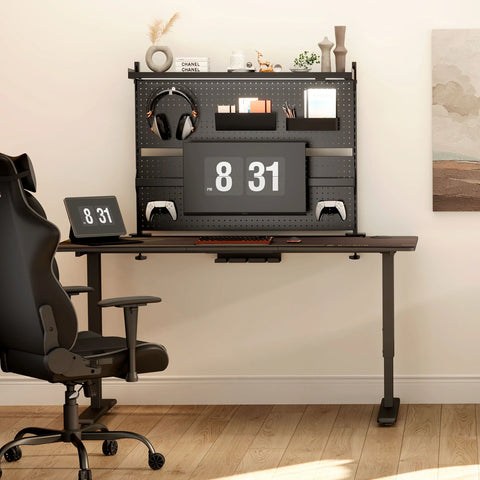
- Rectangular executive desk: A single, deep primary surface directly in front of you. Ideal for linear workflows: screen–keyboard–documents in a straight line.
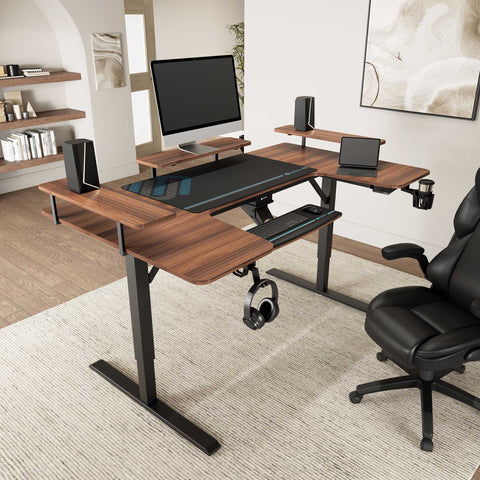
- L-shaped desk: A main surface plus a perpendicular wing, creating two or three distinct “zones” (primary computing, secondary paperwork, occasional collaboration).
Ergonomically, the key difference is how often and how far you reach and rotate. The OSHA eTools guide on computer workstations notes that neutral working postures keep joint angles close to 90–120° and minimize trunk rotation. Once the torso twists beyond about 15° for long periods, the risk of fatigue and discomfort increases.
An L-shaped desk can either support neutral postures—by keeping secondary tasks within a short pivot—or create constant twisting if the primary monitor or keyboard is placed on the corner or side wing. A rectangular desk, by contrast, encourages a single, centered primary zone but may push secondary tasks beyond comfortable reach if it is too narrow or cluttered.
Executive scenario: strategic vs. operational leadership
Two typical patterns show up repeatedly in workplace assessments:
- Strategic/creative executives (deep thinking, writing, one main screen): They benefit from a wide rectangular desk with a clean visual field. Fewer active zones reduce “task switching cost,” which aligns with the expert insight that productivity is dominated by task design, not just surface area. Extra surface for its own sake rarely improves focus for this group.
- Operational/multitasking managers (live dashboards, documents, frequent calls): They often gain more from an L-shaped workstation that supports multiple active zones in easy reach—screens ahead, reference materials on the side, and space for a laptop or tablet.
2. Ergonomic Fundamentals That Should Guide Your Choice
2.1 Coverage for different body sizes
Desk shape is only one part of the equation; height and depth matter just as much. The BIFMA G1 ergonomics guideline sets recommended dimensions aimed at covering roughly the 5th to 95th percentile of the adult population. In practical terms, this means:
- Sitting elbow height for most adults: about 24–30 in (61–76 cm) from the floor.
- Standing elbow height: roughly 38–46 in (97–117 cm).
Height-adjustable executive desks with an electric range spanning ~24–49 in typically cover this spectrum well. This is more important than shape: a perfectly sized L-desk that is too high or low still forces shrugging shoulders or slumped posture.
2.2 Depth and reach: how far is “too far”?
From repeated field installations and the practitioner heuristics you can use a simple rule:
- Primary zone (screen + keyboard): 60–80 cm (about 24–31 in) deep.
- Secondary side zone (wing or return): 45–60 cm (about 18–24 in) deep for documents or peripherals.
If the primary depth is less than ~60 cm, monitors are often too close or keyboards end up at the very edge, encouraging wrist extension and rounded shoulders. If the desk is excessively deep (>80 cm) and you cannot pull monitors forward with an arm, executives tend to lean and protrude the head, increasing neck strain. The OSHA desk component guidance reinforces this by emphasizing adequate legroom and accessible work zones.
2.3 Sitting vs. standing: shape does not replace movement
Height-adjustable rectangular and L-shaped desks both aim to reduce static sitting. A Cochrane review on sit–stand desks found that these workstations reduced sitting time at work by about 84–116 minutes per day, yet evidence for long-term health outcomes remains limited.
The takeaway: shape and height adjustment are tools to enable movement. According to the World Health Organization guidelines on physical activity and sedentary behaviour, adults should accumulate 150–300 minutes of moderate-intensity activity per week and avoid long uninterrupted sedentary periods. Standing is not a substitute for exercise; it is one way to break up sitting.
3. Comparing L-shaped vs. Rectangular Executive Desks
3.1 At-a-glance comparison
Use this table as a first filter before looking at room layout and personal habits.
| Aspect | L-shaped Executive Desk | Rectangular Executive Desk |
|---|---|---|
| Surface organization | Multiple zones for screens, documents, and devices, suitable for multitasking | Single large zone that favors linear, focused workflows |
| Corner-space utilization | Uses corners efficiently, ideal for fitting into room corners | Works best centered in a room or against a straight wall |
| Neck and trunk rotation risk | Low if monitor and keyboard remain on the main section; higher if primary work migrates to the corner or side wing | Generally low if centered; risk increases if users pile items at far left/right edges |
| Cable and power routing | More complex because equipment may span two runs; benefits from integrated cable management | Simpler routing and strain relief |
| Meeting/collaboration | Side wing can serve as informal meeting surface | Visitors sit opposite or beside; better for face-to-face interactions |
| Room flexibility | Orientation (left/right return) must match door and window positions | Easier to reorient when rearranging office |
| Storage integration | Side cabinets frequently integrated into the wing; must be balanced on sit–stand frames | Pedestals and credenzas often freestanding or under main top |
3.2 Corner space utilization and monitor placement
A recurring installation mistake in executive offices is placing the primary monitor directly on the corner of an L-shaped desk. This forces constant torso rotation and a twisted neck. Practitioner observations show that even a modest 10–20° twist held for several hours a day accumulates into fatigue.
To stay closer to the neutral posture defined in OSHA’s neutral working positions guide:
- Place the main monitor centered on the rectangular part of the desk.
- Use the wing for secondary devices (laptop, documents, reference books) that you consult occasionally.
- If two large monitors are needed, align them in a shallow arc on the main surface instead of wrapping them around the corner.
On a rectangular desk, corner utilization is a different question: many executives add a separate credenza or low cabinet behind them rather than pushing the primary desk into room corners. This keeps the view open and supports quick pivots from screen to storage without major trunk rotation.
3.3 Multitasking workflows: when more surface helps—and when it hurts
A common myth is that an L-shaped desk is automatically more productive for multitaskers. Expert analysis of real offices shows that productivity gains depend far more on task design and switching cost than on sheer surface area. Creative and strategic work often suffers when there are too many active zones competing for attention.
In practice:
- If your day involves simultaneous streams (e.g., a financial dashboard, project management tool, and handwritten notes), an L-shape can reduce clutter in your primary zone by moving secondary materials to the wing.
- If your work is deep-focus (strategy documents, design thinking, negotiations), a generous rectangular desk encourages a cleaner visual field and easier control of what stays in view.
Pro Tip: A simple experiment in several executive offices showed that reducing the number of active desk zones from three to two (even on an L-shaped desk) improved perceived focus and reduced unnecessary reaching. The same L-shape can behave like a “multitasking cockpit” or a “calm primary desk + occasional side shelf,” depending on how strictly you assign roles to each surface.
4. Matching Desk Shape to Room Layout and Management Style
4.1 Room layout: doors, windows, and circulation
Executives rarely work in empty rectangles. Sightlines, door placement, and visitor seating strongly influence whether an L or a rectangle works better.
Rectangular desk tends to suit:
- Central placement with the desk facing the door, leaving room behind for a credenza or storage wall.
- Narrow rooms, where an L-shape would block circulation.
- Frequent in-person meetings, because visitors can sit directly opposite the executive without the wing interfering.
L-shaped desk tends to suit:
- Corner offices, where the return can hug the wall, preserving floor space.
- Rooms with two functional walls (one for screens, one for storage or a window view). The desk can align with one wall while the wing supports side work.
- Telepresence-heavy roles, where multiple screens and devices need defined locations.
When planning, installers routinely measure not just floor area but also door and stair clearances versus box sizes, particularly for large L-shaped modules. For complex L-sets, planning an assembly zone and pre-routing cables through grommets and trays reduces on-site labor and ensures clean cable management from day one.
4.2 Management style: “command center” vs. “studio”
Think of your desk as either a command center or a studio bench:
- Command center executive (operations-focused): Multiple dashboards, frequent calls, quick pivots between tasks. L-shaped desks, or rectangular desks paired with a return or side cabinet, often align with this style.
- Studio-style executive (creative/strategy): Extended writing or design work, with occasional bursts of meetings. A rectangular executive standing desk with carefully planned accessories often supports this approach better.
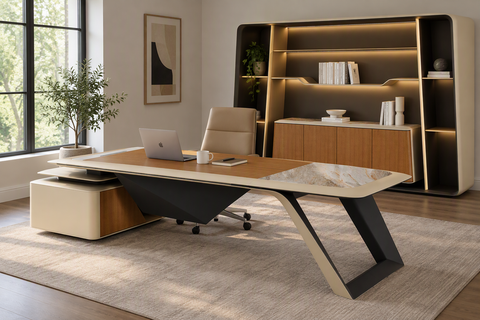
For example, an executive standing desk such as the Zen Classic Executive Standing Desk provides an expansive 86" × 39" rectangular surface and integrated storage. In a studio-style setup, the primary screen and keyboard sit in the frontal 60–70 cm, while the rear zone holds curated reference materials and a single document stand instead of stacks of files.

4.3 Stand-sit practicality with larger desks
Executive desks often carry heavier tops like sintered stone or thick veneer and may incorporate storage modules. This changes what is practical for sit–stand use:
- Dual- or four-motor frames with 2- or 3-stage columns handle heavy tops more stably.
- Anti-collision is particularly valuable when returns or cabinets sit beneath the top.
- Load rating must be checked before pairing heavy stone tops with electric frames to prevent long-term sag.
Our installation data shows that multi-motor executive frames typically maintain smooth, quiet travel even at loads of 70–100 kg distributed across the top, provided the load is balanced and the crossbar is correctly installed.
An executive rectangular desk with integrated storage like the Ark ES Executive Standing Desk (60"×26") illustrates this: the primary surface remains clear for work, while side storage is engineered to avoid unbalancing the lifting system. When configuring an L-shaped variant, avoid mounting very heavy cabinets on only one side of the lift frame unless the system is designed and rated for that asymmetry.
5. Storage, Accessories, and Cable Management: Hidden Determinants of Comfort
5.1 Storage ergonomics: where your documents live
The OSHA guidance on identifying ergonomic problems lists awkward postures and excessive reaching as key MSD risk factors. Storage placement strongly influences both.
Practical rules from workplace assessments:
- Keep frequently used drawers within 0.5–1.0 m of your neutral sitting or standing position.
- Use lateral cabinets and wall units for infrequently accessed binders and archives.
- Avoid placing heavy items in high overhead cabinets that require shoulder elevation.
A compact file solution such as the Ark EL 29" File Storage Cabinet, Oak can sit within easy reach of the main desk without overloading a sit–stand frame. Pairing freestanding storage with a rectangular desk often yields better balance and flexibility than trying to hang all storage off an L-shaped lift system.
5.2 Keyboard trays, monitor arms, and CPU holders
Accessories often determine whether an L or rectangle works ergonomically:
- Keyboard tray: Helps maintain neutral wrist and elbow angles when the main surface is thick or higher due to design. The OSHA keyboard component guidance recommends keeping wrists straight and elbows close to the body.
- Monitor arm: Vital on very deep desks (>80 cm) so you can pull displays into the ideal 50–70 cm viewing distance described by the OSHA monitor guidelines. This is especially important on large rectangular tops.
- CPU holder and under-desk power: These protect equipment and keep the footwell clear, which matters more on L-shapes where legs can otherwise collide with vertical elements.
On an L-shaped desk, mount monitor arms on the main section rather than on the corner or wing, so the primary viewing angle remains straight ahead. Use the wing for printers, scanners, or reference devices that do not require constant fine-motor interaction.
5.3 Cable management: an often-overlooked risk
Poor cable routing can undermine even the most elegant executive desk, especially with sit–stand movement. Installers consistently see three preventable issues:
- Fixed-length cables without slack: During height adjustment, tight cables strain connectors or lift objects off the surface. Always route cables with a gentle loop and secure them to an under-desk junction box or tray.
- Multiple power paths across an L-shape: Align main power and data entry points close to the pivot of movement and use a single “umbilical” where possible.
- Unanchored floor cables: These create tripping and tip-over risks around lateral cabinets.
The UL 962 overview for height-adjustable desks highlights the importance of mechanical and electrical safety, including cord routing and strain relief. Choosing desks with integrated cable channels and grommets simplifies compliance with these expectations.
6. Making the Decision: A Practical Selection Framework
6.1 Quick self-assessment checklist
Use this checklist to align desk shape with your real work pattern.
-
How many screens do you use daily?
- 1–2 large screens: Either shape works; prioritize height range and depth.
- 3+ screens: L-shape or large rectangle (80"+) with monitor arms.
-
How often do you handle physical documents?
- Minimal: Prioritize clean rectangular surface with a single document holder.
- Frequent, multi-file work: L-shape or rectangle + side cabinet.
-
What percentage of your day is meetings vs. deep work?
-
50% meetings in-office: Rectangular desk that faces the door supports visitor seating.
- Mostly remote/solo: L or rectangle; choose based on equipment layout.
-
-
Is your office narrow or irregular?
- Narrow/long: Favor rectangle along the long wall.
- Corner-heavy or square: L-shape can use corners efficiently.
-
Do you stand frequently?
- Yes: Prioritize electric height adjustment, memory presets, anti-collision.
- No, but planning to start: Rectangular sit–stand desks are often easier to set up and cable-manage initially.
6.2 Example configurations
Scenario A: Executive strategist in a home office
- Desk: Rectangular executive standing desk (e.g., 60–70" wide, 28–32" deep) with integrated storage, such as the Ark ES Executive Standing Desk.
- Setup: Single ultrawide monitor centered; keyboard and mouse 5–10 cm from the edge; a compact file cabinet like the Ark EL to the side; a single document holder behind the keyboard.
- Rhythm: Following the Cornell University ergonomics “20-8-2” guidance from the Cornell workstation guides, aim for each 30-minute cycle to include about 20 minutes sitting, 8 minutes standing, and 2 minutes of light movement.
Scenario B: Operations director managing live dashboards
- Desk: L-shaped executive sit–stand workstation with dual-motor frame and balanced storage.
- Setup: Two primary monitors centered on the main surface; a side laptop and phone dock on the wing; printer and reference binders on the far part of the wing. Frequently used drawers placed within a 0.5–1.0 m reach of the primary seat.
- Rhythm: Shorter but more frequent sit–stand changes (e.g., 15–20 minutes per posture), especially during high-intensity monitoring periods, to prevent prolonged static positions as discussed in ISO 11226.
Scenario C: Hybrid manager with limited space
- Desk: Compact rectangular standing desk (around 48–60" wide) and a slim file cabinet or credenza.
- Setup: One main screen on an arm, laptop on a stand to one side, keyboard and mouse on the main surface. Storage placed to avoid blocking leg movement.
- Rhythm: Sit–stand changes aligned with calendar blocks, plus micro-breaks guided by reminders, as suggested in the OSHA work process recommendations.
7. Wrapping Up: Key Takeaways for Executive Decision-Makers
Choosing between an L-shaped and rectangular executive desk is ultimately a question of workflow, room geometry, and ergonomic fundamentals, not status or surface size alone.
- Start with body fit: ensure the desk, whether L or rectangle, offers an adjustable height range that aligns with BIFMA and ISO ergonomic guidelines for the 5th–95th percentile adult.
- Map your primary tasks: deep-focus work favors a clear rectangular surface; multitasking operations can benefit from a well-organized L-shape.
- Plan for storage and cabling: keep frequently used items within 0.5–1.0 m reach, and give equal weight to cable management and safety.
- Treat the sit–stand feature as a movement enabler, not a health cure-all. Follow WHO and Cornell guidance to integrate movement throughout the day.
Approached this way, the decision between an L-shaped or rectangular executive desk becomes a structured design exercise. The result is a workspace that reflects leadership style, supports musculoskeletal health, and sustains focus through long, demanding days.
Disclaimer: This article is for informational purposes only and does not constitute medical, safety, or legal advice. Individuals with existing musculoskeletal or other health conditions should consult a qualified healthcare or ergonomics professional before making significant changes to their workstation or activity patterns.
Sources
- CDC / NIOSH – About Ergonomics
- BIFMA G1-2013 Ergonomics Guideline for Furniture
- OSHA eTools: Computer Workstations – Neutral Working Postures
- OSHA eTools: Computer Workstations – Desks
- OSHA – Ergonomics: Identify Problems
- UL 962 – Safety of Height-Adjustable Desks (Overview)
- World Health Organization – Guidelines on Physical Activity and Sedentary Behaviour
- Cornell University Ergonomics – Ergoguide
- ISO 11226:2000 – Evaluation of Static Working Postures
- OSHA eTools: Computer Workstations – Work Process
- OSHA eTools: Computer Workstations – Keyboards
- OSHA eTools: Computer Workstations – Monitors
- Cochrane Review – Workplace interventions for reducing sitting at work




Leave a comment