

Imagine a studio that flows with you: sketching on a tablet, reviewing reference prints, cutting motion graphics — all without shuffling piles or twisting your neck. The right desk layout turns that vision into an everyday reality.
This guide breaks down how L-shaped and rectangular desks really perform for creatives, so you can choose a layout that supports deep work, not daily friction.

How Creatives Actually Use Desk Space
Before comparing shapes, it helps to understand what a creative workstation must handle.
For most designers, illustrators, editors, and hybrid creators, the primary worksurface has to accommodate:
- A keyboard and mouse or control surface
- One or more monitors (often 27–32" or ultrawide)
- A drawing tablet or sketch area
- Physical media (notebooks, color swatches, storyboards)
- Reference devices (laptop, tablet, phone)
Ergonomics research shows that layout matters more than raw desk size. According to the OSHA eTools guidance on computer workstations, the key is to keep the keyboard, mouse, and primary monitor aligned with your body in a neutral posture — elbows roughly at 90°, wrists straight, and the monitor at eye level with a 15–20° downward gaze.
Experience in studio setups confirms this: a compact but well-arranged rectangular desk often outperforms a cluttered, oversized L. Research insight IG1 from the Eureka Ergonomic blog emphasizes that posture quality depends more on where you place your primary zone (keyboard, pointing device, main monitor) than on total area. In other words, a badly arranged L can be more fatiguing than a smaller straight desk.
The Three-Zone Layout Model
A simple way to think about creative desk space is in three zones:
- Primary zone (60–70% of your attention): Centered on your torso. Keyboard, mouse/pen, and main monitor live here.
- Secondary zone (about 30–45° to either side): Control surface, drawing tablet (if not your primary), phone dock, audio interface.
- Perimeter / reference zone: Farther edges and shelves for printers, storage, fabric swatch books, camera gear.
Whether you choose an L-shaped or rectangular desk, your goal is to keep core tools in the primary zone and push only lower-frequency items outward.
L-Shaped vs. Rectangular Desks: Big-Picture Comparison
Here’s a high-level comparison of how each shape supports creative work.
Quick Comparison Table
| Aspect | Rectangular Desk | L-Shaped Desk |
|---|---|---|
| Primary work zone | Strong, centered; easy to align with neutral posture | Can be excellent if you stay on one leg; risky if you sit in the corner |
| Surface depth for big monitors/tablets | Needs 70–80 cm (27–31") depth to comfortably fit 27–32" or ultrawide monitors at arm’s length | One leg is usually deep enough; corner radius can push monitors too far away |
| Multitasking zones | Great for single-station setups (one main workflow) | Ideal for two distinct stations (e.g., editing vs. sketching) |
| Room fit | Works well in narrow rooms and small studios | Shines in corners and larger rooms but can block circulation in tight spaces |
| Cable management on sit–stand frames | Straightforward routing front-to-back | More complex: 3-leg frames and longer cable runs need extra slack and planning |
| Collaboration & reviews | Good for side-by-side viewing and face-to-face critiques | Better for solo focus; corner can visually isolate you from guests |
According to Cornell University’s ergonomic workstation guide, most adults work more comfortably when monitors sit about an arm’s length away (roughly 50–70 cm). That typically translates to a main worksurface depth of 70–80 cm, regardless of shape (research insight IG6). If a desk is much shallower, your elbows drift forward and your neck angles down to see the screen.
Minimum Depth for Creative Comfort
For mixed digital and analog work, I recommend:
- At least 28–30" (70–76 cm) depth on your primary surface, or
- Reserving a 28"-long segment free of keyboard clutter for a drawing tablet or sketch pad.
Shallow desks under ~23" can work for pure laptop tasks, but for creative workflows with tablets and larger displays, they usually force awkward reach and cramped tilt angles.
When an L-Shaped Desk Shines for Creatives
L-shaped desks can feel like a dream if your work genuinely requires distinct stations.
Best Fit: Two or More Dedicated Work Modes
You will likely benefit from an L-shaped layout if your day oscillates between modes like:
- Digital editing vs. analog sketching
- 3D or motion work vs. audio mixing
- Client calls vs. intense production work
In these scenarios, one leg of the L can be your digital command center (monitor, keyboard, tablet), while the other leg becomes a clear, tactile surface for sketchbooks, storyboards, or a secondary laptop.
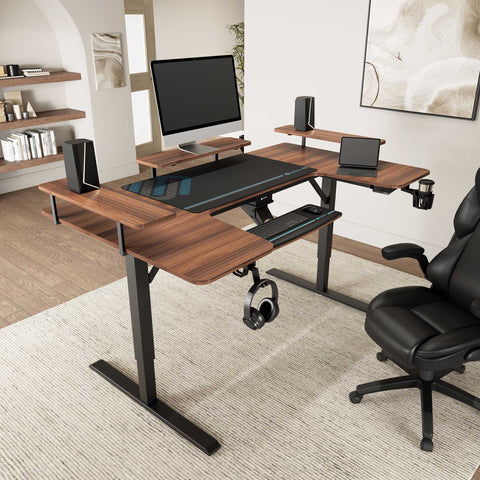
A height-adjustable L, such as the Ark Pro L-Shaped Standing Desk (Sintered Stone, 63"x23"), adds another dimension: you can stand for sketching, then sit for pixel-perfect retouching without changing rooms. The trapezoidal leg design and sintered stone surface provide both stability and a premium tactile feel that holds up to daily creative wear.

Pro Tip: Don’t Sit in the Corner
A common misconception is that the interior corner of an L is the most ergonomic spot because it feels like you’re “surrounded” by tools. Research insight IG8, drawing on Cornell ergonomics guidance, shows the opposite: sitting in the corner often forces asymmetric rotation of your neck and trunk toward one wing.
Instead:
- Place your keyboard and main monitor on one straight leg of the L, centered with your torso.
- Use the corner area for a monitor stand, storage, or as a raised platform for speakers.
- Reserve the other leg for a drawing tablet, secondary laptop, or layout space.
This keeps your spine neutral in your primary zone, while the L still gives you a generous secondary zone.
Managing Corner Depth and Monitor Distance
Another hidden trap: deep corner radii. Insight IG3, again aligned with Cornell’s monitor recommendations, notes that deep corners can push monitors beyond the ideal 50–70 cm viewing distance, increasing neck flexion and eye strain.
To counter this:
- Keep your primary display on a straight leg, not directly in the deepest part of the corner.
- Use the corner for a dual-monitor stand or speakers angled slightly toward you, so the primary sightline remains aligned with your body.
- If you must use the corner for a display, a shallow monitor riser and arm can bring the screen closer into the ideal range.
Expert Warning: L-Shaped Standing Desks and Cable Stress
Expert Warning
Research insight IG9 highlights that three-leg L-shaped sit–stand frames tend to have more complex flex patterns and cable routing risks than straight desks. Heavy creative gear like external drives, RAID arrays, and audio interfaces can snag cables or create tension when the desk moves.
In practice, I recommend:
- Leaving 20–30 cm of slack per cable between desktop gear and wall outlets.
- Routing bundles through an under-desk tray and down one or two dedicated cable “drops” near desk legs.
- Using a mobile CPU cart or under-desk mounts for towers and audio racks, so they travel with the desk.
These steps align with engineeering-control principles from OSHA’s ergonomics solutions framework: instead of just reminding yourself to be careful, you physically design the system to prevent snags.
Room Layout: Corners, Windows, and Flow
L-shaped desks often work beautifully in open corners with at least 1 m of clearance behind the chair. But in compact rooms, they can:
- Block doors or closet access
- Trap you so you have to squeeze past the desk leg every time you stand up
- Make it hard to add separate seating for clients or collaborators
Insight IG4 captures this trade-off: for urban apartments, a mid-sized rectangular sit–stand desk plus wall-mounted shelves frequently provides more usable storage and movement clearance than a massive L that dominates the room.
When a Rectangular Desk Is the Better Creative Tool
Rectangular desks are often underestimated for creative work, yet they excel in several common scenarios.
Best Fit: One Primary Visual Plane
If your work lives mostly in one frontal plane — like writing, 2D illustration, UI design, or photo editing — a deep rectangular desk gives you everything you need without extra side surfaces you rarely touch.
Research insight IG5 points out that many writers and 2D illustrators benefit more from a stable, deep straight desk with clean cable routing than from the extra leg of an L. The extra side area often turns into clutter rather than productive workspace.
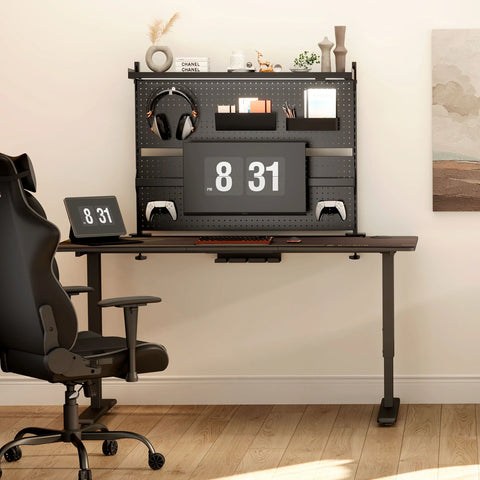
A 60"-wide by 26"-deep standing desk such as the Ark EL Executive Standing Desk (60"x26") is a good example. The depth gives enough room for a large monitor at arm’s length plus a drawing tablet in front, while the height adjustability lets you switch from focus-sitting to idea-storming standing with a single touch.

Stability for Heavy Monitor Setups
Another misconception is that rectangular desks are always the “budget, flimsy” option. Insight IG10 notes a more nuanced reality: entry-level rectangular sit–stand frames can indeed wobble under heavy creative loads, but a robust rectangular or L-shaped desk with quality construction is often a smarter long-term investment than a larger but unstable surface.
The key stability checks for creatives are:
- Does the desk stay solid at your maximum height, even with dual 27–32" monitors and a tablet?
- Are there crossbars or trapezoidal legs that reduce wobble?
- Can you mount monitor arms securely without flexing the top?
According to UL’s overview of height-adjustable desk safety, safety evaluations consider not only electrical components but also mechanical stability. While UL 962 is primarily a safety standard, it underscores why structural robustness should be part of your selection criteria.
Depth and Corner Ergonomics
Rectangular desks simplify depth and corner ergonomics:
- You have one continuous edge, so you can slide your chair left or right without hitting a corner radius.
- You can avoid the common mistake of placing your keyboard in a corner, which tends to hyperextend wrists.
For creatives who use large tablets, the rule of thumb holds: aim for 70–80 cm depth on the main section or, at minimum, keep a 28"-long strip dedicated as a drawing zone. You can position the keyboard slightly back on a tray or move it aside when you switch into “drawing mode.”
Ergonomic Essentials That Matter More Than Shape
Regardless of whether you choose an L-shaped or rectangular desk, your body doesn’t care about geometry — it cares about angles, heights, and durations.
Height, Posture, and Sit–Stand Rhythm
The core height guideline for both sitting and standing:
- Desk height ≈ elbow height in your chosen posture
- Monitor top at or just below eye level, with eyes looking slightly downward
The OSHA neutral working postures guide defines ideal joint angles: elbows around 90°, wrists straight, shoulders relaxed, thighs roughly parallel to the floor. To achieve this, set your chair first with feet flat, then raise or lower the desk to meet your elbows.
For sit–stand use, Cornell’s CUErgo sit-stand recommendations suggest alternating regularly and avoiding extreme “all-day standing.” Their analysis supports a 65–130 cm desk height range that fits most adults (research insight IG12) and a rhythm that roughly clusters around a 1:1 or 2:1 sitting-to-standing ratio for comfort and adherence.
A practical progression for creatives:
- Start with 15–30 minutes of standing each hour.
- Build toward about 50% standing time as your legs and lower back adapt.
- Use posture changes as mode shifts: sitting for pixel-level precision, standing for concept sketching or brainstorming.
The World Health Organization’s guidelines on physical activity and sedentary behaviour emphasize reducing prolonged static postures and interrupting sitting, but they also clarify that standing is not exercise. You still need regular movement, walks, or stretching routines.
Micro-Movements and Accessories
Smaller accessories can refine your setup substantially:
- A dual monitor stand like the Carbon Fiber Dual Monitor Stand helps raise screens to eye level, free space under the monitors for notebooks or a keyboard, and maintain that 50–70 cm viewing distance.
- An adjustable footrest such as the Adjustable Ergonomic Footrest lets you fine-tune lower limb angles when sitting, encouraging healthy circulation and easing tension during long editing sessions.
According to the OSHA guidance on workstation components like chairs and foot support, having proper foot support can help maintain neutral posture and reduce strain in the lower back and legs.
Avoiding Static Postures
The ISO 11226 standard on static working postures and related occupational health research stress that duration is as important as posture quality. Even a perfect pose, held for hours, increases the risk of musculoskeletal discomfort.
For creatives, that means:
- Set timers or use focus apps to remind you to move every 30–45 minutes.
- Change not just from sitting to standing, but also adjust display angles, tablet tilt, and chair recline.
- Keep regularly used tools within easy reach to avoid repetitive overreaching, a known risk factor per OSHA’s ergonomics problem-identification guide.
Designing Your Ideal Creative Workspace: Step-by-Step
Here’s a practical framework to decide between an L-shaped and rectangular layout — and get the dimensions right.
Step 1: Map Your Work Modes
List your top 3–4 recurring tasks. For example:
- Task A: 4–6 hours/day — video editing on dual 27" monitors
- Task B: 1–2 hours/day — drawing on a 16" or 22" pen display
- Task C: 1 hour/day — client reviews or screen-sharing calls
If one task dominates and stays in front of you, a deep rectangular desk is often the most efficient choice. If you frequently pivot between front-facing digital work and side-facing analog or admin tasks, an L-shape begins to make more sense.
Step 2: Mock Up Your Layout
Before buying anything, mock up your desk footprint and gear placement:
- Use painter’s tape or cardboard cutouts to trace monitor and tablet sizes on the floor or an existing table.
- Mark a 70–80 cm depth for your primary zone.
- Sit or stand in front and test reach: can you access your keyboard, mouse, and tablet without leaning or twisting?
This simple test, borrowed from studio buildouts, reveals quickly whether an L will truly give you usable extra zones or just more distant clutter.
Step 3: Check Room Flow and Clearance
Measure your room and mark where doors, windows, and radiators are. Then check:
- Do you have at least 90–100 cm behind your chair to roll back and stand up comfortably?
- Will an L-shape block access to storage or force you to squeeze sideways to exit?
- Is there wall space for shelves or pegboards, so bulk storage can live off the desktop?
Insight IG14 notes that decoupling bulk storage — for example, using wall grids or rolling carts — helps creatives who stand or move often to keep the primary plane clear and maintain leg and cable clearance.
Step 4: Choose Your Shape
Use this simple decision guide:
- Choose an L-shaped desk if:
- You need two genuinely different workstations in one footprint.
- You have enough room to avoid being trapped in a corner.
- You’re disciplined about keeping your keyboard–monitor line on a straight leg, not in the corner.
- Choose a rectangular desk if:
- You work mostly in one frontal plane, even with multiple monitors.
- Your room is narrow, or you share the space with others.
- You want easier cable routing and a simpler sit–stand frame with fewer moving parts.
Step 5: Dial in Heights and Accessories
Once the desk is chosen and placed:
- Adjust your chair so feet are flat and thighs are roughly parallel to the floor.
- Raise or lower the desk until your elbows are at 90° while typing.
- Set monitor(s) so the top line of text is at or slightly below eye level, as recommended by CCOHS’s sit–stand workstation guide.
- Add a monitor riser or stand if needed, such as a dual-monitor stand, to fine-tune height and free space.
- Use a footrest if your feet don’t reach the floor comfortably or you want multiple leg positions.
Common Myths About Desk Shapes — Debunked
Myth 1: “L-Shaped Desks Are Always More Ergonomic for Creatives”
Reality: An L can be fantastic, but only if the primary work zone is set up correctly. As IG1 highlights, posture quality hinges on the alignment of keyboard, mouse, and primary monitor — not on sheer surface area.
Myth 2: “L-Shaped Desks Are Automatically Better for Multi-Monitor Setups”
Reality: Insight IG2 shows that ultrawide and 32"+ monitors often work better on a deep rectangular desk because they fit within realistic human eye rotation limits when centered in front of you. L-shaped desks shine when you truly need separate stations (editing vs sketching), not when you’re simply trying to host one huge display.
Myth 3: “You Should Always Mirror the L to Your Dominant Hand”
Reality: IG11 points out an interesting pattern among artists: many right-handed creatives actually prefer their drawing tablet on the left leg of the L. That way, the right hand moves freely over the tablet, while the right edge of the main leg stays open for the mouse or a control surface, reducing cross-body reaching.
Myth 4: “More Desk Is Always Better”
Reality: Oversized desks can threaten room flow, reduce movement, and invite clutter. IG4 reminds us that a mid-sized rectangular sit–stand desk plus smart vertical storage can create a more flexible studio than a huge L that blocks circulation.
Wrapping Up: Choosing a Desk That Serves Your Creative Life
The choice between an L-shaped and rectangular desk is less about fashion and more about how you create.
- If your day is dominated by one primary digital workflow, invest in a deep, stable rectangular sit–stand desk and arrange your tools in clear zones.
- If you genuinely live in two modes — digital and analog, or editing and admin — a well-planned L-shaped standing desk can give you a dedicated surface for each, as long as you avoid the corner trap and plan cables carefully.
Pair your chosen shape with thoughtful monitor positioning, an intentional sit–stand rhythm, and supportive accessories such as a dual monitor stand or ergonomic footrest, and your desk becomes more than furniture. It becomes a workspace sanctuary that keeps you present, comfortable, and inspired project after project.
Frequently Asked Questions
Is an L-shaped or rectangular desk better for two 27" monitors and a drawing tablet?
If you mainly work facing one direction, a deep rectangular desk (around 70–80 cm depth) usually offers the cleanest ergonomics. You can center your monitors and place the tablet in front or slightly to the side without twisting. An L becomes more useful if you want a separate leg dedicated to sketching or analog work.
How much space do I need behind my chair for a comfortable creative setup?
Aim for at least 90–100 cm of clearance behind your chair so you can roll back, stand up, and move around without hitting walls or shelves. This is especially important with L-shaped desks, which can otherwise make the space feel tight.
What’s a good sit–stand schedule for long creative sessions?
Cornell’s CUErgo guidance on sit–stand work suggests alternating regularly rather than standing all day. A practical pattern is 15–30 minutes standing every hour, building toward roughly 50% standing time if your body tolerates it well. Remember: movement and position changes matter more than any single “perfect” posture.
Do I need a footrest if I already have a height-adjustable desk and chair?
A footrest is not mandatory, but it can be very helpful if your feet don’t naturally rest flat on the floor, or if you like to vary leg positions while maintaining good posture. It supports circulation during intense focus work and aligns with ergonomic recommendations from OSHA’s chair component guide.
Disclaimer: This article is for informational purposes only and does not constitute medical, health, or occupational safety advice. Ergonomic needs vary widely. If you have existing musculoskeletal pain, cardiovascular conditions, or other health concerns, consult a qualified healthcare or ergonomics professional before making significant changes to your workstation or activity patterns.
Sources
- OSHA eTools: Computer Workstations – Neutral Working Postures
- Cornell University Ergonomics Web – Workstation Guides
- Cornell CUErgo – Sit–Stand Recommendations
- CCOHS – Office Ergonomics: Sit/Stand Desk
- World Health Organization – Guidelines on Physical Activity and Sedentary Behaviour
- OSHA – Ergonomics: Identify Problems
- UL – Safety of Height-Adjustable Desks




Leave a comment