

Imagine stepping into your home office as the sun begins to set. Instead of a jarring overhead glare or a cave-like darkness that strains your eyes, you are greeted by a soft, intentional glow. Your L-shaped desk—your workspace sanctuary—is bathed in a light that doesn't just illuminate your keyboard; it sets the stage for your most ambitious projects and most engaging streams. This is where your day of deep work begins, in a space where every shadow is planned and every highlight serves a purpose.
Creating this ideal environment requires more than just a desk lamp. It is an orchestration of ergonomic science, spatial awareness, and aesthetic intuition. For those of us who demand the most from our workstations—the creators, the multi-taskers, and the professional streamers—the lighting layout is the invisible thread that weaves productivity and wellness together.
The Foundation of Ergonomic Illumination
When we transition from a standard desk to an L-shaped configuration, the spatial dynamics of our lighting needs change fundamentally. We are no longer lighting a single plane; we are lighting a workflow that spans two distinct zones. According to the Canadian Centre for Occupational Health and Safety (CCOHS), proper workstation setup is vital to preventing musculoskeletal disorders, and lighting plays a pivotal role in maintaining the "neutral" postures that protect our bodies.
The primary goal of ergonomic lighting is the reduction of eye strain and the elimination of glare. For many of us, the biggest mistake is placing a key light directly opposite the primary monitor. This creates a harsh reflection that forces the eyes to work harder to resolve the image on the screen, leading to "digital eye strain." Instead, we should look toward the "hierarchy of controls" model outlined by OSHA - Ergonomics: Solutions to Control Hazards. While administrative controls (like taking breaks) are helpful, engineering controls—such as the physical placement of light sources and the use of adjustable monitor arms—provide a more robust solution to environmental stressors.
The 20-8-2 Rhythm and Light
The Cornell University Ergonomics Web recommends a "20-8-2" rhythm: 20 minutes of sitting, 8 minutes of standing, and 2 minutes of moving. In a multi-monitor L-shaped setup, your lighting must adapt to these postural shifts. A light that looks great while you are seated may create shadows under your brow once you stand. This is why we advocate for lighting that is slightly above eye level and angled at 30–45 degrees off-axis from your line of sight.
The Professional Streamer’s Spatial Reality
For the professional content creator, an L-shaped desk is often a necessity rather than a luxury. However, the complexity of a pro-level setup—complete with liquid-cooled towers, triple monitors, and greenscreens—imposes physical demands that standard office lighting guides often ignore.
In our deep-dive analysis of a professional streamer’s "battlestation," we found that the spatial requirements for a truly functional L-shaped setup often exceed the dimensions of a standard 10x10 room. If you are planning a comprehensive studio, consider the following spatial constraints we simulated for a "High-Intensity Creator" persona:
| Metric | Requirement | Standard Room (10' x 11') | Status |
|---|---|---|---|
| Required Room Depth | 132 Inches | 120 Inches | Insufficient |
| Viewing Distance (34" Ultrawide) | 27.06 Inches | 30-inch Desk Depth | Deficit (-2.94") |
| Total Equipment Load | 92.5 kg | Single Motor Limit | Overload (115%) |
| Circulation Zone | 36 Inches | Remaining Space | Cramped |
Note: Values are estimated based on a professional streaming persona with a greenscreen and triple-monitor setup.
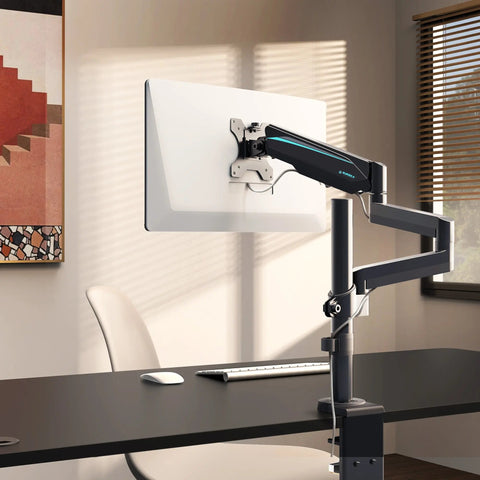
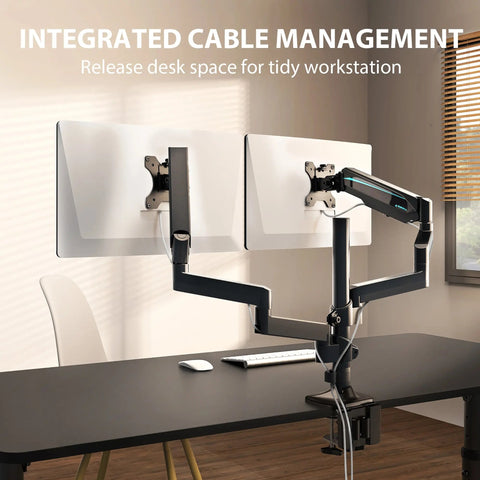
As the data suggests, the common 30-inch desk depth can actually create a viewing distance deficit for ultrawide monitors. To solve this, we recommend using a high-quality dual-monitor arm. By floating the monitors, you regain the physical space needed to position your keyboard and lighting equipment correctly. According to OSHA eTools: Computer Workstations - Monitors, the monitor should be at a height where the top line of text is at or slightly below eye level. A monitor arm allows you to maintain this ergonomic standard while freeing up the desk surface for task lighting and audio interfaces.

Space Transformation: The Two-Point Key Light Strategy
The most significant challenge with an L-shaped desk is the "Turning Shadow." Conventional wisdom suggests a single key light at a 45-degree angle. However, in an L-shaped configuration, you are frequently rotating between your primary monitor and your secondary wing. When you turn toward your secondary screen, a single light source will cast a deep, defining shadow across half of your face, which looks unprofessional on camera and can be visually tiring.
The transformation begins when you move to a two-point lighting system. Instead of one powerful light, we use two lower-intensity sources.
- Primary Key Light: Placed 30 degrees off-center from your main camera angle.
- Secondary Fill Light: Placed on the opposite side, or centered above the corner junction of the L-shape.
This layout ensures that regardless of which "wing" of the desk you are focused on, your face remains evenly illuminated. This isn't just about looking good for your audience; it’s about reducing the contrast ratio in your field of vision, which minimizes pupil dilation fatigue.
Linking Functionality with Emotion: The Science of Color Temperature
Lighting isn't just functional—it is emotional. The color temperature of your workspace sanctuary dictates your circadian rhythm and your focus levels. While many believe "cooler" light (5000K+) is better for focus, the reality is more nuanced.
According to research insights on office lighting, the optimal range for a streaming and focus environment is actually 4000K to 4500K.
- Why not cooler? Light above 5000K (Daylight) increases blue light exposure. While this keeps you alert, it can lead to significant eye strain during 6+ hour sessions and creates a sterile, "hospital-like" atmosphere that kills the creative vibe.
- Why not warmer? Light below 4000K (Warm White) can make you look tired or "yellowed" on camera and may induce a level of relaxation that hinders high-intensity execution modes.
A neutral 4000K-4500K provides a crisp, alert appearance for the camera while maintaining a comfortable, inviting ambiance. This balance is the hallmark of a professional who understands that longevity in the creator economy requires protecting one's visual health. As noted in The 2026 Workstation White Paper: Converging Ergonomic Science and Sustainable Engineering, the integration of human-centric lighting is a cornerstone of the next generation of high-performance workspaces.
The RGB Sanctuary: Ambiance with Purpose
We often think of RGB lighting as "just for show," but when implemented with mindfulness, it becomes a powerful tool for immersion and mood regulation. The key is to treat RGB as bias lighting.
By placing RGB strips or smart wall panels behind your monitors or along the back edge of your L-shaped desk, you create a "glow" that reflects off the wall. This reduces the perceived brightness of your monitors, making the screen appear sharper and reducing the strain on your eyes in a dark room.
The 30-40% Rule
A common heuristic for a professional-looking setup is to keep your RGB ambient brightness at 30-40% of your key light's intensity. If the background is too bright, it washes out the camera’s exposure, making you look like a silhouette. If it's too dim, the "immersion" effect is lost.
The Reflectance Factor
Your wall color acts as a secondary light modifier.
- White Walls: These scatter and dilute color, often leading to "color pollution" where your face turns the color of your lights.
- Dark Walls: These absorb light, meaning you’ll need much higher lumens to see any effect.
- Medium-Gray Walls: This is the "Goldilocks" zone. With approximately 18-30% reflectance, gray walls allow RGB colors to pop without distorting the white balance of your primary camera.

Personal Tips: Conquering the Friction Points
Even the most beautiful lighting plan can be ruined by poor execution. Over years of observing high-end setups, we’ve identified several "gotchas" that separate the amateurs from the experts.
1. The Cable Management Tax
Integrating multiple light sources—key lights, fill lights, RGB strips, and desk lamps—adds a significant "cable tax." Expect to spend an additional 2 to 3 hours just on cable routing. For L-shaped desks, the 90-degree joint is a notorious failure point. We recommend using adhesive-backed cable channels or magnetic cable ties to route wiring along the inner corner. Trying to "bridge" a 90-degree gap with a loose RGB strip usually leads to peeling and uneven light diffusion.
2. Managing the Load
As our experiment data showed, a full-scale creator setup can weigh over 90kg. When you add heavy lighting arms and C-stands to an L-shaped desk, you are putting immense pressure on the frame. If you are using a height-adjustable desk, a dual-motor system is non-negotiable. Single-motor desks often struggle with the asymmetrical weight distribution of an L-shaped setup, leading to jerky movements or motor failure over time.
3. The "Key Light" Glare Hack
If you wear glasses, the 45-degree light placement is even more critical. To eliminate the "white square" reflection in your lenses, raise your key light higher than usual and tilt it downward at a steeper angle. This moves the reflection out of the "glass box" of your lenses and down toward your cheeks.
A Holistic Lifestyle Solution
Transforming your workspace into a sanctuary is a journey of small, intentional tweaks. By layering your light—starting with the ergonomic foundation of task lighting, moving to the professional clarity of key lights, and finishing with the emotional resonance of RGB ambiance—you create a space that supports both your health and your hustle.
Remember that a tidy desk isn't just about aesthetics; it’s about reducing the cognitive load. When your cables are hidden and your lighting is optimized, you remove the micro-distractions that pull you out of "Execution Mode." You aren't just building a desk; you are building a platform for your limitless creativity.
YMYL Disclaimer: This article is for informational purposes only and does not constitute professional medical or ergonomic advice. While ergonomic workstations can reduce the risk of musculoskeletal disorders, individuals with pre-existing conditions or chronic pain should consult a qualified physiotherapist or ergonomic specialist before making significant changes to their setup.
References
- Canadian Centre for Occupational Health and Safety (CCOHS) - Sit/Stand Desk Guide
- OSHA eTools: Computer Workstations - Monitors
- Cornell University Ergonomics Web — Workstation Guides
- World Health Organization (WHO) Guidelines on Physical Activity and Sedentary Behaviour
- The 2026 Workstation White Paper: Converging Ergonomic Science and Sustainable Engineering
- ISO 9241-5:2024 Workstation layout & postural requirements
- BIFMA G1-2013 Ergonomics Guideline for Furniture




Leave a comment