

The Ergonomic Challenge of Compact Workspaces
In the modern remote work landscape, the professional environment has migrated from expansive corporate offices to the varied constraints of residential architecture. For many professionals in North America and Europe, the "home office" is often a repurposed corner of a bedroom or a multi-functional living area. This spatial compression frequently leads to a significant drop in productivity, often manifesting as physical discomfort by mid-afternoon. The question arises: is the desk itself the bottleneck, or is it the failure to align furniture geometry with human physiology?
The L-shaped desk, frequently dismissed as a luxury for executive suites, has emerged as a technical solution for maximizing utility within a restricted footprint. However, its effectiveness is not merely a matter of surface area; it is rooted in how the desk’s geometry supports the "neutral reach zone" and facilitates task separation. By utilizing the often-wasted corner space, these workstations can provide the functional depth required for professional equipment while maintaining the floor clearance necessary for a healthy, breathable room.
Physiological Mechanics: The Impact of Static Loading
To understand why a workspace layout matters, one must examine the physiological consequences of poor ergonomics. According to the Canadian Centre for Occupational Health and Safety (CCOHS), the primary risk factor in office environments is prolonged static loading. This occurs when muscles are held in a constant state of tension to support a posture, such as hunching over a shallow desk or reaching for a mouse that is positioned too far away.
Static loading restricts blood circulation, leading to a buildup of metabolic byproducts like lactic acid, which causes the familiar "burning" sensation in the trapezius and lower back. Furthermore, repetitive strain injuries (RSIs) often stem from deviated wrist angles or repetitive reaching beyond the optimal work zone. The ISO 11226:2000 standard provides specific limits for static working postures, emphasizing that the closer a joint is to its neutral position, the lower the risk of musculoskeletal disorders (MSDs).
An L-shaped configuration addresses these physiological stressors by placing more equipment within the user's primary and secondary reach zones. The "Primary Zone" is the area reachable with the forearms when elbows are at a 90-degree angle, while the "Secondary Zone" is reachable by extending the arms without leaning the torso. By wrapping the work surface around the user, the L-shape reduces the need for trunk rotation and excessive reaching, thereby maintaining the spine in a more neutral position.
The L-Shaped Desk as a Productivity Engine
Productivity in a tight space is often a battle against cognitive load. When a single rectangular surface is cluttered with a laptop, secondary monitor, reference documents, and personal items, the brain must constantly filter out visual noise. This "clutter tax" reduces focus and increases the time required to switch between different types of tasks.
The L-shaped desk facilitates a "Dual-Zone Workflow." Experts in space planning recommend assigning the primary leg of the desk to deep-work activities—such as coding, writing, or data analysis—where the main monitor and keyboard are centered. The secondary leg (the "short leg") is reserved for administrative tasks, reference materials, or a secondary device. This physical separation creates a mental "context switch." Physically turning the chair 90 degrees to address a different task helps reinforce focus and reduces the mental friction associated with multitasking on a single cramped surface.

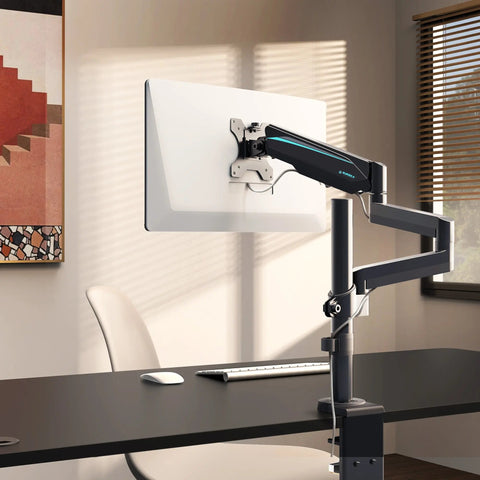
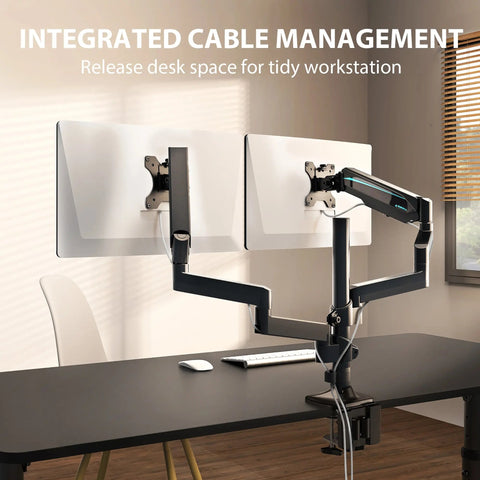
Furthermore, the integration of specialized accessories can significantly enhance this efficiency. For instance, using a monitor arm is considered a non-negotiable strategy for small spaces. According to the OSHA eTools for Computer Workstations, proper monitor placement—where the top line of text is at or slightly below eye level—is crucial for preventing neck strain. A monitor arm reclaims the desktop real estate traditionally occupied by a bulky stand, allowing the area underneath to be used for storage or active task materials.
The "Petite User" Simulation: Solving the Ergonomic Gap
A common oversight in ergonomic planning is the "one size fits all" approach. Standard fixed-height desks are typically manufactured at 29 inches (73.7 cm), a height that accommodates the 95th percentile of the male population but often fails the 5th percentile of the female population. To demonstrate the impact of desk geometry on varied body types, we simulated an L-shaped setup for a petite remote worker (155 cm / 5'1") in a compact 10x10 ft room.
Table 1: Ergonomic Requirements vs. Standard Furniture (Petite Persona)
| Metric | Petite User (155 cm) | Standard Desk (Fixed) | Ergonomic Gap |
|---|---|---|---|
| Ideal Seat Height | 41.25 cm (16.2") | N/A | Variable |
| Ideal Seated Desk Height | 64.5 cm (25.4") | 73.7 cm (29.0") | +9.2 cm (3.6") |
| Ideal Standing Height | 93.95 cm (37.0") | N/A | N/A |
| Reach Zone (Primary) | ~35-40 cm | Fixed | Restricted |
Values estimated based on ANSI/HFES 100-2007 anthropometric ratios.
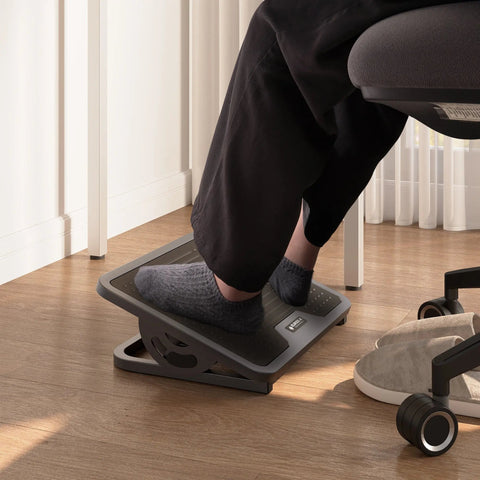
The data reveals a 3.6-inch "ergonomic gap." For a petite user, a standard desk forces a choice: sit at the correct height for the floor and reach up (causing shoulder strain), or raise the chair to align with the desk and leave feet dangling (restricting circulation in the thighs). An adjustable L-shaped desk eliminates this gap. By lowering the surface to the 25.4-inch requirement, the user can achieve a neutral elbow angle and maintain full foot contact with the floor—or a dedicated ergonomic footrest—thereby adhering to the Safe Work Australia workstation setup guidelines.
Spatial Logistics: Maximizing the 10x10' Footprint
The primary concern with L-shaped desks in tight spaces is the "dominance" factor—the fear that the furniture will overwhelm the room. However, when positioned correctly, an L-shaped desk actually improves "circulation zones" compared to a large rectangular desk placed in the center of a wall.
Table 2: Clearance and Circulation Analysis (10x10' Room)
| Component | Required Depth | Practical Application |
|---|---|---|
| Desk Surface Depth | 24" | Minimum depth to avoid diagonal sitting at the corner. |
| Dynamic Zone | 40" | Space required for chair movement and user entry/exit. |
| Circulation Zone | 30" | Minimum walkway width required for room safety. |
| Total Footprint Depth | 94" | Leaves 26" of surplus in a 120" (10') wide room. |
Analysis based on standard space planning rules for home offices.
A critical "gotcha" in L-shaped desk selection is the corner junction depth. If the desk is shallower than 25 inches, the user is often forced to sit diagonally to fit their legs, which can lead to poor spinal alignment. To optimize a small room, the "long leg" of the L should be placed against the longest wall, while the "short leg" acts as a natural room divider or occupies a corner. This layout preserves the central floor space, making the room feel larger while providing a more expansive work area.

Industry Standards and Safety Benchmarks
When investing in a workstation intended for professional use, adherence to industry standards is a primary indicator of durability and safety. The BIFMA G1-2013 Ergonomics Guideline provides the industry benchmark for furniture dimensions that accommodate the 5th to 95th percentile of the population.
For height-adjustable L-shaped desks, safety certifications are even more critical. The UL 962 standard covers the mechanical and electrical safety of these units, ensuring that the lifting mechanisms are robust and the electrical components are fire-resistant. Additionally, users should look for compliance with ISO 9241-5:2024, which specifies the latest postural requirements for workstations using display screen equipment (DSE).
Load Capacity and Motor Selection
Our research indicates that a typical professional "battlestation"—including dual 27-inch monitors, a mid-tower PC, and peripherals—totals approximately 50kg (110 lbs). While many assume dual motors are a necessity for L-shaped desks, a high-quality single-motor system often has a capacity of 80kg (176 lbs). Operating at 62.5% of its maximum capacity ensures motor longevity and smooth transitions, following the engineering best practice of staying below the 80% utilization threshold.
The Strategic Advantage of Corner Optimization
The transition to an L-shaped desk in a small space is not just an aesthetic choice; it is a strategic engineering control for the home office. By aligning the workstation with the principles of the 2026 Workstation White Paper, professionals can create an environment that supports both physiological health and cognitive focus.
Key Implementation Checklist:
- Prioritize Adjustability: Ensure the desk can reach the specific seated height required for your stature (e.g., 25.4" for a 5'1" user).
- Verify Clearance: Maintain at least 30 inches of circulation space around the desk to prevent the room from feeling claustrophobic.
- Manage the Corner: Ensure the desk depth is sufficient (at least 24-25") to allow for proper knee and leg clearance without forcing a diagonal posture.
- Utilize Verticality: Use desk-mounted organization systems or monitor arms to reclaim the primary work surface.
- Adopt the 20-8-2 Rhythm: According to Cornell University Ergonomics, for every 30 minutes, you should sit for 20, stand for 8, and move for 2.
Ultimately, an L-shaped desk is an excellent tool for productivity in tight spaces, provided it is selected and configured with a deep understanding of ergonomic standards and spatial logistics. By bridging the gap between available space and human needs, these workstations transform a cramped corner into a high-performance professional hub.
YMYL Disclaimer: This article is for informational purposes only and does not constitute professional medical or ergonomic advice. The recommendations provided are based on general industry standards and simulated data. Individuals with pre-existing musculoskeletal conditions, chronic back pain, or other health concerns should consult with a qualified physician or a certified professional ergonomist before making significant changes to their workstation setup or work habits.
References
- BIFMA G1-2013 Ergonomics Guideline for Furniture
- CCOHS: Office Ergonomics - Sit/Stand Desk
- ISO 9241-5:2024 Workstation layout & postural requirements
- Cornell University Ergonomics Web — Workstation Guides
- OSHA eTools: Computer Workstations - Monitors
- ISO 11226:2000 Evaluation of static working postures
- The 2026 Workstation White Paper: Converging Ergonomic Science and Sustainable Engineering




Leave a comment