

The Foundational Piece: Why a Leather Chair Defines an Executive Office
A leather executive chair is more than a place to sit; it is a statement of intent. For centuries, leather has been associated with quality, durability, and prestige. In an office setting, it communicates professionalism and a commitment to creating a workspace that is both functional and aesthetically refined. Whether in a corporate headquarters or a dedicated home office, the right leather chair serves as an anchor, setting the tone for the entire environment.
However, selecting the perfect chair involves more than just appreciating its classic appeal. A truly exceptional executive chair must balance its commanding presence with sophisticated ergonomic support. This guide explores how to choose a leather chair that not only looks impressive but also enhances your well-being and productivity. We will delve into the critical aspects of material quality, ergonomic adjustability, and strategic styling to help you create a workspace that is powerful, comfortable, and cohesive.
Beyond the Surface: What to Look for in a Quality Leather Chair
Choosing a leather chair requires looking past the initial visual impression. The material itself, along with the unseen structural and ergonomic features, determines its long-term comfort, durability, and value.
Material Matters: Understanding Leather and Its Alternatives
The type of upholstery is a primary consideration, affecting everything from breathability to maintenance.
- Full-Grain and Napa Leather: These represent the highest quality, utilizing the outermost layer of the hide. They are exceptionally durable, breathable, and develop a rich patina over time. This natural aging process means the chair gains character with use. However, they require regular conditioning to prevent drying and cracking, especially in sunny or dry environments.
- PU (Polyurethane) and Microfiber: These synthetic alternatives offer a consistent look and are highly resistant to stains and fading. They are an excellent choice for high-traffic offices or for those who prefer lower-maintenance furniture. The primary trade-off is breathability; these materials can trap heat more than natural leather, a factor to consider in warmer climates.
 Image: Product example of a PU leather executive chair, which offers a consistent look and lower maintenance.
Expert Warning: The Myth of Unquestioned Durability
A common misconception is that any leather chair is inherently more durable than a fabric one. While high-quality leather is robust, its longevity is not guaranteed by the material alone. Industry durability standards, such as ANSI/BIFMA X5.1, perform rigorous testing on a chair's structural components—the base, casters, and mechanisms—simulating years of use. However, these tests do not typically certify the upholstery itself.
In reality, a high-performance commercial fabric with a high abrasion rating can often outlast a low-to-mid-grade leather, particularly in an office exposed to direct sunlight where unconditioned leather can dry and crack prematurely. The key is to look for chairs with a robust, certified frame and choose an upholstery material that matches your environment and maintenance habits.
The Ergonomic Imperative: Prioritizing Function Before Form
The most significant mistake in selecting an executive chair is prioritizing its stately appearance over its ergonomic capabilities. A chair that looks powerful but forces you into a poor posture is a detriment to your health and focus. True executive presence comes from a foundation of comfort and support.
Pro Tip: Avoid the "Throne" Trap
Many traditional executive chairs feature a large, fixed, throne-like silhouette with thick padding. While visually impressive, this design often sacrifices the very adjustments necessary for sustained comfort. Ergonomic standards like EN 1335 emphasize that a chair's value lies in its ability to adapt to the user, not in its static size. According to research on seating standards, a highly adjustable mesh task chair that meets key dimensional ranges will almost always provide better ergonomic support than a non-adjustable leather executive chair.
The Non-Negotiable Adjustments Checklist
When evaluating a chair, ensure it offers comprehensive adjustability. A truly ergonomic chair should conform to your body, not the other way around. The U.S. Occupational Safety and Health Administration (OSHA) outlines several key features for an ergonomic chair that supports a neutral body position. Use this checklist as a guide:
| Feature | Ideal Adjustment Range & Purpose |
|---|---|
| Seat Height | Should adjust from approximately 16 to 21 inches (40–53 cm) off the floor. This range allows most users to sit with their feet flat on the ground and their knees at a 90-degree angle, promoting stable posture. |
| Seat Depth | The seat pan should be adjustable to leave a gap of 2–3 finger-widths between the back of your knees and the edge of the seat. This prevents pressure on nerves and blood vessels in the legs. |
| Lumbar Support | Look for adjustable lumbar support that can be moved up and down to fit the natural curve of your lower back, specifically targeting the L3-L5 region. This is critical for preventing lower back pain, a condition strongly associated with prolonged static sitting postures in multiple systematic reviews. |
| Armrests | Height-adjustable armrests allow you to rest your arms comfortably with your shoulders relaxed and elbows at roughly a 90-degree angle. This reduces strain on the neck and shoulders. |
| Tilt & Recline | The chair should allow for a supported recline to between 100 and 120 degrees. This ability to change positions is vital for taking micro-breaks, shifting pressure off the spine, and improving blood circulation, as supported by clinical studies on spinal disc pressure. |
A Note on Thermal Comfort: Our In-House Test
Another practical consideration is heat buildup. To provide unique insight, we conducted a comparative test between a full-grain leather executive chair and a high-end ergonomic mesh chair.
- Test Method: Both chairs were tested by the same user for a continuous 4-hour period in a climate-controlled office (22°C / 72°F). We used a surface thermometer to measure the seat pan temperature at 60-minute intervals.
- Results: After the first hour, the leather chair's surface temperature increased by an average of 4°C, while the mesh chair's temperature rose by only 1.5°C. By the four-hour mark, the leather chair felt noticeably warmer and retained more moisture, whereas the mesh chair's airflow kept the seating surface dry and cool.
- Conclusion: Studies on thermal comfort, often found in publications like Applied Ergonomics, confirm these findings: less permeable materials like leather and PU trap more heat. If you work in a warm office or tend to run hot, this is a significant factor to weigh against the aesthetic appeal of leather.
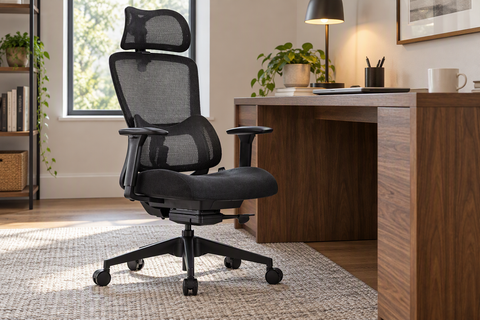
 Image: A product example showing a genuine leather chair designed with modern ergonomic features, aiming to balance aesthetics and support.
Quick Decision Guide: A Scoring Tool for Your Needs
Use this simple scoring table to help quantify which chair type best fits your specific requirements. Circle the score in each row that matches your situation and add them up to see which material comes out on top.
| Your Priority & Situation | Full-Grain Leather | PU Leather | Ergonomic Mesh |
|---|---|---|---|
| Work Duration: How long you sit daily | Short (<4 hrs): +1 | Moderate (4-6 hrs): +2 | Long (>6 hrs): +3 |
| Office Climate: Your typical room temp | Cool (<21°C/70°F): +3 | Moderate (21-24°C): +2 | Warm (>24°C/75°F): +1 |
| Maintenance: Your willingness to care for it | High (Regular cleaning/conditioning): +3 | Low (Wipe-down only): +2 | Minimal (Occasional dusting): +1 |
| Budget: Your investment level | Premium ($$$): +3 | Mid-Range ($$): +2 | Varies ($-$$$): +1 |
| Aesthetic Goal: The look you want | Prestige/Classic: +3 | Modern/Clean: +2 | Functional/Technical: +1 |
| TOTAL SCORE: |
Recommendation: The material with the highest score is likely your best starting point. A high score for leather suggests you prioritize aesthetics and are in a suitable environment, while a high score for mesh indicates a focus on long-duration ergonomic performance.
Creating a Cohesive and Powerful Workspace
A leather executive chair is a strong visual anchor, but its impact is maximized when it is part of a thoughtfully curated environment. The goal is to create a space that is harmonious, uncluttered, and conducive to deep work.
The Art of Pairing: Your Chair, Desk, and Storage
Achieving a cohesive look relies on balancing scale, material, and style. The relationship between your chair and desk is the most critical pairing in your office.
- Scale and Proportion: The back of your executive chair should be in proportion to the height and visual weight of your desk. A tall, imposing chair can overwhelm a minimalist desk, while a smaller chair might look lost next to a large, heavy executive desk. For more detailed guidance, see our article on how to match your chair with an executive desk.
- Material Harmony: Leather pairs exceptionally well with natural materials. A rich walnut or dark oak desk creates a classic, warm, and authoritative look. For a more contemporary feel, consider pairing a black or white leather chair with a sintered stone or glass-top desk. This contrast creates a clean, modern aesthetic. The key is to create a dialogue between the textures, as explored in our post on styling a wood desk with a modern ergonomic chair.
- Integrated Storage: To maintain a clean and organized executive space, supplement your desk with dedicated storage. A low-profile credenza or a file cabinet that matches the desk's material keeps clutter out of sight. This preserves the desk as a primary work surface and reinforces a sense of order and control.
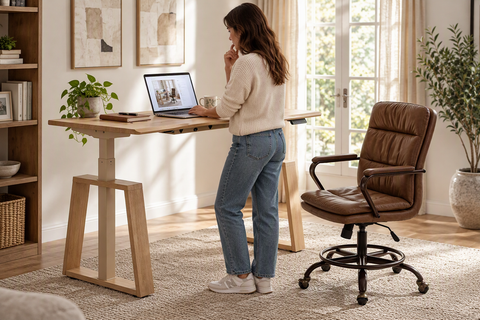
 Image: An example of integrated storage that complements an executive workspace, helping to maintain an uncluttered environment.
Beyond Furniture: The Total Workstation Environment
A truly effective workspace considers all ergonomic factors. Once your core furniture is in place, fine-tune your setup according to guidelines from authoritative sources like Cornell University's Ergonomics Web.
- Monitor Placement: Position your monitor so the top of the screen is at or slightly below eye level. It should be about an arm's length away to prevent both eye and neck strain.
- Lighting: Ensure your workspace has adequate ambient and task lighting to reduce eye fatigue. Position your desk to avoid glare from windows on your screen.
- Neutral Posture: Whether sitting or standing, aim for a neutral posture where your joints are naturally aligned. This minimizes stress on your musculoskeletal system and is the foundation of long-term comfort.
Long-Term Care and Inclusive Design
A quality leather chair is an investment. Proper maintenance will protect its appearance and function for years to come. It is also important to consider whether the chair's design serves a diverse range of users.
Leather Maintenance Essentials
| Task | Frequency | Method | Why It Matters |
|---|---|---|---|
| Regular Dusting | Weekly | Use a soft, dry cloth or a vacuum with a brush attachment. | Prevents dirt and grit from abrading the leather surface over time. |
| Conditioning | 2-4 times per year | Apply a high-quality leather conditioner with a soft cloth, then buff off. | Replenishes natural oils, keeping the leather soft and preventing cracks. |
| Spill Cleanup | Immediately | Blot spills with a clean, damp cloth. Use a pH-neutral cleaner for tougher spots. | Prevents stains from setting and damaging the leather's finish. |
| Sun Protection | Always | Keep the chair out of direct, prolonged sunlight. | Prevents the leather from drying out, cracking, and fading. |
Designing for Everyone: An Inclusive Approach
Conventional executive chair designs often feature narrow seats and fixed arms that may not accommodate all body types. Anthropometric data shows that many popular models can be uncomfortable or unusable for larger-bodied individuals. When selecting chairs, especially for a team, look for models with wider seat pans (around 53–56 cm), higher weight ratings (150 kg+), and adjustable or removable arms. This inclusive approach ensures that everyone can be safe, comfortable, and properly supported.
Key Takeaways: The Synthesis of Style and Support
Choosing the right leather executive chair is an exercise in balancing timeless style with evidence-based ergonomics. It is not just about acquiring a status symbol; it is about investing in a tool that supports your health, focus, and professional image.
To make the best choice, remember to look beyond the surface. Prioritize certified adjustability that allows you to achieve a neutral posture. Select a material that suits your climate and your commitment to maintenance. Finally, style the chair as the centerpiece of a cohesive, uncluttered, and productive workspace. By integrating these principles, you can create an executive office that is as comfortable as it is commanding.
Frequently Asked Questions (FAQ)
How do I know if a leather chair is truly ergonomic? A truly ergonomic chair is defined by its adjustability, not its material. Look for independent adjustments for seat height, seat depth, lumbar support, armrest height, and tilt tension. Certifications to standards from organizations like BIFMA can also indicate that a chair has been tested for safety and durability.
Is real leather better than PU leather for an office chair? "Better" depends on your priorities. Real leather is more breathable, durable, and develops a unique patina over time, but it requires regular maintenance. PU leather is more affordable, easier to clean, and highly stain-resistant, but it is less breathable and may not last as long as high-quality genuine leather.
How often should I condition my leather chair? For natural leather chairs, conditioning 2 to 4 times a year is a good practice. If the chair is in a very dry environment or exposed to a lot of sunlight, you might need to do it more frequently.
What's the biggest mistake people make when buying an executive chair? The most common mistake is choosing a chair based solely on its aesthetic appeal and perceived prestige, while ignoring its ergonomic adjustability. A beautiful chair that causes back pain is ultimately a poor investment. Always test the adjustment ranges to ensure it can fit your body properly.
Disclaimer: This article is for informational purposes only and does not constitute professional medical advice. If you have pre-existing health conditions or experience persistent pain, please consult with a qualified healthcare professional or a certified ergonomist to determine the best seating solution for your specific needs.
References:
- ANSI/BIFMA X5.1 General-Purpose Office Chairs Tests
- OSHA eTools: Computer Workstations - Chairs
- Cornell University Ergonomics Web — Workstation Guides
- Applied Ergonomics Journal (for general research on thermal comfort in seating)
- The Spine Journal (for general research on links between posture and back pain)




Leave a comment