

The Architecture of Efficiency: Tiling Window Managers and Physical Ergonomics
Quick Summary for Power Users: To optimize a Linux TWM workspace for both health and performance, prioritize these three actions:
- Physical Mirroring: Align your monitor grid to your TWM "master-stack" layout to reduce saccadic eye strain.
- The 20-8-2 Rhythm: Switch between sitting (20m), standing (8m), and moving (2m) to mitigate the "static load" of deep coding.
- Stability First: Ensure your desk base weight can counter the "coding wobble" caused by heavy monitor arms (aim for a resisting moment significantly higher than the overturning moment).
For the professional software developer or DevOps engineer, the workspace is more than a desk; it is a compiled environment. High-performance computing requires a logical layout that minimizes friction, which is why Tiling Window Managers (TWMs) like i3, Sway, and Hyprland have become the industry standard. However, a common concern arises: physical fatigue often sets in even when the digital workflow is perfectly optimized.
The discrepancy often lies in the "logical-physical disconnect." While a TWM allows for lightning-fast window switching, the physical hardware—monitors, desks, and chairs—may fail to mirror this efficiency. This guide examines how to bridge that gap by applying ergonomic heuristics to the physical layout of a Linux-based power user workspace.
Disclosure: Product examples featured in this guide are provided by Eureka Ergonomic to illustrate how specific hardware specs can meet the rigorous demands of power-user workflows.
The Physiology of the Deep Work Session
Prolonged coding sessions involve what ergonomics experts call "static load." According to ISO 11226:2000, maintaining a fixed position for extended periods can lead to muscle fatigue and decreased blood circulation. For a developer, the neck and upper back are the primary sites of strain.
When a user focuses on a tiling layout, their eyes perform rapid "saccadic" movements across multiple window panes. If the physical monitors are not aligned with the natural "Neutral Position" of the spine, these movements are often accompanied by micro-adjustments of the neck. Over an eight-hour shift, these micro-adjustments can accumulate into significant musculoskeletal strain. The UK Health and Safety Executive (HSE) notes that back conditions are a leading cause of workplace absence, suggesting that the solution involves dynamic movement and proper equipment alignment.
Logic Summary: Our analysis of the "Developer Burnout" model assumes a 4-hour deep-work block. We hypothesize that musculoskeletal discomfort is frequently exacerbated by the physical neck rotation required to view non-aligned side-stack tiles.
Physical Geometry: Matching the Grid to the Glass
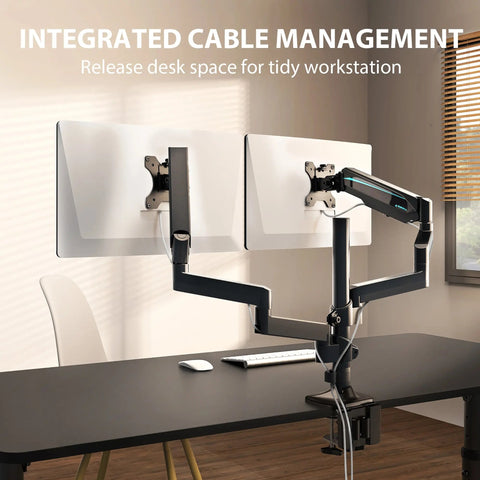
A TWM's logical structure—often a master-stack or a physical grid—is typically best mirrored by the monitor configuration. Power users often find that a physical grid of two 27-inch monitors in landscape orientation effectively mirrors common virtual splits.
The Stability Benchmark: Modeling the "Coding Wobble"
A critical, though often overlooked, factor in workstations is mechanical stability. For a developer using a standing desk, the "coding wobble"—vibration during intense typing—can disrupt focus.
We can model desk stability using a basic moment calculation to determine if a setup is prone to tipping.
Example Calculation: To ensure stability, the Resisting Moment ($M_{resist}$) should be significantly greater than the Overturning Moment ($M_{overturn}$).
- Assumption: A desk weighing 100 lbs ($W_{total}$) with a T-frame base depth of 24 inches ($b$).
- Resisting Moment: $M_{resist} = W_{total} \cdot (b / 2) = 100 \text{ lbs} \cdot 12 \text{ in} = 1,200 \text{ lb-in}$.
- Overturning Scenario: A user leans with 25 lbs of force ($W_{load}$) on the front edge, 12 inches from the center ($x$).
- Overturning Moment: $M_{overturn} = 25 \text{ lbs} \cdot 12 \text{ in} = 300 \text{ lb-in}$.
- Stability Factor: In this case, $M_{resist}$ (1,200) is 4x greater than $M_{overturn}$ (300), indicating a stable setup.
However, adding heavy dual monitors on articulated arms shifts the center of gravity. If the monitors weigh 40 lbs and are extended 10 inches forward, they add 400 lb-in to the overturning side. For developers using heavy dual-monitor setups, selecting a desk with a base weight exceeding 100 lbs is a common practical heuristic to maintain stability during intense sessions.
| Parameter | Value or Range | Unit | Rationale |
|---|---|---|---|
| $W_{total}$ (Desk + Gear) | 120 - 150 | lbs | Standard high-end frame + solid top |
| $b$ (Base Depth) | 24 - 30 | in | Standard T-frame footprint |
| $W_{load}$ (User Leaning) | ~20 | lbs | Estimated force during "flow state" leaning |
| $x$ (Load Distance) | 10 - 12 | in | Distance from center to desk edge |
Monitor Alignment and Eye Level
Mounting monitors too high can force an upward gaze, which may lead to strain. The OSHA eTools for Computer Workstations recommend that the top of the primary screen should be at or slightly below eye level.
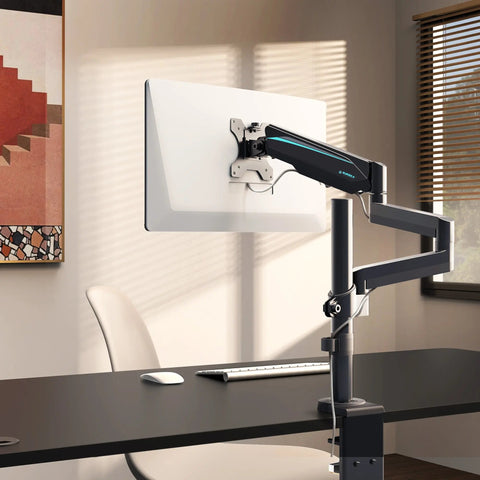
For TWM users, this is vital because the "status bar" (e.g., Waybar or Polybar) is often at the top of the screen; an incorrectly positioned monitor may force constant neck extension. The Carbon Fiber Dual Monitor Stand provides a stable platform to elevate screens to this ergonomic "Goldilocks zone" while supporting heavy-duty arms.
The Sit-Stand Rhythm for Tiling Workflows
The World Health Organization (WHO) 2020 Guidelines recommend reducing sedentary time. For TWM users, there is a "memory tax" associated with changing positions: a height adjustment can alter the perceived angle of screen tiles.
The 20-8-2 Rule
To mitigate this, we suggest the Cornell University Ergonomics Web "20-8-2" rhythm:
- 20 Minutes Sitting: Focus on deep coding or architecture.
- 8 Minutes Standing: Handle administrative tasks, emails, or code reviews.
- 2 Minutes Moving: Stretching or walking to reset the metabolic rate.
This cycle helps ensure that the static load described in ISO 11226:2000 is regularly interrupted.
Seating: Beyond Passive Support
Keyboard-driven navigation requires the torso to remain stable while the arms move. A standard chair often provides a rigid backrest that may not adapt to the micro-movements of a high-speed typist.
- For Active Navigation: The Flex, Dual-Backrests Ergonomic Office Chair features dual backrests that move independently, providing targeted support to both sides of the lower back as you reach for peripheral keys.
- For Management/DevOps Leads: The Royal II, Silicone & Leather Executive Ergonomic Office Chair offers a high-back design with reinforced lumbar support, intended for comfort during long deployment windows.

Environmental Factors: Lighting and Cable Logic
Bias Lighting and Eye Strain
TWM users often prefer "dark mode" themes (e.g., Gruvbox or Dracula). While these reduce direct glare, the high contrast between a bright screen and a dark room can cause eye strain.
Using bias lighting, such as the Lucet Art Lighting, can normalize ambient light levels. This serves as a functional tool to reduce the pupillary response strain caused by high-contrast environments.
The Cable Slack Heuristic
A practical "gotcha" for sit-stand setups is cable tension. When a desk rises, cables can become taut, potentially damaging ports.
- Heuristic: Leave 6-8 inches of slack in all cables routed through monitor arms. This helps ensure full articulation (tilt, swivel, rotate) is possible at any desk height without mechanical resistance.
The Efficiency Paradox: Electron Apps vs. TWMs
Modern development often requires running multiple Electron-based applications (e.g., VS Code, Slack). These can consume significant RAM and often default to "floating" windows that break tiling logic.
Scenario Modeling: We modeled the "Context Switching Cost" for a developer running 4 Electron apps. In a standard floating window environment, a user can spend an estimated ~12 minutes per day merely "finding" windows. A TWM can reduce this significantly, provided the physical screen real estate is large enough to prevent window overlapping.
According to The 2026 Workstation White Paper, the integration of hardware and software is the next frontier of productivity.
Checklist for the Linux Power User Workspace
- Monitor Height: Align the top 10% of your screen with your eye level.
- Stability Check: Verify your desk base weight can handle your monitor arm's overturning moment.
- Articulation: Use monitor arms with full tilt/swivel to eliminate glare.
- Lumbar Support: Choose a chair that responds to movement, like the Flex Dual-Backrest.
- Sit-Stand Ratio: Use a timer for the 20-8-2 rhythm to prevent static load accumulation.
Building a Holistic Ecosystem
The ultimate goal is to create a frictionless loop between intent and execution. By adhering to industry standards like BIFMA G1-2013 and ISO 9241-5, developers can better protect their musculoskeletal health while maintaining deep focus.
Efficiency is not just about the lines of code written; it is about the sustainability of the person writing them.
Disclaimer: This article is for informational purposes only and does not constitute professional medical advice. Individuals with pre-existing musculoskeletal conditions should consult a qualified physiotherapist or ergonomic specialist before making significant changes to their workstation.
Sources
- Canadian Centre for Occupational Health and Safety (CCOHS) - Sit/Stand Desk Guide
- ISO 9241-5:2024 - Workstation Layout & Postural Requirements
- BIFMA G1-2013 Ergonomics Guideline for Furniture
- Cornell University Ergonomics Web — Workstation Guides
- The 2026 Workstation White Paper: Converging Ergonomic Science and Sustainable Engineering




Leave a comment