

The Persistence of Lower Back Fatigue: Why Ergonomic Features Often Fail
Many professionals invest in high-end executive seating only to find that their afternoon fatigue remains unchanged. The common health concern is not a lack of support, but a lack of precision. While most ergonomic chairs include a lumbar support component, users frequently report that it feels intrusive, misplaced, or simply ineffective. This discomfort often stems from a fundamental misunderstanding of the "Lumbar Apex"—the specific point where the spine’s inward curve is most pronounced.
When lumbar support is misaligned, it creates a cascade of musculoskeletal issues. If set too high, the support presses into the thoracic region, encouraging a rounded-shoulder posture and upper back strain. If set too low, it fails to stabilize the pelvis, leading to "slumping" and increased intradiscal pressure. Understanding the physiological principles of spinal neutral position is the first step toward transforming a premium chair from a luxury item into a therapeutic tool.
The Physiological Principles of Spinal Neutrality
The human spine is not a straight pillar; it is a series of interconnected curves designed to distribute weight and absorb shock. The lumbar region (the lower back) naturally curves inward—a shape known as lordosis. Maintaining this curve while seated is critical for preventing Musculoskeletal Disorders (MSDs).
Static Load and Blood Circulation
In a seated position, the body is subject to "static load." Unlike walking, where muscles contract and relax to pump blood, sitting requires muscles in the back and neck to remain in a state of constant, low-level contraction to maintain posture. According to the Canadian Centre for Occupational Health and Safety (CCOHS), prolonged static postures can restrict blood circulation and lead to muscle fatigue.
The Functional Apex: L3 vs. L4
Conventional wisdom often suggests that the lumbar apex is a fixed point for everyone. However, recent biomechanical research challenges this "one-size-fits-all" approach. A 2022 study published in Frontiers in Surgery found that the anatomical apex varies significantly based on individual pelvic anatomy. In approximately 56.6% of cases, the apex is located at the L4 vertebra, while in 40.2% of cases, it resides at L3. This variation is strongly predicted by "Pelvic Incidence"—the angle of the pelvis relative to the spine. For professionals, this means that a support height that works for a colleague may be fundamentally incorrect for them.
Logic Summary: Our analysis of spinal positioning acknowledges that the 'global lordosis apex' remains relatively stable, but its vertical location relative to a chair’s backrest depends on the user's unique torso length and pelvic tilt. This necessitates a highly adjustable support system rather than a static one.
Scenario Modeling: The Height Extremes Challenge
To demonstrate why standard furniture often fails to provide adequate lumbar relief, we modeled the ergonomic requirements for two distinct professional personas at opposite ends of the height spectrum. This scenario modeling illustrates the "Ergonomic Gap" created by fixed-height or limited-range furniture.
Analysis of Tall vs. Petite Professionals
Under these modeling assumptions, we compared a Tall Professional (195cm/6'5" male, 95th percentile) and a Petite Professional (155cm/5'1" female, 5th percentile).
| Parameter | Tall Professional (195cm) | Petite Professional (155cm) | Unit | Rationale |
|---|---|---|---|---|
| Rec. Seat Height | ~51 | ~41 | cm | Based on ANSI/HFES 100-2007 popliteal ratios |
| Lumbar Apex Height | ~68.5 | ~54.9 | cm | Calculated from floor to L3/L4 transition |
| Vertical Difference | 13.6 | 13.6 | cm | The total variance in support needs |
| Standard Desk Gap | -6.8 (Too Low) | +9.2 (Too High) | cm | Variance from standard 29" (73.7cm) desk |
| Support Travel Req. | >15 | >15 | cm | Minimum vertical adjustment range needed |
Method & Assumptions: This model uses the Ergo-Precision Anthropometric Calculator logic, applying ANSI/HFES 100-2007 ratios to determine seat height, then scaling the lumbar apex based on torso-to-stature proportions (~0.25–0.29 ratio). It assumes a neutral 90° sitting posture with feet flat.
The Tall Professional’s Friction Point
For a user at 195cm, a standard chair's lumbar support often sits 5–10cm too low. This forces the user to lean forward to find support, or worse, allows the lower back to flatten against the backrest. This "slumping" increases disc pressure by an estimated 30% compared to a standing position.
The Petite Professional’s Friction Point
Conversely, a user at 155cm often finds that the lumbar support is too high, pressing into the middle of their back (the thoracic region). Furthermore, if the seat depth is not adjustable, they may experience sciatic nerve compression as the edge of the seat presses against the back of their knees (the popliteal fold).
Solving the Alignment Crisis: Engineering Meets Anatomy
The solution to persistent back pain lies in furniture that mimics the body’s natural adaptability. Premium ergonomic executive chairs address these issues through three core engineering pillars:
- Independent Vertical Lumbar Adjustment: Rather than moving the entire backrest, the lumbar component should move independently to target the L3–L4 transition precisely.
- Dynamic Pressure Response: Modern designs often utilize "self-adapting" mechanisms. These systems use flexible materials or spring-loaded frames that adjust the depth of support as the user changes their recline angle.
- Adjustable Seat Depth: This is a non-obvious but critical feature. By moving the seat pan forward or backward, a user can ensure their back is fully flushed against the lumbar support without the seat edge cutting into their thighs.
According to the ISO 9241-5:2024 standard, workstation layout must support a variety of postures. A chair that only supports a 90-degree upright position is insufficient for a full workday. As detailed in the 2026 Workstation White Paper: Converging Ergonomic Science and Sustainable Engineering, the integration of advanced materials like aluminum alloy frames and high-density resins allows for supports that are both firm and responsive.
Practical Recommendations: Calibrating Your Executive Chair
To achieve a personalized fit, professionals should follow a systematic calibration process. Do not rely on "how it feels" initially, as the body often adapts to poor posture over time, making a "wrong" position feel "normal."
Step 1: The Belt Line Heuristic
A highly effective rule of thumb is to align the apex (the thickest part) of the lumbar support with your belt line or just above the top of your pelvis. This typically corresponds to the L4 vertebral level.
Step 2: The Two-Finger Rule
After adjusting the height, perform a self-check. While sitting upright, you should be able to slide two fingers snugly between the lumbar support and your lower back. If there is a large gap, the support depth is insufficient. If the support is pressing firmly enough to displace your torso forward, the depth is too aggressive and may cause muscle guarding.
Step 3: The Recline Adjustment
The effectiveness of lumbar support changes as you recline. According to ISO 11226:2000, static working postures should be evaluated based on duration and angle. If you frequently work at a 110-degree recline, you may need to slightly increase the lumbar depth to maintain contact with the spine as it shifts away from the backrest.
Step 4: Monitor and Desk Integration
Lumbar support is only one piece of the puzzle. If your monitor is too low, you will naturally crane your neck forward (the "turtle" posture), which rounds the upper back and negates the benefits of lower back support.
- Monitor Height: The top third of the screen should be at eye level.
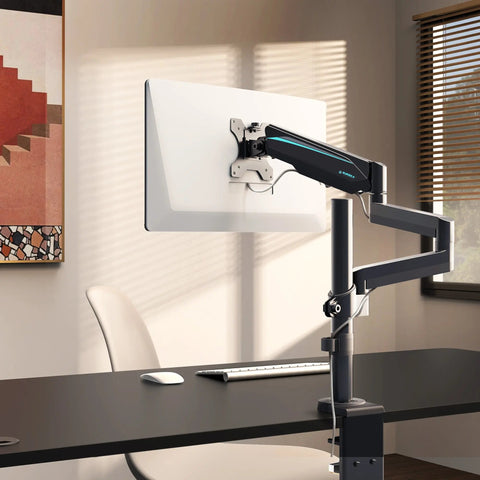
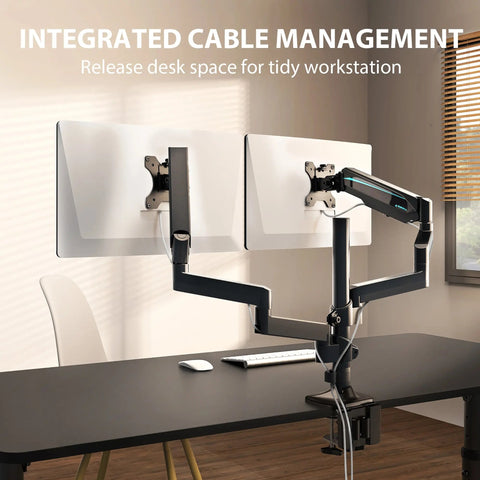
- Desk Height: Your elbows should be at a 90-degree angle, with wrists in a neutral, flat position. Using tools like a Dual Monitor Arm can provide the necessary range to keep your head balanced over your spine.
The Ideal Workday Rhythm: The 20-8-2 Rule
Even the most perfectly calibrated chair cannot overcome the biological necessity for movement. The World Health Organization (WHO) 2020 Guidelines emphasize reducing sedentary time to lower cardiovascular risk.
Cornell University’s Ergonomics Web recommends the 20-8-2 Rhythm:
- 20 Minutes Sitting: In a neutral, supported posture.
- 8 Minutes Standing: Using a height-adjustable executive desk to transition to a standing neutral position.
- 2 Minutes Moving: Stretching or walking to stimulate blood circulation and metabolic activity.
A systematic review by Cochrane (2018) concluded that sit-stand desks can reduce sitting time by up to 116 minutes per day. When combined with a chair that features a precisely adjusted lumbar apex, this rhythm significantly reduces the cumulative strain on the musculoskeletal system.
Strategic Implementation for Professionals
For executives and professionals, ergonomic furniture is an investment in long-term productivity and well-being. When selecting or adjusting equipment, prioritize the following:
- Verification of Standards: Ensure chairs meet ANSI/BIFMA X5.1 for structural integrity and BIFMA G1-2013 for ergonomic dimensions.
- Environmental Safety: Look for UL GREENGUARD Gold certification to ensure the materials do not compromise indoor air quality through VOC emissions.
- Sustainability: Sustainable sourcing, such as FSC Certification, ensures that the premium wood or materials used in executive desks are responsibly managed.
By moving beyond generic "comfort" and focusing on the anatomical precision of the lumbar apex, professionals can eliminate the root causes of back pain. The goal is a workspace that does not just accommodate the body, but actively preserves its health through the rigors of the modern workday.
Disclaimer: This article is for informational purposes only and does not constitute professional medical advice. Individuals with pre-existing musculoskeletal conditions or chronic back pain should consult a qualified healthcare professional or occupational therapist before making significant changes to their workstation or adopting new ergonomic routines.
References
- BIFMA. (2013). G1-2013 Ergonomics Guideline for Furniture.
- ISO. (2024). ISO 9241-5: Ergonomics of human-system interaction — Part 5: Workstation layout and postural requirements.
- Frontiers in Surgery. (2022). Predicting the ideal apex of lumbar lordosis based on individual pelvic incidence.
- Cochrane Library. (2018). Workplace interventions for reducing sitting at work.
- WHO. (2020). Guidelines on Physical Activity and Sedentary Behaviour.
- OSHA. Computer Workstations eTool: Neutral Working Postures.
- Cornell University Ergonomics Web. Workstation Setup Guides.
- PubMed. (2021). Static and dynamic sagittal lumbar apex: A new concept.




Leave a comment