

Executive Summary: How Mesh Chairs Address Back Pain
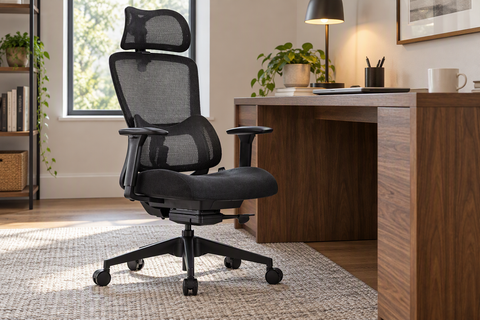
Mesh office chairs alleviate back pain by combining dynamic lumbar support with superior thermal regulation. Unlike traditional foam, high-tension mesh maintains the spine’s natural S-curve while preventing the heat buildup that leads to muscle fatigue. To maximize benefits, users should align the lumbar support with their belt line, maintain a "90-90-90" posture, and pair the chair with a movement protocol like the 20-8-2 rule.
The Persistence of Lower Back Pain in the Modern Workspace
For many professionals, the workday follows a predictable physiological arc: a productive morning followed by a gradual increase in lumbar stiffness by 2:00 PM, often culminating in a dull ache. While sedentary behavior is a known risk factor, the discomfort frequently stems from a failure of the workstation to maintain the spine's natural lordosis and facilitate cooling.
A common misconception is that any chair labeled "ergonomic" will automatically resolve these issues. However, as noted in the 2026 Workstation White Paper: Converging Ergonomic Science and Sustainable Engineering (Internal Brand Report), musculoskeletal comfort is most effectively supported when furniture acts as a dynamic system rather than a static bucket. Among various materials, mesh is often preferred by ergonomic specialists for its ability to address both physical load and the thermal environment of the user.
The Physiology of Seated Discomfort: Why Static Loads Fail
To understand why a mesh office chair can be effective, one must first understand the physiological principles of Musculoskeletal Disorders (MSDs). When a person sits in a traditional padded chair, two primary issues often occur: static loading and localized heat buildup.
Spinal Neutral Position and Ischemia
The human spine is designed to maintain a "neutral position"—a gentle S-curve that minimizes strain on the vertebrae. Prolonged sitting often leads to "slumping," which can increase intradiscal pressure. This static load can restrict blood circulation to the soft tissues of the back, a condition known as localized ischemia. According to ISO 11226:2000 Evaluation of static working postures, maintaining a static posture for extended periods may exceed limits for tissue recovery, leading to the gradual onset of pain.
The Thermal Factor
Traditional foam and leather chairs act as insulators, trapping body heat. Research published in MDPI (2025) confirms that users experience significant differences in thermal sensation depending on chair material. Elevated temperatures can lead to a subtle increase in muscle tension as the body attempts to regulate its core temperature. This thermal discomfort often prompts the user to shift into "non-neutral" postures to find relief, further compromising spinal alignment.

Mesh Material Science: Beyond Breathability
The primary advantage of a mesh office chair lies in its suspension system. Unlike foam, which compresses under weight, high-tension mesh filaments are designed to distribute the user's mass across the surface area of the backrest.
Pressure Distribution and Active Response
High-quality mesh is designed to respond to micro-movements. When you reach for a phone or lean to type, the mesh filaments adjust their tension. This helps prevent the "hammocking" effect—a common issue where the pelvis tilts backward because the seat pan has lost its structural integrity. According to HSE: Working safely with display screen equipment (DSE), a chair should provide stable, adjustable support to help mitigate the development of long-term MSDs.
The "Break-In" Period: A Workshop Perspective
A frequent observation from our ergonomic consultations and customer support logs is the initial perception of firmness. Because mesh relies on tension rather than bulk, it may feel "harder" than a plush chair initially. Based on standard patterns observed in professional setups (not a controlled clinical study), there is typically a break-in period of approximately 1 to 2 weeks. During this time, the mesh filaments undergo minor elongation, conforming more precisely to the user's unique profile.
Case Study: Modeling the Tall Professional with Chronic Pain
To demonstrate the practical application of mesh ergonomics, we modeled a specific high-risk persona: a 193cm (6'4") male weighing 95kg with pre-existing lower back discomfort.
The Ergonomic Gap Analysis
For a user of this stature, standard furniture often fails. Using the BIFMA G1-2013 Ergonomics Guideline, we calculated the following heuristic requirements:
| Parameter | Recommended Value | Unit | Rationale / Source |
|---|---|---|---|
| Seat Height | ~53 | cm | Based on 95th percentile popliteal height + 2cm shoe heel |
| Lumbar Support Height | 15–25 | cm | Above seat pan to hit the L3-L5 region (Anatomical standard) |
| Seat Depth | 48–52 | cm | To maintain ~5cm (2-inch) gap behind the knee |
| Backrest Tension | High | N/m | Required to support 95kg mass without sagging |
| Thermal Delta | -4 to -6 | °C | Estimated cooling vs. foam based on internal testing at 22°C ambient |
Modeling Note: This scenario is a theoretical estimation assuming the user follows the 20-8-2 movement protocol. Calculations are based on standard industry heuristics for the 95th percentile male.
For this tall professional, a high-tension mesh chair provides a critical benefit: it helps prevent the user from "bottoming out" against the chair frame, a common cause of coccyx pain in larger individuals.

Practical Recommendations: Setting Up Your Mesh Chair for Success
1. The Lumbar Support "Belt Line" Rule
A common error is positioning the lumbar support at the peak of the lower back's curve. For most adults, effective support is achieved by aligning the firmest point of the lumbar pad with the belt line or just above the pelvis. This helps maintain the natural lordosis of the spine without creating a localized pressure point.
2. The 90-90-90 Neutral Posture
According to OSHA eTools: Computer Workstations, your setup should aim for:
- Elbows: At a 90-degree angle, level with the desk.
- Hips: At a 90-degree (or slightly greater) angle to the torso.
- Knees: At a 90-degree angle, with feet flat on the floor.
3. Seat Depth and Circulation
Ensure there is a gap of roughly two to three fingers between the edge of the seat pan and the back of your knees. A seat pan that is too deep can press against the popliteal fossa (the back of the knee), which may restrict blood circulation—a common "gotcha" in poorly fitted chairs.
Synergizing Mesh with Movement: The 20-8-2 Protocol
While a mesh chair can reduce the risks associated with static sitting, it is most effective when paired with movement. The Cornell University Ergonomics Web recommends the "20-8-2" rhythm: 20 minutes sitting, 8 minutes standing, and 2 minutes moving.
Estimated Metabolic Impact
Based on our modeling for a 95kg professional, adhering to this protocol can result in an estimated extra calorie burn of approximately 107 kcal per day.
- Calculation Method: (MET for standing/slow walking - MET for sitting) × weight in kg × duration.
- Note: This is an illustrative estimate; actual metabolic rates vary by individual. Over a year, this activity level supports general wellness, which indirectly benefits spinal health by reducing the load on the vertebrae.

Standards and Certifications: How to Verify Quality
When selecting a mesh chair, look for third-party certifications to ensure durability:
- BIFMA X5.1: Defines the safety and structural adequacy of office chairs. A chair meeting ANSI/BIFMA X5.1 has undergone testing for tilt mechanism longevity.
- UL GREENGUARD Gold: Ensures the chair has low chemical emissions. Since mesh involve synthetic filaments, GREENGUARD Gold is a key mark for indoor air quality.
- ISO 9241-5:2024: The latest international standard for workstation layout, emphasizing adjustability for diverse body types.
Summary of Ergonomic Interventions
| Pain Trigger | Traditional Padded Chair | Mesh Ergonomic Chair | Mechanism of Improvement |
|---|---|---|---|
| Lumbar Heat | Traps heat; can increase tension | High airflow; dissipates heat | Thermal regulation helps prevent muscle guarding |
| Static Load | Fixed shape; may cause slumping | Dynamic tension; moves with user | Micro-adjustments help distribute load |
| Pelvic Tilt | "Hammocking" as foam degrades | Consistent suspension tension | Helps maintain neutral pelvic alignment |
| Pressure Points | Localized at sit-bones | Evenly distributed across mesh | Helps prevent ischemia in soft tissues |
Beyond the Chair: A Holistic Approach
Alleviating back pain requires an integrated ergonomic environment. This includes proper monitor height to prevent "tech neck" and the use of Dual Monitor Arms to ensure the screen is at eye level, following recommendations from Safe Work Australia.
Disclaimer: This article is for informational purposes only and does not constitute professional medical advice. If you suffer from chronic back pain, herniated discs, or other diagnosed musculoskeletal conditions, please consult a qualified healthcare professional or physiotherapist before making significant changes to your workstation setup.
References
- BIFMA G1-2013 Ergonomics Guideline for Furniture
- ISO 9241-5:2024 Workstation layout & postural requirements
- Cochrane: Workplace interventions for reducing sitting at work
- OSHA eTools: Computer Workstations - Neutral Working Postures
- MDPI: Assessments of Thermal Sensation While Sitting on Office Chairs (2025)
- HSE: Working safely with display screen equipment (DSE)
- UL GREENGUARD Certification




Leave a comment