

Achieving Minimalism with a Dual Monitor Setup: Creating Your Workspace Sanctuary
Imagine a home office that sparks your limitless creativity—a place where the morning light hits a clean, expansive surface, and the only things greeting you are your two perfectly aligned screens. There is no tangle of "cable spaghetti" beneath your feet, no clutter of pens and sticky notes competing for your attention, and no nagging ache in your neck. This is the "Workspace Sanctuary." It is a state where your environment no longer demands cognitive energy, allowing you to enter a state of Deep Work the moment you sit down.
Many professionals believe that adding a second monitor inevitably leads to a cluttered, "maximalist" desk. However, minimalism isn't about having less; it's about making room for more of what matters. By integrating sophisticated design with ergonomic science, you can maintain a modern, minimalist aesthetic while enjoying the expansive screen real estate required for modern content creation and complex workflows.
The Dual-Monitor Paradox: Productivity vs. Visual Noise
While a dual-monitor setup is often touted as a productivity multiplier, it presents a unique challenge to the minimalist philosophy. According to insights on digital minimalism from Calm.com, an excess of digital and physical stimuli can fracture attention and increase stress. In our observations of thousands of workstation configurations, we have found that the "clutter" of a dual-monitor setup is rarely the screens themselves, but rather the infrastructure supporting them—bulky stands, trailing power cords, and the loss of desk depth.
To bridge this gap, we must look at the workstation as a unified system. As outlined in The 2026 Workstation White Paper: Converging Ergonomic Science and Sustainable Engineering, the convergence of mechanical stability and aesthetic purity is the hallmark of the next generation of workspaces. Achieving this requires a shift from "adding parts" to "integrating solutions."
Space Transformation: From Chaos to Clarity
The transformation from a cluttered desk to a minimalist sanctuary begins with the foundation: your desk. A common mistake in dual-monitor planning is selecting a desk that is too shallow.
The 30-Inch Depth Rule
For a minimalist dual-monitor setup, desk depth is more critical than width. We recommend a minimum depth of 30 inches (approximately 76 cm). This depth is not arbitrary; it is based on the ISO 9241-5:2024 standard for workstation layout, which emphasizes postural requirements and viewing distances. A 30-inch depth allows you to place your monitors at an arm's length (roughly 20–30 inches from your eyes) while still leaving 30–40% of the desk surface visibly empty in the foreground. This "negative space" is essential for reducing cognitive load and maintaining a sense of order.

The GTG - I43, LED Glass Desktop Gaming Desk (43"x23") offers a compact yet highly functional foundation. While its 23-inch depth is optimized for smaller rooms, its integrated power strip holder and cable management accessories help maintain a clean look even when space is at a premium. For those utilizing larger ultra-wide screens, the tempered glass surface provides a sleek, reflective aesthetic that makes the room feel larger and more open.
Elevation through Engineering: Monitor Arms
The single most effective way to reclaim your desk surface is to eliminate the factory monitor stands. Standard stands are "space thieves," occupying the most valuable real estate directly in front of you.
By using a Single Monitor Arm for each screen (or a dual-arm system), you transition from a "desk-bound" setup to a "floating" setup. This creates an immediate "Before & After" effect: the area beneath your monitors becomes clear, providing a dedicated space for a slim keyboard or simply a clean vista that promotes mindfulness.
Methodology Note: Postural Alignment Logic Our recommendations for monitor placement are aligned with the ANSI/HFES 100-2007 Computer Workstations standard.
- Height: The top of the screen should be at or slightly below eye level to minimize neck flexion.
- Tilt: A slight upward tilt of 10–20 degrees often compensates for the natural downward gaze.
- Distance: We estimate the optimal distance to be 20–30 inches based on typical visual acuity requirements (not a clinical measurement).
Linking Functionality with Emotion: The Ergonomic Flow
Minimalism in the workspace isn't just a visual choice; it’s a physiological one. When your equipment is positioned correctly, your body moves into a "neutral posture." The Occupational Safety and Health Administration (OSHA) eTools on Neutral Working Postures describe this as a state where your joints are naturally aligned, reducing stress and strain on the muscles, tendons, and skeletal system.
When you use a high-quality Single Monitor Arm, the ease of adjustment becomes an emotional benefit. Height adjustment isn’t just for health—it’s a way to shift between "thinking" and "execution" modes. You might pull the screens closer for intense video editing or push them back and tilt them up when you stand to present during a video call. This fluidity turns your desk from a static piece of furniture into a responsive partner in your workflow.

Modeling the "Tall Creator" Scenario
To demonstrate the importance of precise setup, let’s look at a common "Edge Case" we often encounter: the tall professional.
Scenario: The 188cm (6'2") Content Creator A creator of this stature faces unique ergonomic challenges that standard "one-size-fits-all" furniture cannot solve. Using anthropometric ratios, we have modeled the requirements for this specific persona:
| Parameter | Value/Requirement | Units | Rationale |
|---|---|---|---|
| Ideal Desk Height (Seated) | ~32 | inches | Based on 95th percentile elbow height |
| Monitor Top Height | ~52-54 | inches | Measured from floor to eye level |
| Viewing Distance | 33-36 | inches | Optimized for dual 34" ultra-wides |
| Load Capacity | ~60 | kg | Dual ultra-wides + professional audio gear |
| Minimum Desk Depth | 30 | inches | To accommodate focal depth of large screens |
Analysis: For this user, a standard 29-inch desk is approximately 3 inches too low, leading to "slumping." Furthermore, ultra-wide monitors require a greater viewing distance to prevent "eye scanning" fatigue. A minimalist setup for this user must involve high-capacity monitor arms and a desk with a deep surface to maintain the aesthetic without sacrificing physical comfort.
The Invisible Web: Masterful Cable Management
The greatest enemy of minimalism is the cable. In a dual-monitor setup, you have at least four cables (two power, two data) converging at the desk. To achieve a "Zen" environment, these must be rendered invisible.
Practitioner Tips for a "Zero-Cable" Look:
- The "One In, One Out" Rule: For every new accessory you add to your desk, remove one. This prevents "accessory creep" that leads to cable clutter.
- Strategic Anchoring: Use adhesive-backed hooks or cable raceways under the desk for power strips. Reserve permanent solutions for cables that never move (like monitor power) and use Velcro ties for things that might change (like your mouse or keyboard).
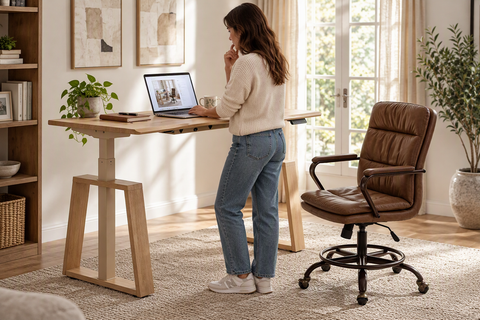
- The Slack Factor: If you use a height-adjustable desk, always route your cables with enough "service loop" (slack) to reach the highest setting. According to the CCOHS guide on Sit/Stand Desks, failing to account for cable length can lead to equipment damage or "tip-over" risks when the desk is raised.
Space Transformation: Decluttering the Surface
Minimalism thrives on the "Out of Sight, Out of Mind" principle. If you don't use a tool every 30 minutes, it shouldn't be on your desk. This is where secondary storage becomes a hero of the minimalist aesthetic.
The 23" Rolling File Cabinet with Drawer is a perfect example of a "Space Transformation" tool. By moving your office supplies, notebooks, and peripheral hardware into a mobile unit, you keep the primary work surface pristine. The lockable casters allow you to tuck it under the desk when not in use or move it aside to create a more open "ambiance" during creative brainstorming sessions.

For those who prefer a more structured desktop, the Carbon Fiber Dual Monitor Stand provides a sophisticated middle ground. It elevates your monitors to eye level—a key recommendation from Cornell University's Ergonomics Web—while creating a "hidden" shelf underneath for your keyboard or laptop. The carbon fiber texture adds a touch of modern "Aesthetic" without the visual weight of a traditional wooden riser.
Personal Tips for Atmosphere and Mindfulness
A minimalist sanctuary is about more than just furniture; it's about the environment you create.
- Lighting and Eye Strain: We recommend a color temperature of 5000K–6500K (neutral to cool white) for your workspace. This mimics daylight and can help reduce mental fatigue. Ensure your monitors are not positioned directly in front of a window to avoid glare, which is a leading cause of "Computer Vision Syndrome."
- The 20-8-2 Rhythm: To maintain long-term health, follow the Cornell University "20-8-2" rule: sit for 20 minutes, stand for 8 minutes, and move/stretch for 2 minutes. This keeps your circulation active and prevents the "static load" risks identified by ISO 11226:2000.
- Greenery: A single, well-placed plant can soften the "Tech-heavy" look of a dual-monitor setup. It provides a natural focal point for your eyes during breaks, helping to reset your focus.
- Surface Discipline: Aim to leave 30-40% of your desk surface visibly empty. This isn't just for looks; it reduces the "visual noise" that your brain has to process, allowing for deeper concentration.
Final Thoughts on the Minimalist Sanctuary
Achieving minimalism with a dual-monitor setup is an intentional act of design. It requires choosing tools that serve multiple purposes—like a desk that manages your cables or a monitor arm that gives you back your surface. When you say goodbye to the chaos of a cluttered desk, you aren't just cleaning a room; you are clearing your mind.
By following industry standards like those from BIFMA and OSHA, and selecting pieces that blend form with function, you can create a workspace that doesn't just look like a sanctuary—it feels like one. Your day of deep work begins the moment you step into a space that was designed, from the ground up, for your focus and well-being.
Appendix: Modeling Assumptions & Reproducibility
The ergonomic calculations provided in this article are based on a deterministic model using the following parameters. Please note that these are hypothetical estimates for illustrative purposes and not clinical data.
| Parameter | Value/Assumption | Unit | Source Category |
|---|---|---|---|
| User Height | 188 | cm | Scenario Persona |
| Seated Elbow Height | 79-82 | cm | Anthropometric Estimate |
| Monitor Size | 34 (Ultrawide) | inch | Common Creator Spec |
| Focal Distance | 85-90 | cm | Visual Ergonomics Model |
| Desk Surface Load | 60 | kg | Component Weight Sum |
Boundary Conditions:
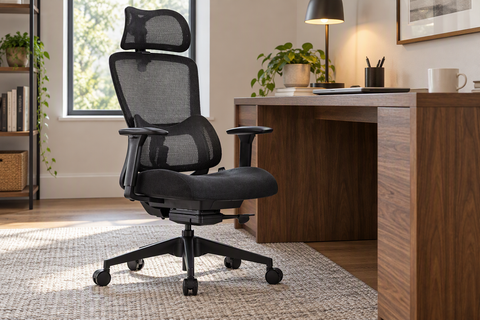
- Assumes a standard 5-star base ergonomic chair with adjustable armrests.
- Calculations assume the user's feet are flat on the floor or a footrest.
- Viewing distance assumes 20/20 corrected vision.
References
- BIFMA G1-2013 Ergonomics Guideline for Furniture
- CCOHS: Office Ergonomics - Sit/Stand Desk
- Cornell University Ergonomics Web — Workstation Guides
- ISO 9241-5:2024 Workstation layout & postural requirements
- OSHA eTools: Computer Workstations - Neutral Working Postures
- WHO 2020 Guidelines on Physical Activity & Sedentary Behaviour
Disclaimer: This article is for informational purposes only and does not constitute professional medical, legal, or financial advice. Ergonomic needs vary significantly by individual; users with pre-existing musculoskeletal conditions should consult a qualified physical therapist or ergonomic specialist before making significant changes to their workstation.




Leave a comment