

Crafting Your Workspace Sanctuary: The Art of Intentional Minimalism
Imagine a home office that sparks your limitless creativity—a space where the physical world fades into a quiet hum, leaving only you and your craft. Here’s how a day of deep work begins once you say goodbye to chaos: you step into a room bathed in soft, natural light, where every surface serves a purpose and every tool sits exactly where your hand expects it to be. This is more than just a desk; it is your Workspace Sanctuary.
For the modern content creator, focus is the most valuable currency we have. Yet, we often find ourselves battling a subtle, creeping friction—the "rats nest" of cables under the feet, the slight neck strain from a monitor that’s just an inch too low, or the mental weight of a cluttered surface. True minimalism in a creative studio isn't about owning nothing; it’s about workflow-intentionality. It is the bridge between a sterile aesthetic and high-performance execution.
In this guide, we will explore how to transform your environment from a source of distraction into a catalyst for inspiration, grounded in ergonomic science and the practical wisdom of those who live at their desks.
The Ergonomic Blueprint: Building from the Ground Up
Before we discuss the beauty of a wood finish or the curve of a chair, we must address the invisible framework of comfort. A minimalist setup that causes physical pain is a failure of design. We often see creators make the mistake of choosing a desk based solely on its "look," only to find that their posture suffers within weeks.
To build a truly authoritative workspace, we look to the BIFMA G1-2013 Ergonomics Guideline, which provides the dimensions necessary to accommodate the 5th to 95th percentile of the population. However, standard guidelines often miss the nuances of the "Tall Creator."
Modeling the 95th Percentile: The Tall Creator Scenario
We modeled a scenario for a 190cm (6'3") professional—a height that represents approximately the 95th percentile of males. Our analysis revealed a significant "ergonomic gap" when using standard fixed-height furniture.
| Parameter | Value (190cm User) | Unit | Rationale |
|---|---|---|---|
| Seated Desk Height | ~78.5 | cm | ANSI/HFES 100-2007 Ratios |
| Standing Desk Height | ~116.5 | cm | Including shoe correction (2.5cm) |
| Standard Desk Height | 73.7 (29") | cm | Industry standard fixed height |
| Ergonomic Gap | 4.8 | cm | The deficit causing slouching |
Methodology Note: This scenario is a deterministic parameterized model based on anthropometric ratios from the US Army Natick Survey data. It is a scenario model, not a controlled lab study. Results may vary based on individual limb proportions and footwear.
For a creator of this stature, a fixed 29-inch desk is nearly two inches too low, forcing a constant, subtle hunch. To solve this, we recommend a high-performance solution like the Standing Desk with Drawers, Wood Finish (47'' /55''). Its adjustable range (29"-48") ensures that whether you are sitting in deep-focus mode or standing for a collaborative brainstorm, the desk meets you exactly where you are.
A minimalist walnut standing desk with integrated drawers and a monitor riser, showcasing a clean and organized workspace.
Minimalism vs. Austerity: The 70/30 Rule
A common pitfall in the quest for a minimalist Aesthetic is confusing it with austerity. An empty desk is often an unusable one. In our experience, the most effective creators use what we call the 70/30 Real Estate Heuristic:
- 70% Clear Surface: This is your "breathing room." It allows for physical movement, note-taking, and reduces the cognitive load that visual clutter creates.
- 30% Essential Gear: This zone is reserved for items you use at least once per hour—your keyboard, mouse, and a single beverage.
Everything else follows the "One-Touch Rule": if you don't use it daily, it doesn't belong on the surface. This is where integrated storage becomes a hero. The Standing Desk with Drawers, Wood Finish (47'' /55'') allows you to tuck away hard drives, SD cards, and pens into soft-close sliders, keeping them within reach but out of sight.
For larger items like tax folders or reference books, a dedicated piece like the Ark EL, 29" Display File Storage Cabinet, Oak preserves the minimalist vibe of the room while providing a functional home for the "non-essentials."

Visual Ergonomics and the Depth Deficit
Creators often gravitate toward massive 38-inch ultrawide monitors for video editing or multi-track audio work. While beautiful, these screens introduce a "Viewing Distance Deficit."
According to the Cornell University Ergonomics Web, your monitor should be at a distance that allows you to see the screen clearly without leaning forward or straining your eyes. For a 38-inch ultrawide, the THX-recommended viewing distance is approximately 48 inches for an immersive 40-degree field of view.
On a standard 24-inch deep desk, you are sitting nearly two feet too close. This is why we emphasize the importance of a monitor riser or an adjustable arm. By raising the screen to eye level—as specified in ISO 9241-5:2024—you align your cervical spine and reduce the risk of "tech neck." The Standing Desk with Drawers, Wood Finish (47'' /55'') includes a built-in monitor riser, which effectively increases your usable desk depth and keeps your primary tool at the correct ergonomic height.
The Unseen Infrastructure: Cables and Towers
Nothing breaks the Ambiance of a Workspace Sanctuary faster than a tangle of black plastic wires. Minimalism requires hidden infrastructure.
- Cable Management: Use the 78” roll of velcro straps and magnetic ties included with your desk to group cables into a single "trunk" that follows the desk leg.
- CPU Placement: Keeping your PC tower on the desk takes up valuable real estate and adds noise. However, placing it directly on the carpet is a recipe for dust-clogged fans. We suggest an Adjustable CPU Stand, Mobile, Black. It keeps the tower off the floor for better airflow and allows you to wheel it out easily when you need to plug in a new peripheral.

Linking Functionality with Emotion: The Executive Seat
The chair is the most intimate part of your workflow. It is where your body spends the most time, and its impact on your Mindfulness cannot be overstated. While many "gaming" chairs prioritize loud aesthetics, a creator's sanctuary demands something more refined.
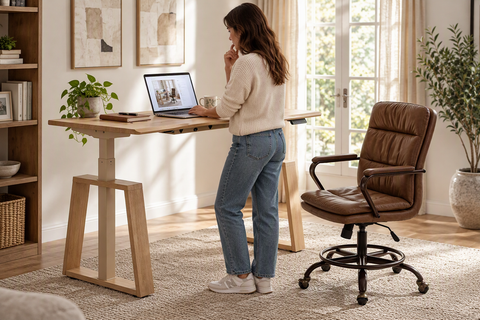
The Serene, Napa Leather Executive Office Chair is designed for what we call "Active Comfort." The use of genuine full-grain Napa leather isn't just a luxury—it’s a tactile experience that signals to your brain that you have "arrived" at your place of work.
From a technical standpoint, this chair aligns with the ANSI/BIFMA X5.1 standards for safety and durability. More importantly, its adjustability allows you to maintain a "neutral posture," where your joints are naturally aligned, reducing the physiological stress on your muscles.

The Rhythm of Deep Work
Even with the most ergonomic setup, the human body was not designed for static behavior. The World Health Organization (WHO) 2020 Guidelines emphasize reducing sedentary time to lower cardiovascular risks.
We recommend the 20-8-2 Rhythm, a heuristic popularized by Cornell University:
- 20 Minutes Sitting: For deep, focused execution.
- 8 Minutes Standing: To encourage blood flow and shift into a more active "thinking" mode.
- 2 Minutes Moving: A short walk or stretch to reset your cognitive load.
A systematic review by Cochrane (2018) found that sit-stand desks can reduce sitting time by over 80 minutes a day. To make this transition seamless, use the memory presets on your Standing Desk with Drawers, Wood Finish (47'' /55''). Programming your exact heights removes the "friction of adjustment," making the healthy choice the easiest one.
Personal Tips for Atmosphere Building
To truly transform your space into a sanctuary, consider the elements that go beyond the furniture:
- Biophilic Design: Adding a single low-maintenance plant (like a Snake Plant or Pothos) can improve air quality and provide a visual "rest point" for your eyes.
- Lighting Layers: Avoid harsh overhead lights. Use a warm desk lamp for task lighting and a monitor light bar to reduce screen glare, as suggested by HSE DSE guidelines.
- Scent and Sound: A subtle essential oil diffuser or a dedicated "deep work" playlist can act as a Pavlovian trigger, telling your brain it’s time to create.
As detailed in The 2026 Workstation White Paper: Converging Ergonomic Science and Sustainable Engineering, the future of the workspace is one where technology and biology exist in harmony. By choosing pieces that respect both your aesthetic vision and your physical needs, you aren't just buying furniture—you are investing in your own creative longevity.
Declutter your space, and you will find that you have decluttered your mind. Your best work is waiting for you in the quiet, focused corners of your new Workspace Sanctuary.
Disclaimer: This article is for informational purposes only and does not constitute professional medical or occupational therapy advice. Always consult with a qualified healthcare professional before making significant changes to your physical work environment, especially if you have pre-existing musculoskeletal conditions.
References
- BIFMA G1-2013 Ergonomics Guideline for Furniture
- CCOHS: Office Ergonomics - Sit/Stand Desk
- Cochrane: Workplace interventions for reducing sitting at work (2018)
- Cornell University Ergonomics Web — Workstation Guides
- HSE: Working safely with display screen equipment (DSE)
- ISO 9241-5:2024 Workstation layout & postural requirements
- WHO 2020 Guidelines on Physical Activity & Sedentary Behaviour
- ANSI/BIFMA X5.1 General-Purpose Office Chairs
- The 2026 Workstation White Paper: Converging Ergonomic Science and Sustainable Engineering




Leave a comment