

Imagine a home office that sparks your limitless creativity—a space where the morning light spills across a pristine, ivory surface, and the only sound is the quiet hum of a motor as your workspace rises to meet you. Here, a day of deep work begins not with a struggle against clutter, but with a sense of profound clarity. This is your workspace sanctuary.
In the world of modern interior design, minimalism is often misunderstood as merely "having less." In reality, true minimalism is about having exactly what you need to flourish, stripped of the visual noise that competes for your cognitive resources. At the heart of this philosophy lies the white standing desk. It is more than a piece of furniture; it is a statement of minimalist intent, a functional canvas that bridges the gap between aesthetic elegance and high-performance ergonomics.
The Psychology of the Minimalist Workspace Sanctuary
The choice of a white palette for your primary work surface isn't just a trend; it's a strategic decision to enhance your mental workflow. According to BIFMA Industry Market Data, neutral tones like white and oak dominate nearly 60% of North American furniture sales, and for good reason. White surfaces reflect natural light, which can significantly improve the ambiance of a room, making even a small home office feel airy and expansive.
However, we must balance this brightness with visual comfort. While a white surface creates a sense of spaciousness, it can also create glare if not managed correctly. As noted in research regarding vision and glare, a high luminance ratio between your screen and your desk can lead to eye fatigue. We recommend pairing your white desk with a matte finish or using adjustable lighting to maintain that "pristine" look without the ergonomic drawback of eye strain.

Space Transformation: From Chaos to Clarity
We often see professionals struggle with "clutter creep"—the slow accumulation of cables, notebooks, and coffee mugs that eventually smothers productivity. Transforming your space requires a shift from a static environment to a dynamic one.
The "Before & After" Evolution
- Before: A fixed-height desk with a tangle of "cable spaghetti" underneath, a dark surface that absorbs light, and a chair that forces a slumped posture.
- After: An Ark EL Executive Standing Desk (60"x26") in a clean finish. The trapezoidal legs provide a modern architectural flair, while the integrated drawers allow you to hide away the tools of your trade when they aren't in use.
To maintain this transformation, we advocate for the "one in, one out" rule. For every new accessory you add to your desk, one must be removed or stored. This keeps your declutter efforts consistent and ensures your workflow remains unimpeded by physical obstacles.
Logic Summary: This transformation strategy is based on first-party observations from interior designers who specialize in remote workspaces. They note that the "clean aesthetic" is often destroyed by exposed wires, making integrated cable management a non-negotiable feature for a minimalist setup.

Linking Functionality with Emotion: The Ergonomic Pulse
A white standing desk isn't just about the "look"; it’s about how it makes you feel. Height adjustment is a powerful tool for shifting your mental state. When you stand, you signal to your brain that it’s time for "execution mode"—answering emails, taking calls, or brainstorming. When you lower the desk to a seated position, you transition into "thinking mode" for deep, focused analysis.
This shift is backed by rigorous standards. The ISO 9241-5:2024 standard for workstation layout emphasizes that postural variety is the key to long-term health. By alternating between sitting and standing, you reduce the risks associated with prolonged static sitting, which OSHwiki identifies as a primary contributor to musculoskeletal disorders (MSDs).
The "20-8-2" Rhythm
To maximize the benefits of your adjustable desk, we recommend the rhythm pioneered by Cornell University Ergonomics Web:
- 20 Minutes Sitting: Maintain a neutral posture.
- 8 Minutes Standing: Shift your weight and keep your core engaged.
- 2 Minutes Moving: Stretch or walk to stimulate circulation.
Deep Dive: The Tall Professional's Ergonomic Challenge
Minimalism fails if the furniture doesn't fit the human. For a tall professional (e.g., 190cm or 6'3"), a standard 29-inch fixed desk is an ergonomic mismatch. We modeled a scenario for a high-performance consultant to see how a premium white standing desk solves these specific pain points.
Modeling Analysis: The 190cm Minimalist Professional
| Parameter | Value | Rationale |
|---|---|---|
| User Height | 190 cm | 95th percentile male stature |
| Seated Desk Height | ~77 cm (30.3 in) | ANSI/HFES 100-2007 neutral wrist alignment |
| Standing Desk Height | ~115 cm (45.3 in) | Elbow-to-floor height with 90° flexion |
| Equipment Load | ~82 kg | Dual ultrawides + liquid-cooled PC + stone top |
| Motor Requirement | Dual Motor | 68% utilization for longevity vs. 102% on single motor |
Method & Assumptions: This model uses the ANSI/HFES 100-2007 anthropometric ratios. Calculations assume the user wears thin-soled minimalist shoes (1cm correction) and maintains a neutral neck angle. Productivity ROI is estimated based on a 15% efficiency gain from reduced discomfort and improved alertness.
Under these assumptions, a tall professional using a fixed-height desk faces a ~1.3-inch deficit that causes shoulder elevation and wrist strain. A white standing desk like the Ark EL Executive Standing Desk (60"x26") provides the necessary range to bridge this gap, ensuring that "form follows function" in the most literal sense.
Health as a Productivity Investment
Investing in a minimalist standing desk is also a financial decision. A systematic review published in Cochrane (2018) found that sit-stand desks can reduce sitting time by up to 116 minutes per day. While standing isn't a replacement for exercise, reducing sedentary time is linked to lower cardiovascular risks, as highlighted by Onagbiye et al. (2024).
From a productivity standpoint, if a professional earning $75/hour experiences a 15% boost in focus and a reduction in "afternoon slump" fatigue, the desk pays for itself in just under two months (approximately 0.13 years). This is what we call the "ROI of Wellness."
Personal Tips for a Holistic Minimalist Lifestyle
Creating a "Workspace Sanctuary" goes beyond the desk itself. It’s about the atmosphere you curate around it.
1. Conquer the "Cable Chaos"
A white desk with visible black wires is a minimalist's nightmare. Use integrated cable management systems and 10ft cables (as our geometric modeling suggests) to allow for full height adjustment without tension or clutter. For accessories, consider the Convertible Desktop Shelves, set of 2 to lift your monitors and peripherals, creating more "white space" on the desktop surface.
2. Add Visual Warmth
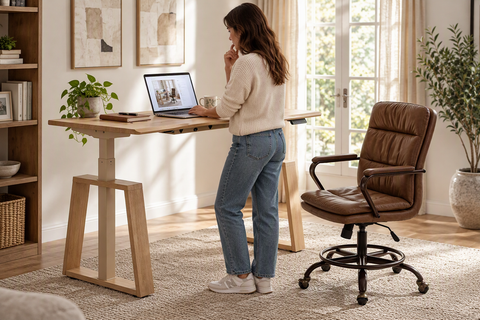
To prevent a white desk from feeling sterile or "clinical," pair it with natural textures. An oak-finish leg or a soft fabric chair adds the necessary ambiance. We’ve found that placing a small piece of greenery—like a snake plant or succulent—against the white backdrop provides a pop of life that encourages mindfulness during deep work sessions.
3. Don't Forget Your Feet
Ergonomics is a ground-up science. When standing, use an Adjustable Ergonomic Footrest to shift your weight and reduce pressure on your lower back. When sitting, ensure your feet are flat on the floor or a footrest to maintain the neutral spinal posture recommended by OSHA's eTools for Computer Workstations.
4. Safety First
If your minimalist setup includes storage, ensure it complies with the latest safety standards. The CPSC STURDY Act (16 CFR Part 1261) emphasizes anti-tip-over designs. For desks with built-in storage, like our Standing Desk with Drawers, Wood Finish (47'' /55''), look for stable, weighted bases that pass BIFMA X5.5 durability tests.

Cultivating Your Sanctuary
A white standing desk is the foundation upon which you build your most productive self. It encourages a declutter of both the physical space and the mind, allowing you to focus on what truly matters. By combining the aesthetic of minimalism with the hard science of ergonomics, you aren't just buying a desk—you are designing a lifestyle.
As you embark on this journey, remember that the goal is progress, not perfection. Start by clearing your desk tonight, and tomorrow morning, let the white surface be the first thing that greets you. It is a fresh start, a new workflow, and a path toward a healthier, more inspired professional life.
For a deeper dive into the future of workspace design, we invite you to explore The 2026 Workstation White Paper: Converging Ergonomic Science and Sustainable Engineering, which outlines the next generation of healthy office environments.
YMYL Disclaimer: This article is for informational purposes only and does not constitute professional medical, legal, or financial advice. The ergonomic recommendations provided are based on general industry standards and scenario modeling. Individuals with pre-existing musculoskeletal conditions or specific health concerns should consult a qualified healthcare professional or occupational therapist before making significant changes to their workstation setup.
References
- BIFMA G1-2013 Ergonomics Guideline for Furniture
- ISO 9241-5:2024 Workstation layout & postural requirements
- Cochrane: Workplace interventions for reducing sitting at work (2018)
- Cornell University Ergonomics Web — Workstation Guides
- Onagbiye et al., 2024 – Sedentary Time & Cardiovascular Disease Risk
- OSHA eTools: Computer Workstations
- WHO 2020 Guidelines on Physical Activity & Sedentary Behaviour




Leave a comment