

The Science of Surface Selection: Durability Meets Office Aesthetics
In high-traffic corporate environments, the reception sofa or collaborative lounge chair is often the first touchpoint for clients and the most abused asset in the facility. We frequently observe a recurring frustration among office managers: a sofa that looked impeccable in the showroom begins to show "pilling," "shining," or structural sagging within just 18 months of deployment. This premature failure rarely stems from poor craftsmanship alone; more often, it is the result of a mismatch between material specifications and actual user load.
Selecting materials for office furniture is not merely a design exercise—it is a technical challenge rooted in musculoskeletal health and material science. According to the Canadian Centre for Occupational Health and Safety (CCOHS), the physical environment significantly impacts employee well-being. When collaborative seating fails—whether through degraded aesthetics or lost support—it ceases to be a functional tool and becomes a liability to both brand image and ergonomic comfort.

Understanding Abrasion Resistance: The Martindale and Wyzenbeek Metrics
For procurement teams, the most critical technical specification is the abrasion rating. In the North American and European markets, two primary tests define how a material will handle the friction of hundreds of users: the Martindale and Wyzenbeek tests.
The Martindale Test (ASTM D4966)
The Martindale method is the gold standard for evaluating how fabrics withstand circular rubbing. A small piece of the fabric is loaded into a machine and rubbed against a standard abrasive (usually wool or wire) in a figure-eight pattern.
- General Contract Use: 20,000 – 30,000 cycles.
- Heavy-Duty Commercial: 30,000 – 50,000 cycles.
- High-Performance/Extreme: 100,000+ cycles.
Based on standard ASTM D4966 testing protocols, we estimate that for a reception area with 50+ daily users, a material with fewer than 30,000 cycles will show visible "bald spots" or fiber thinning within two years.
The Wyzenbeek Test
While Martindale uses circular motion, Wyzenbeek uses a back-and-forth "double rub" motion. For heavy-duty commercial environments, a rating of 30,000 double rubs is the baseline requirement set by the Association for Contract Textiles (ACT).
Expert Heuristic: When reviewing specifications, look for the "70,000+ Martindale" threshold for 24/7 facilities or high-traffic tech campuses. This provides a buffer for the "friction heat" generated by synthetic clothing (like denim or polyester blends) which can accelerate fiber degradation.
Performance Fabrics vs. Genuine Leather: A Technical Comparison
A common misconception in B2B procurement is that genuine leather is the "only" choice for durability. While leather offers a high-end aesthetic, modern technical fabrics often outperform mid-grade leathers in commercial settings.
The Performance Fabric Advantage
Modern high-performance synthetics, such as polyester blends treated with nanotechnology, offer superior stain resistance. According to AATCC 130 standards for soil release, these materials can be engineered to prevent oily stains (like coffee or ink) from bonding with the fibers.
- Pros: Lower lifecycle cost, moisture-wicking (crucial for thermal comfort), and high Martindale ratings (often exceeding 100,000 cycles).
- Cons: Can be sensitive to direct UV light if not treated with light-fastness stabilizers (ISO 105-B02).
Genuine Leather and the HVAC Factor
Leather, such as the full-grain Napa leather used in the Serene Ella, Napa Leather Executive Chair, provides unparalleled prestige and tactile comfort. However, in corporate environments with constant HVAC airflow, leather can lose its natural oils.
- The Maintenance Trap: We often see leather cracking in offices because it lacks quarterly conditioning. In environments with humidity below 40%, leather requires 4x annual maintenance to prevent permanent structural damage.
- The Durability Paradox: While leather is puncture-resistant, technical fabrics often have higher "breathability," which reduces the static load on the user's skin and improves blood circulation during long meetings.
Scenario Modeling: High-Traffic Corporate Reception
To illustrate the impact of material selection on long-term value, we modeled a scenario for a tech company HQ with 80+ daily visitors. This analysis compares a standard commercial material (30,000 Martindale) against a premium performance material (100,000 Martindale).
Modeling Note (Reproducible Parameters)
This scenario is a deterministic model based on industry-standard replacement cycles and maintenance costs. It is not a controlled lab study.
| Parameter | Value | Unit | Rationale |
|---|---|---|---|
| Daily Users | 80 | Users/Day | High-traffic tech campus benchmark |
| Analysis Period | 5 | Years | Typical corporate capital budget cycle |
| Standard Material Durability | 30,000 | Cycles | Baseline commercial grade |
| Premium Material Durability | 100,000 | Cycles | High-performance grade |
| Cleaning Frequency | Quarterly | - | Standard facility management protocol |
Results of the Analysis
Our modeling suggests that the standard material reaches its "failure threshold" (visible aesthetic or structural degradation) at approximately 2.5 years when subjected to 80+ daily users. Conversely, the premium material maintains its integrity throughout the 5-year cycle.
- Total Cost of Ownership (TCO): Despite a 100% higher initial purchase price for premium materials, the TCO is actually lower over 5 years. This is because the standard material requires a full replacement (including labor, disposal, and procurement time) midway through the cycle.
- Sustainability Impact: According to the EU Ecodesign Requirements for office furniture, extending the lifespan of a product is the most effective way to reduce its carbon footprint. A single high-performance sofa has a ~10% lower manufacturing footprint than two standard sofas over the same period.
The 70/30 Rule in Commercial Design
Experienced office designers utilize a heuristic known as the 70/30 Rule to balance budget, durability, and visual interest.
- 70% Performance Materials: Use high-durability, neutral-toned performance fabrics for primary seating (reception sofas, task chairs, and breakout benches). These should be rated for 50,000+ Martindale cycles and feature subtle textures to hide soil.
- 30% Accent Materials: Use more delicate or high-aesthetic materials—like velvet, light-colored wool, or premium leather—for accent chairs, executive suites, or low-traffic zones.
This strategy ensures that the "visual weight" of the office remains professional while focusing the maintenance budget where it is most effective. For instance, pairing a high-durability lounge sofa with a statement piece like the Serene Ella, Napa Leather Executive Chair allows for a touch of luxury without compromising the overall floor's durability.
Ergonomic Integration: Beyond the Surface
Material selection is only one half of the equation; the other half is the structural layout of the workspace. The ISO 9241-5:2024 standard emphasizes that workstation layout and postural requirements are inseparable from the materials used.
For executive spaces where collaboration often happens at the desk, the transition between sitting and standing is vital for maintaining blood circulation and reducing Musculoskeletal Disorders (MSDs). Integrating height-adjustable solutions like the Ark X Executive Standing Desk (60"x26") or the Ark EL Executive Standing Desk (60"x26") provides the necessary postural variety.
These desks often feature a combination of materials—such as oak veneers and leather-finish desktops—that must meet the same durability standards as seating. For example, the leather finish on the Ark X Executive Standing Desk (60"x26") provides a soft-touch surface that reduces wrist pressure, aligning with OSHA guidelines for neutral working postures.
Lifecycle Maintenance: Protecting the Investment
To ensure that office sofas and chairs reach their rated lifespan, facility managers must implement a proactive maintenance protocol. We recommend the following schedule based on common patterns from commercial warranty handling:
- Weekly: Vacuuming with an upholstery attachment. This prevents dust and grit from acting as an abrasive within the fabric weave.
- Monthly: Inspection for "pilling" (small fiber balls). For performance fabrics, these can be safely removed with a fabric shaver without affecting structural integrity.
- Quarterly: Professional steam cleaning for fabrics or conditioning for leather. For executive pieces like the Serene Ella, Napa Leather Executive Chair, this conditioning is essential to prevent the leather from drying out under office lights.
- Immediate: Spot treatment for spills using pH-neutral cleaners. Never use bleach-based products on performance fabrics unless they are specifically "bleach-cleanable" rated.
Aesthetic Cohesion in the Executive Suite
In B2B settings, the aesthetic must signal stability and professionalism. The "resimercial" trend—merging residential comfort with commercial durability—has led to a preference for materials that look like home textiles but perform like industrial coatings.
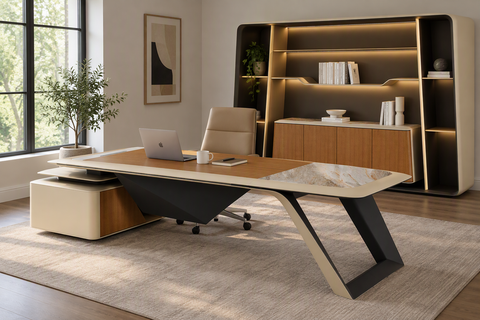
The Opal Executive Standing Desk (66"x29"), with its ribbed panels and brass accents, exemplifies this trend. When selecting a sofa to complement such a piece, the material should echo the desk's textures. A dark-toned polyester blend with a subtle "salt and pepper" weave effectively conceals wear while matching the sophisticated profile of the Opal Executive Standing Desk (66"x29").
For more detailed engineering insights, we recommend consulting The 2026 Workstation White Paper: Converging Ergonomic Science and Sustainable Engineering, which explores the future of material science in the workplace.
Final Recommendations for Facility Managers
When evaluating office sofas and collaborative furniture, move beyond the "touch test" and demand technical data.
- Request the Martindale/Wyzenbeek Rating: For any area with more than 20 daily users, do not accept anything under 30,000 cycles.
- Verify the Stain Release Grade: Ensure the fabric meets AATCC 130 standards if food or beverages are allowed in the area.
- Audit the Frame Construction: As noted in industry lifecycle analysis, frame quality determines 70-80% of a sofa's lifespan. Ensure the manufacturer uses kiln-dried hardwood or reinforced steel frames.
- Consider Climate Stability: If your office has inconsistent humidity, prioritize moisture-wicking performance fabrics over leather to ensure long-term user comfort and material health.
By focusing on evidence-based material selection, corporate procurement teams can transition from a cycle of constant replacement to a strategy of long-term asset management, ensuring that the office environment remains both beautiful and functional for years to come.
YMYL Disclaimer: This article is for informational purposes only and does not constitute professional medical, legal, or facility safety advice. Ergonomic requirements may vary based on individual health conditions and local workplace safety regulations. Always consult with a certified ergonomist or health professional before making significant changes to your workstation or office layout.
References
- BIFMA G1-2013 Ergonomics Guideline for Furniture
- ISO 9241-5:2024 Workstation layout & postural requirements
- OSHA eTools: Computer Workstations - Neutral Working Postures
- Association for Contract Textiles (ACT) Performance Guidelines
- Canadian Centre for Occupational Health and Safety (CCOHS): Office Ergonomics
- EU Ecodesign Requirements for Office Furniture (2025/2027)




Leave a comment