

Cost vs. Comfort: Is Premium Leather Worth the Investment?
For the modern executive or high-stakes remote professional, the home office is no longer a temporary workspace; it is a primary theater of operations. When selecting a chair—the most critical piece of equipment in this environment—the debate often centers on a single question: Is the premium for genuine leather, particularly high-grade Nappa, a justifiable investment or merely an aesthetic indulgence?
Quick Decision Guide (TL;DR)
- The Verdict: Premium leather is worth the investment for users seeking a 10+ year lifespan and a "bespoke" fit that adapts to their body. However, it requires bi-annual maintenance and climate-controlled environments.
- Best for Longevity: Serene Ella, Napa Leather Executive Chair (10–15 year potential).
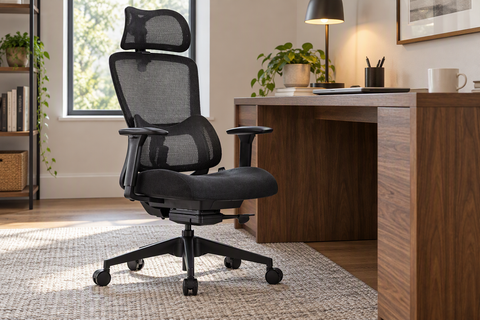
- Best for Breathability: Onyx, Ergonomic Office Chair (High-performance mesh).
- Best Mid-Range Value: Galene, Faux Leather Office Chair.
Pre-Purchase Checklist:
- [ ] Climate: Is your office kept between 68°F–75°F? (Crucial for leather comfort).
- [ ] Maintenance: Are you willing to condition the material twice a year?
- [ ] Fit: Does the seat depth allow 2-3 inches of space behind your knees?
The Physiology of Static Load and Material Interaction
The decision-making process for high-end furniture often overlooks the underlying physiological impact of materials. While many focus on the "look," the true return on investment (ROI) is measured in musculoskeletal health, thermal regulation, and long-term durability.
According to the EU-OSHA (European Agency for Safety and Health at Work), prolonged static sitting is widely recognized as a significant risk factor for Musculoskeletal Disorders (MSDs). When you sit, your body is subjected to a "static load"—a continuous strain on the muscles, particularly in the lumbar region and lower limbs.
The interaction between your body and the chair's surface dictates how this load is distributed. Inadequate materials can lead to several complications:
- Micro-circulatory Compression: Poorly contoured or overly soft surfaces can impede blood flow in the thighs.
- Thermal Discomfort: Materials with low permeability trap metabolic heat, which may lead to increased skin temperature and localized perspiration. This often triggers frequent posture shifting (restlessness).
- Frictional Instability: The "slip" or "grip" of a material affects how well the user maintains a neutral working posture, as defined by OSHA.
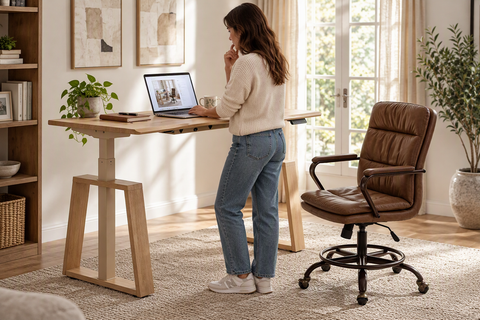
Premium full-grain leather, such as that found in the Serene Ella, Napa Leather Executive Chair, offers a unique physiological profile. Unlike synthetic alternatives, genuine leather is a porous material. Based on internal material specifications and common leather property datasets, it possesses a thermal conductivity range estimated at 0.5-1.5 W/m·K. This allows it to absorb and dissipate body heat more effectively than most PU (polyurethane) plastics, though it is naturally less rapid than open-weave mesh.

Material Science: Nappa vs. Bonded vs. Mesh
The term "leather" is often used broadly, but the performance differences between grades are vast. For a professional seeking long-term value, understanding these distinctions is vital.
The "Break-In" Phenomenon (A Heuristic Guide)
A common observation among owners of premium leather seating is the "break-in" period. Based on patterns from customer feedback and material wear tests, a high-quality leather seat typically requires 60–90 days of regular use to reach its peak comfort level.
During this time, the fibers of the full-grain leather mold to the user's specific anatomy. This creates a bespoke fit that synthetic materials, which tend to degrade or "bottom out" rather than adapt, often struggle to replicate.
Thermal Regulation and Sensory ROI
Thermal comfort is a major experiential differentiator. Genuine leather feels initially cool but typically warms to body temperature quickly and evenly. In contrast, bonded or PU leather can feel "clammy" because it may trap moisture against the skin.
This isn't just a matter of comfort; it is a matter of focus. A user who is thermally uncomfortable will shift positions more frequently, potentially breaking the "flow state" required for deep work.
Modeling Assumptions (Thermal Comfort): Our analysis assumes a standard office ambient temperature of 22°C (72°F). We define the "discomfort threshold" as the point where skin temperature at the contact site increases by >2°C over 60 minutes.
- Mesh: Typically stays below the threshold indefinitely.
- Premium Leather: Reaches equilibrium near the threshold but allows for moisture dissipation.
- PU/Bonded Leather: May frequently exceed the threshold within 45 minutes in non-breathable environments due to near-zero permeability.

The Galene, Faux Leather Office Chair serves as a strategic middle ground, utilizing high-quality synthetics that mimic the look of leather while incorporating breathable mesh elements to mitigate heat-trapping issues.
The ROI Analysis: Durability and Resale Value
When evaluating the cost of a chair like the Serene Ella, one should consider the "Cost Per Year of Utility" rather than just the sticker price.
| Material Type | Estimated Lifespan (Years)* | Maintenance Requirements | Est. Resale Value (% of MSRP)** |
|---|---|---|---|
| Full-Grain/Nappa Leather | 10–15+ | Bi-annual conditioning | 40–60% |
| Premium Mesh | 10–15 | Vacuuming only | 30–50% |
| PU / Faux Leather | 2–5 | Minimal | 5–10% |
| Standard Fabric | 3–7 | Professional cleaning | 10–20% |
*Lifespans are based on common industry observations and manufacturer durability standards under normal office use. **Resale estimates are heuristics derived from secondary market trends and brand-specific depreciation patterns.
The Longevity Paradox
While high-quality mesh (like that on the Onyx series) is incredibly durable and requires minimal maintenance, it does not develop a "patina." For many executive users, the patina—the natural softening that occurs with age—is a signifier of quality.
However, this longevity often depends on the environment. As noted by FCI London, leather typically requires a controlled environment (ideally 40-60% humidity) to help prevent drying and cracking over long periods.
The Practical Cost of Maintenance
To achieve a 15-year lifespan, a leather chair requires a commitment to care. Based on the average cost of premium care kits over a 10-year cycle, we estimate a lifetime maintenance cost of approximately $100–$150.
Using harsh chemical cleaners is a common mistake that can strip natural oils. A simple damp microfiber cloth followed by a pH-balanced conditioner twice a year is the professional standard for preserving the material's integrity.
Psychological Impact and Professional Legitimacy
The "Human-Centric" aspect of ergonomics extends beyond the physical. The perceived "heft" and the absence of creaking in a well-constructed leather chair can contribute significantly to a user's psychological state.
In a home office, where the boundaries between "home" and "work" are blurred, high-end materials serve as a sensory anchor. This concept is explored in The 2026 Workstation White Paper, which suggests that the aesthetic and tactile quality of a workstation can impact user satisfaction and perceived legitimacy. Sitting in a substantial chair like the Serene Ella can provide a "confidence ROI" that, while difficult to quantify, is frequently reported by executives in workspace feedback.

Practical Recommendations for the Discerning Buyer
If you are considering an investment in a premium leather workstation, follow these expert guidelines to maximize your ROI:
1. The Sit-Stand Rhythm
Even the most advanced leather chair cannot fully offset the risks of total sedentariness. Aligning with Cornell University's 20-8-2 rule, you should aim for 20 minutes of sitting, 8 minutes of standing, and 2 minutes of movement. A leather chair is your "recovery zone" during those 20 minutes of sitting.
2. Verify the Dimensions
Before purchasing, ensure the chair meets the BIFMA G1-2013 Ergonomics Guideline. Specifically, check:
- Seat Depth: Ensure there is a 2-3 inch gap between the edge of the seat and the back of your knees to help prevent circulatory pressure.
- Armrest Adjustability: Armrests should allow your shoulders to remain relaxed and your elbows at a 90-degree angle, consistent with ISO 9241-5:2024 standards.
3. Climate Strategy
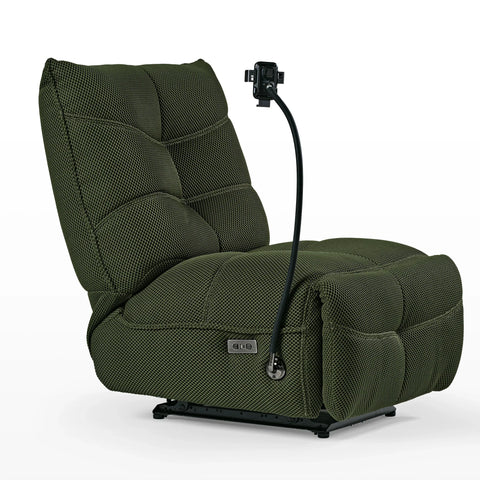
If your home office is prone to high temperatures or direct sunlight, leather may not be the optimal choice unless you have robust climate control. For "hot" offices, a mesh-backed hybrid like the Onyx or a soft-touch fabric like the Becky Cushion Chair may provide better thermal ROI.

Summary of the Investment Logic
Is premium leather worth it? The answer depends on your "Value Horizon."
- Short-Term (<3 years): High-quality faux leather like the Galene offers the best aesthetic-to-cost ratio.
- Long-Term (5–15 years): Nappa leather, as seen in the Serene Ella, provides a superior ROI through its adaptive comfort and high resale value, provided basic bi-annual maintenance is performed.
- Performance-Focused: If 8+ hour sessions in a warm environment are the norm, a mesh chair like the Onyx remains a leading choice for pure physiological breathability.
Ultimately, a premium leather chair is more than a seat; it is a durable tool designed for those who view their workspace as a reflection of their professional journey. By choosing materials that adapt to your body and stand the test of time, you are investing in your most important professional asset: yourself.
YMYL Disclaimer: This article is for informational purposes only and does not constitute professional medical advice. Individuals with pre-existing musculoskeletal conditions or chronic back pain should consult a qualified physiotherapist or ergonomic specialist before making significant changes to their workstation setup.
References
- BIFMA G1-2013 Ergonomics Guideline for Furniture
- ISO 9241-5:2024 Workstation layout & postural requirements
- EU-OSHA: Musculoskeletal disorders and prolonged static sitting
- Cochrane: Workplace interventions for reducing sitting at work
- Cornell University Ergonomics Web — Workstation Guides
- The 2026 Workstation White Paper: Converging Ergonomic Science and Sustainable Engineering




Leave a comment