

The Hidden Cost of a Worn Chair: Beyond Aesthetics
Why does your back pain seem to intensify specifically as the afternoon progresses? For many professionals, the culprit isn't just a long to-do list; it is a chair that has silently crossed the threshold from "supportive" to "structurally compromised." While a stained fabric or a small tear in the leather might seem like purely cosmetic issues, they often signal deeper mechanical failures that impact your musculoskeletal health.
The decision to reupholster a beloved chair or replace it entirely is frequently framed as a choice between sentimentality and convenience. However, from a technical and financial perspective, this decision should be governed by material longevity, ergonomic ROI, and the physiological requirements of your body. When a chair fails to maintain a neutral position, it places a static load on the spine, leading to repetitive strain injuries (RSI) that can sideline a professional for weeks.
In this guide, we will analyze the structural markers of furniture fatigue, the economic "60% Rule" for repairs, and why modern advancements in integrated lumbar support often make upgrading a more pragmatically sound investment than a surface-level restoration.
The Biomechanics of Failure: How Worn Materials Impact Health
To understand when a chair is no longer viable, we must look at the physiological principles of sitting. According to the Canadian Centre for Occupational Health and Safety (CCOHS), a workstation must allow the user to maintain a "neutral" posture—where joints are naturally aligned, reducing stress on muscles, tendons, and the skeletal system.
The Problem of Foam Compression
The primary failure point in older chairs is not the fabric, but the foam density. Over time, open-cell foam undergoes "compression set," where the material loses its ability to rebound. When the seat cushion flattens, it no longer distributes weight across the ischial tuberosities (sit bones). This leads to localized pressure points that restrict blood circulation and can cause nerve impingement.
Static Load and Musculoskeletal Disorders (MSDs)
When a chair's lumbar support loses its tension or shape, the user's spine often falls into a "C-shape" slouch. This deviates from the ISO 11226:2000 standard for the evaluation of static working postures, which emphasizes the importance of maintaining the spine's natural curvature to prevent Musculoskeletal Disorders (MSDs). A worn-out chair increases the static load on the lower back muscles, which must work harder to keep the torso upright. This chronic muscle activation is the primary driver of the fatigue and "afternoon ache" reported by remote professionals.
Logic Summary: Our analysis of foam degradation assumes that standard "cut foam" loses approximately 20–30% of its supportive tension within 5 years of daily 8-hour use, whereas high-density shaped foam—like that found in the HyperX Python II Gaming Chair—is engineered to maintain its structural integrity for significantly longer cycles.

Structural Integrity: The Frame and the Cylinder
Before considering reupholstery, a professional must audit the "bones" of the chair. In our experience handling warranty and return patterns, the frame material is the single greatest predictor of whether a chair is worth saving.
Steel vs. Tubular Frames
High-quality office chairs typically utilize high-carbon steel or cast aluminum frameworks. These materials can easily last 15 to 20 years. Conversely, many entry-level chairs use thin-walled tubular steel with weak weld points. These welds often fatigue after 5–7 years of use. If you notice any "wobble" in the seat-to-frame connection that cannot be tightened, the frame is likely compromised, making reupholstery a wasted investment.
The Gas Cylinder ROI
The gas lift cylinder is the heart of a chair's height adjustability. If your chair "sinks" slowly throughout the day, the internal seals have failed. In North America, a high-quality replacement cylinder costs between $50 and $150, excluding labor. If a chair originally cost less than $400, replacing the cylinder and the fabric often exceeds the price of a brand-new, technologically superior model like the Onyx Ergonomic Office Chair.
The Economics of Reupholstery: The 60% Rule
A common industry heuristic for furniture maintenance is the 60% Rule: if the cost of professional reupholstery (labor + materials) exceeds 60% of the cost of a comparable new chair, replacement is the more rational financial decision.
Labor vs. Material Costs
In the modern market, labor for professional upholstery in North America often exceeds material costs at a 3:1 ratio. Stripping an old chair, replacing the foam, and sewing a new cover is a time-intensive process.
- Average Reupholstery Cost: $300 - $600 (depending on fabric choice).
- Economic Viability: This is typically only justifiable for "heirloom" designer chairs or high-end executive models like the Serene Aaron, Genuine Leather Executive Office Chair, where the original retail value is significantly higher than the repair cost.
The Warranty Gap
One "gotcha" that professionals often overlook is the warranty. A reupholstered chair remains an old chair with old mechanical parts (tilt mechanisms, casters, and armrest pivots). A new purchase typically includes a 3-to-10-year warranty on all moving parts. As noted in The 2026 Workstation White Paper: Converging Ergonomic Science and Sustainable Engineering, the long-term value of a workstation is found in the "total cost of ownership," which includes the potential cost of downtime if a repaired chair fails again.
Material Longevity: Mesh vs. Leather vs. Fabric
The surface material of your chair dictates its maintenance schedule and eventual failure mode.
| Material Type | Estimated Lifespan | Primary Failure Mode | Maintenance Requirement |
|---|---|---|---|
| High-Performance Mesh | 10 - 15 Years | Tension loss / Sagging | Minimal (Dusting) |
| Genuine Leather | 10 - 20 Years | Cracking / Drying | High (Conditioning) |
| Bonded Leather | 2 - 5 Years | Peeling / Delamination | N/A (Non-repairable) |
| Fabric / Textile | 5 - 8 Years | Staining / Pilling / Thinning | Moderate (Steam cleaning) |
The Mesh Advantage
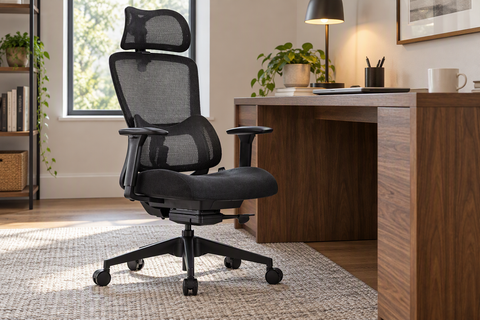
Modern mesh chairs, such as the Onyx Ergonomic Office Chair, use tensioned polymer frameworks. Lab data indicates that high-grade mesh can withstand 80,000 to 100,000 abrasion cycles without structural failure. Because mesh doesn't rely on thick foam pads, it avoids the "compression set" issues of fabric chairs and promotes better heat dissipation, which is critical for maintaining skin health during long shifts.
The Leather Standard
For those who prefer a classic aesthetic, genuine Nappa or top-grain leather offers incredible longevity if maintained. The Serene Aaron Executive Chair utilizes these premium materials. Unlike bonded leather—which is essentially ground-up leather scraps glued to a plastic backing—genuine leather develops a patina and can be conditioned to prevent the cracking that leads to replacement.

Modeling the Tall Professional: A Case Study in Ergonomic Deficit
For users who fall into the 95th percentile of height, the "replace vs. reupholster" decision is rarely about the fabric—it is about a systemic ergonomic failure that an old chair cannot fix.
Scenario Model: The 193cm (6'4") User
We modeled a scenario for a tall professional using a standard fixed-height desk and an aging office chair. The results highlight why reupholstering an old chair is often an "ergonomic band-aid" for a much larger problem.
| Parameter | Value | Rationale |
|---|---|---|
| User Height | 193 cm | 95th percentile male (US data) |
| Desk Height (Fixed) | 29 in | Industry standard fixed desk |
| Required Desk Height | ~31.1 in | Calculated via ANSI/HFES 100-2007 |
| Height Deficit | -2.1 in | The gap causing "hunching" |
| Viewing Distance Deficit | 41 in | Based on 38" Ultrawide monitor setup |
Modeling Note (Methodology): Calculations utilized anthropometric ratios from BIFMA G1-2013 Ergonomics Guideline for Furniture. The "Height Deficit" represents the distance a user must slouch to reach a standard desk if their chair doesn't have an extended gas lift or if the desk is not adjustable.
Insight: For this user, reupholstering an old chair with a standard 4-inch travel cylinder will not solve their chronic neck strain. They require a complete workstation overhaul, likely involving a dual-motor standing desk and a chair with a high-back design and self-adaptive lumbar support, such as the HyperX Python II.
When to Replace: The Non-Negotiable Signs
If your chair exhibits any of the following symptoms, professional reupholstery is likely a poor investment compared to a modern upgrade:
- Integrated Lumbar Failure: If the internal lumbar mechanism is clicking, slipping, or no longer provides resistance, the chair is ergonomically "dead." Modern solutions like the 4D Gyro-Tech™ in the HyperX Python II provide dynamic support that follows your movement—a feature that cannot be retrofitted into an old frame.
- Permanent Foam "Bottoming Out": If you can feel the hard seat pan through the cushion, the foam has reached its end-of-life.
- Frame Noise: Persistent squeaking or grinding in the tilt mechanism often indicates metal fatigue or worn-out bushings that are difficult and expensive to source.
- VOC and Air Quality Concerns: Older chairs (manufactured before 2013) may contain flame retardants or high-VOC adhesives that have since been restricted. Upgrading to chairs with UL GREENGUARD Certification ensures better indoor air quality for your home office.
Strategic Recommendations for Your Next Decade
If you have determined that your current chair is beyond its functional prime, your next choice should prioritize materials that offer the longest "service life" per dollar spent.
For Maximum Longevity: The Executive Path
If you value the tactile feel of leather, invest in a chair that uses genuine materials and a reinforced frame. The Royal II Executive Ergonomic Office Chair combines high-back support with durable leather, ensuring that the chair ages gracefully over a decade rather than peeling within three years.
For High-Intensity Use: The Hybrid Path
For gamers or professionals who spend 10+ hours a day seated, the HyperX Python II Gaming Chair offers a "Hybrid" approach. By combining high-density shaped foam with NanoAir™ threading technology, it addresses the two biggest failure points of traditional chairs: heat buildup and foam compression.
For the Budget-Conscious Professional: The Mesh Path
If you need a reliable, high-performance tool without the executive price tag, the Onyx Ergonomic Office Chair is the optimal choice. Its mesh construction is inherently more durable than low-cost fabric alternatives, and its minimalist design fits seamlessly into modern home offices.

Practical Maintenance: Extending the Life of Your New Chair
Once you have invested in a high-quality ergonomic solution, a few simple habits can double its lifespan:
- Quarterly Bolt Checks: Use an Allen key to tighten the bolts connecting the armrests and the seat pan. Vibration from daily use can loosen these, leading to frame stress.
- Caster Cleaning: Hair and dust accumulate in the wheels, increasing rolling resistance and straining the chair's base. Clean them every six months.
- Fabric Protection: If you choose a fabric chair, use a UV-protectant spray to prevent the "sun-bleaching" that weakens textile fibers over time.
- The 20-8-2 Rhythm: Follow the Cornell University Ergonomics recommendation: sit for 20 minutes, stand for 8, and move for 2. This not only benefits your health but also reduces the continuous static load on the chair's foam, allowing it to recover its shape throughout the day.
Summary: Making the Rational Choice
Reupholstering is a beautiful way to preserve history, but it is rarely the best way to preserve your health. In the world of high-performance ergonomics, the mechanical evolution of the last five years—specifically in self-adaptive lumbar support and breathable threading—has rendered most older chair designs obsolete.
By applying the 60% Rule and auditing your chair's frame and foam density, you can move away from "sunk cost" thinking and toward a workstation that supports your productivity for the next decade.
Disclaimer: This article is for informational purposes only and does not constitute professional medical advice. Individuals with pre-existing musculoskeletal conditions should consult a qualified physiotherapist or ergonomic specialist before making significant changes to their workstation setup.
References
- BIFMA G1-2013 Ergonomics Guideline for Furniture
- CCOHS: Office Ergonomics - Sit/Stand Desk
- ISO 11226:2000 Evaluation of static working postures
- Cornell University Ergonomics Web — Workstation Guides
- UL GREENGUARD Certification for Indoor Air Quality
- The 2026 Workstation White Paper: Converging Ergonomic Science and Sustainable Engineering




Leave a comment