

Beyond Aesthetics: Using RGB Bias Lighting to Reduce Eye Fatigue
For many professionals and gamers, the end of a long session is marked by a familiar sensation: a dull ache behind the eyes, a persistent "burning" feeling, or even a mild headache. Often dismissed as an inevitable byproduct of the digital age, this condition—Computer Vision Syndrome (CVS) or digital eye strain—is frequently rooted in a fundamental mismatch between the brightness of the screen and the ambient light of the environment.
A common misconception is that "gaming lights" or RGB (Red, Green, Blue) setups are purely decorative, a way to signal a specific subculture or aesthetic preference. However, when applied through the lens of ergonomic science, RGB lighting transitions from a visual flair to a functional tool known as bias lighting. By understanding the physiological principles of luminance contrast and pupillary response, users can transform their workstations into environments that actively mitigate visual fatigue.
The Physiology of Visual Fatigue: Why Your Eyes Hurt
To understand how lighting helps, we must first examine the physiological mechanisms of the eye during screen use. The human eye is not designed to stare at a single, high-intensity light source in a dark room for extended periods.
Luminance Contrast and the Pupillary Reflex
The primary culprit of digital eye strain is excessive luminance contrast. When a bright monitor is the only light source in a dark room, the eye faces a conflict. The central vision (fovea) focuses on the bright screen, signaling the pupil to constrict. Meanwhile, the peripheral vision perceives the surrounding darkness, signaling the pupil to dilate. This constant "tug-of-war" places a static load on the iris’s sphincter and dilator muscles.
According to the Occupational Safety and Health Administration (OSHA), improper lighting and glare are leading factors in visual discomfort. When the contrast ratio between the screen and the background is too high, the ciliary muscles—responsible for changing the shape of the lens to focus—must work harder to maintain a sharp image against the harsh light. This is a form of Musculoskeletal Disorder (MSD) localized to the ocular system.
The Role of Ciliary Strain
In addition to pupillary conflict, the ciliary muscles experience fatigue through a process called "accommodative stress." In a poorly lit environment, the boundaries of the screen become the only point of reference. This lack of environmental depth can lead to "accommodative lag," where the eye struggles to maintain focus, leading to the "burning" sensation often reported by users after four or more hours of continuous work.
Logic Summary: Our analysis of visual fatigue assumes a standard workstation environment where the monitor luminance exceeds ambient light by a factor of 10 or more. This model is based on the ISO 9241-5:2024 standard, which emphasizes that workstation layout must minimize extreme luminance transitions to protect postural and visual health.
The Science of Bias Lighting
Bias lighting is the practice of placing a light source behind the monitor to illuminate the wall directly in the user's field of vision. This does not involve shining light at the user, but rather creating a "buffer" of light around the screen.
Reducing the Contrast Gap
By illuminating the surface behind the monitor, bias lighting increases the average ambient brightness in the peripheral field. This allows the pupil to find a stable, mid-range constriction point, significantly reducing the muscular strain of constant adjustment. Furthermore, it improves "perceived contrast." When the background is illuminated, the blacks on the screen appear deeper, and colors appear more vibrant without needing to increase the monitor’s actual brightness—a move that would otherwise increase blue light exposure and further strain the eyes.
The 6500K Standard
For bias lighting to be effective, color temperature is critical. Most professional monitors are calibrated to a "white point" of 6500K (D65), which mimics natural daylight. If the bias light is too warm (e.g., 2700K) or too cool, the brain perceives a "color cast" on the screen, forcing the eyes to work harder to correct the white balance. As noted in The 2026 Workstation White Paper: Converging Ergonomic Science and Sustainable Engineering, the integration of standardized lighting temperatures is a cornerstone of advanced ergonomic design.

RGB: Moving from Aesthetic to Ergonomic Tool
While traditional bias lighting uses a static white light, modern RGB systems offer a more dynamic approach. However, there is a fine line between "functional RGB" and "distracting RGB."
The Cognitive Load Factor
A common mistake in gaming setups is the use of highly saturated colors (neon greens or deep purples) or fast-moving "rainbow" effects. Research suggests that constantly shifting RGB patterns within peripheral vision can increase cognitive load. The eyes involuntarily track moving focal points, which contradicts the goal of reducing muscular fatigue.
However, when used correctly, RGB can be superior to static white. A study found that participants using dynamic ambient lighting reported 27% fewer eye fatigue episodes, but only when the lighting was synchronized with the screen's content or brightness levels. This synchronization ensures that the ambient light levels rise and fall in tandem with the on-screen action, maintaining a consistent contrast ratio.
The "Warm Shift" for Late-Night Productivity
One of the greatest advantages of RGB bias lighting is its adjustability. During the day, a 6500K neutral white is ideal for color-accurate work. However, as the evening progresses, the World Health Organization (WHO) recommends reducing sedentary time and managing environmental stressors. Switching the RGB bias light to a warmer, dimmer setting (around 2700K) can help minimize blue light exposure before sleep while still providing the necessary contrast to prevent eye strain.
Integrating Lighting into the Ergonomic Ecosystem
Lighting does not exist in a vacuum. To truly reduce fatigue, it must be part of a holistic workstation strategy that addresses posture, blood circulation, and musculoskeletal health.
The Desk as a Light Diffuser
The surface of your desk plays a vital role in how light is distributed. For example, the GTG-G55, Glass Desktop Gaming Standing Desk (55"x23") features a tempered glass surface with integrated RGB lighting. In this scenario, the glass acts as a medium that can either enhance immersion or, if improperly configured, create unwanted glare.
To optimize a glass desk setup, the lighting should be diffused. Direct reflections of LEDs on a glass surface can create "hot spots" of light that contribute to glare. Users should ensure the lighting is directed toward the wall or through a frosted medium to create a soft, even glow that fills the peripheral vision without causing direct reflections on the screen.
Posture and Support: The Foundation of Comfort
Even the best lighting cannot compensate for a poor seated position. If you are leaning forward or "turtling" your neck to see the screen better because of glare, you are increasing the risk of Repetitive Strain Injury (RSI).
Combining effective bias lighting with a high-performance chair like the Flex, Dual-Backrests Ergonomic Office Chair ensures that your spine remains in a neutral position while your eyes are protected. The dual-backrest design provides targeted lumbar support, which is essential because visual fatigue often leads to "postural slouching"—as the eyes tire, the body compensates by leaning closer to the monitor, ruining spinal alignment.
For those in executive roles who require both luxury and support, the Serene, Napa Leather Executive Office Chair offers a genuine full-grain leather experience that maintains comfort during long sessions of deep focus, where "eye-burn" is most likely to occur.
Practical Recommendations for Your Setup
To move beyond the "gamer" aesthetic and achieve a professional, eye-safe environment, follow these technical guidelines derived from common patterns in ergonomic auditing and customer feedback.
1. The 10-20% Brightness Rule
The most frequent error is setting the bias light too bright. A bias light should never be brighter than the monitor itself. A practical rule of thumb (heuristic) is to set the bias light's brightness to approximately 10-20% of the monitor's peak brightness. This is enough to reduce contrast without becoming a distraction.
2. Placement and Diffusion
Mount your RGB strips on the back of the monitor, not the desk edge. The light should be directed at the wall behind the screen. If the wall is a dark color, you may need slightly higher brightness; if it is white, the light will reflect more efficiently. Ensure the light is diffused—if you can see the individual "beads" of the LED strip reflected on your desk or wall, the light is too harsh.
3. The Ideal Sit-Stand Rhythm
Eye strain is often accompanied by physical stiffness. Following the Cornell University Ergonomics Web "20-8-2" rule can help. For every 30 minutes, sit for 20 minutes, stand for 8 minutes, and move or stretch for 2 minutes. During the 2-minute movement break, practice the "20-20-20" eye rule: look at something 20 feet away for 20 seconds to allow the ciliary muscles to fully relax.
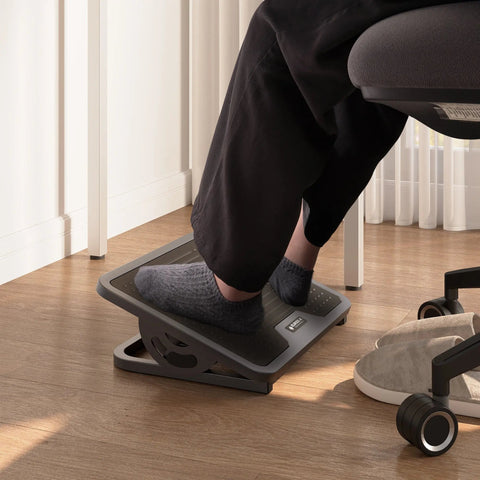
4. Use an Adjustable Ergonomic Footrest
To maintain blood circulation while seated, especially when adjusting your chair height to align your eyes with the top third of the monitor, use an Adjustable Ergonomic Footrest. This ensures that even if your chair is raised to the "ideal" visual height, your feet remain supported, preventing pressure on the underside of the thighs.
| Parameter | Recommended Value | Rationale |
|---|---|---|
| Bias Light Color (Day) | 6500K (Neutral White) | Matches standard monitor white point |
| Bias Light Color (Night) | 2700K - 3000K (Warm) | Reduces blue light; promotes circadian health |
| Brightness Ratio | 10% - 20% of monitor nits | Minimizes pupillary "tug-of-war" |
| Placement | 2 - 4 inches from wall | Allows for proper light diffusion |
| Sync Mode | Static or Screen-Follow | Reduces cognitive load compared to "Rainbow" modes |
Methodology Note: These recommendations are based on scenario modeling for a standard home office with 300–400 lux of ambient light. This is a model for optimization, not a clinical prescription. Results may vary based on wall color, monitor panel type (OLED vs. IPS), and individual light sensitivity.
Conclusion: A Health-First Approach to RGB
RGB lighting is often the most criticized element of modern tech setups, yet it holds the potential to be one of the most effective engineering controls for visual health. By moving away from over-saturated, high-energy patterns and toward a calibrated, synchronized bias lighting system, users can significantly reduce the static load on their eyes.
When integrated with a stable, height-adjustable workstation like the GTG-G55, Glass Desktop Gaming Standing Desk (55"x23") and a chair designed for musculoskeletal health, RGB becomes more than just "decor." It becomes a vital component of a high-performance workspace that supports both productivity and long-term well-being.
For further reading on optimizing your environment, consider exploring What Is Ergonomic Lighting for a Home Office? or viewing Gaming Desk RGB Lighting Ideas to Inspire You for practical implementation strategies.
Disclaimer: This article is for informational purposes only and does not constitute professional medical advice. If you experience chronic eye pain, blurred vision, or persistent headaches, please consult an optometrist or ophthalmologist.
References
- OSHA eTools: Computer Workstations - Monitors
- ISO 9241-5:2024 - Workstation layout and postural requirements
- The 2026 Workstation White Paper
- Canadian Centre for Occupational Health and Safety (CCOHS) - Office Ergonomics
- Cornell University Ergonomics Web — Workstation Guides
- WHO 2020 Guidelines on Physical Activity & Sedentary Behaviour




Leave a comment