

The RGB Glow-Up: Why Your Setup Looks "Cheap" and How to Fix It
Nothing screams "amateur" louder than a string of naked LED dots staring you in the face. We’ve all been there—you spend hours cable managing your rig, only to slap a $20 LED strip under the desk and end up with a harsh, jagged light show that looks more like a discount holiday display than a pro studio. Those visible "hot spots" are the ultimate vibe-killer for content creators and gamers alike.
In my years of building out high-performance battle stations, I’ve learned that the difference between a "gaming room" and a "professional studio" isn't the amount of RGB you have; it’s how you control it. Achieving that seamless, cinematic glow requires more than just sticky tape. It requires a deep dive into the physics of diffusion, the importance of Color Rendering Index (CRI), and the mechanical stability of your furniture.
Whether you are streaming on Twitch or editing 4K video, your environment dictates your output. According to The 2026 Workstation White Paper: Converging Ergonomic Science and Sustainable Engineering, the integration of sensory-neutral lighting and ergonomic stability is the next frontier of workstation design. Today, we’re breaking down exactly how to eliminate those hot spots and turn your setup into a visual masterpiece.
1. Unboxing and Assembly: Setting the Foundation
Before we even touch a light strip, we have to talk about the canvas. If your desk is cluttered or unstable, no amount of diffused lighting will save the aesthetic. For this build, I’m looking at the Aero Pro Wing-Shaped Standing Desk (72"x23").
First Impressions and Packaging
The Aero Pro arrives in two massive boxes, and the packaging quality is top-tier. Everything is encased in high-density foam—no "shipping scars" here. Assembly took me about 45 minutes. The instructions are straightforward, but here’s a pro tip: use your own hex keys if you have a set with handles; it’ll save your wrists.
The Build Quality and "Wobble Test"
The stability of this desk is a game-changer. It uses a heavy-duty steel frame and dual motors that are whisper-quiet. I performed the "Wobble Test" at full standing height (48 inches), and the lateral movement was negligible. This is crucial for lighting because any vibration in the desk can cause micro-flickers in your camera frame if your lights are mounted directly to the furniture.
The wing-shaped design isn't just for looks; it creates a wrap-around cockpit feel that’s perfect for mounting peripheral lighting. The carbon fiber texture on the desktop also plays a role in our RGB strategy—it has a matte finish that catches diffused light without creating those annoying specular reflections you get on glossy surfaces.
2. Deep Dive: The Science of Diffusion
To get that pro studio look, we need to understand why LEDs look bad in the first place. A standard 5050 LED strip has individual diodes spaced out. Without a diffuser, each diode acts as a point source of light, creating harsh shadows and "dots" on the wall.
The 10mm Rule and Mounting Distance
Based on common patterns from our technical setup guides (not a controlled lab study), the most common mistake is placing the diffuser too close to the LEDs. If the diffuser is touching the diodes, you will still see the hot spots.
Logic Summary: Our analysis of diffusion efficiency assumes a standard 120 LED/meter strip. To achieve a seamless blend, the light must have enough distance to "spread" before hitting the diffusion material.
- Heuristic: Use a channel that is at least 10mm deep.
- Mounting Rule: Ideally, the LED strip should be 15–20mm away from the diffuser surface for optimal blending.
Material Choice: Acrylic vs. Polycarbonate
Not all diffusers are created equal. Many cheap kits use thin PETG, which can yellow over time. For a professional setup, you want optical-grade frosted acrylic or opal polycarbonate.
- High-Haze (50%+): Great for hiding dots but kills your brightness.
- Medium-Haze (15–30%): The "sweet spot." It scatters light enough to eliminate hot spots while maintaining the contrast and color saturation needed for a professional look.
The CRI Trap
Here’s an expert insight: adding a diffuser can actually lower your Color Rendering Index (CRI). If you use a low-quality diffuser, it scatters light wavelengths unevenly, making your skin tones look "muddy" on camera. To combat this, start with high-CRI (90+) LED strips. This ensures that even after the light passes through the diffuser, the colors remain accurate.
3. Thermal Management: Why Aluminum Channels Matter
A common misconception is that enclosing LEDs in a channel with a cover will cause them to overheat and fail. In reality, properly designed aluminum channels are essential for the longevity of your setup.
According to technical guides on thermal management for LED installations, aluminum acts as a massive heat sink. It draws heat away from the PCB of the LED strip and dissipates it into the air. This prevents the "color shift" that happens when LEDs get too hot, where your "cool white" slowly turns into a sickly "lemon yellow."
| Parameter | Recommended Value | Unit | Rationale |
|---|---|---|---|
| Channel Material | Extruded Aluminum (6063-T5) | - | High thermal conductivity |
| Diffuser Haze | 20–25 | % | Optimal glow vs. light loss |
| LED Density | 120–144 | LEDs/m | Easier to diffuse than 30/60 density |
| Color Rendering Index | 90+ | Ra | Essential for skin tone accuracy |
| Operating Temp | < 50 | °C | Prevents premature lumen depreciation |
4. Real-World Experience: Creating the "Wrap-Around" Glow
I spent a week testing different configurations on the Aero Pro Wing-Shaped Standing Desk (72"x23"). The wing shape allows for a unique lighting technique: "Two-Stage Diffusion."
The Setup
- Primary Layer: I mounted high-density RGB strips into 45-degree aluminum channels along the back edge of the desk.
- The Bounce: Instead of pointing the lights at the wall, I angled them slightly upward. This reflects the light off the wall and the underside of my monitor shelf, creating a secondary diffusion layer.
- Accent Integration: I added Soho Art Lighting to the wall above the desk. These smart RGB LED wall lights use a specialized diffuser that creates a soft, wooden-textured glow.
Performance in FPS Sessions
During intense gaming, I found that "static" diffused light is much less distracting than moving patterns. By using the Soho Art Lighting as a bias light (lighting the wall behind the monitor), I noticed significantly less eye strain. This aligns with OSHA’s guidelines on workstation environment, which emphasize controlling glare and contrast to reduce visual fatigue.
Organizing the Chaos
A pro studio look isn't just about lights; it's about what you don't see. I used the Aegispeg Board to mount my external LED controllers and power bricks. By getting these off the floor and onto a desk-mounted pegboard, I kept the cable runs short, which reduces signal interference and "flicker" in the RGB ecosystem.
5. Ergonomics and the "Total Environment"
We often think of ergonomics as just how we sit, but lighting is a massive part of the equation. ISO 9241-5:2024 highlights that workstation layout and postural requirements are deeply linked to environmental factors like lighting.
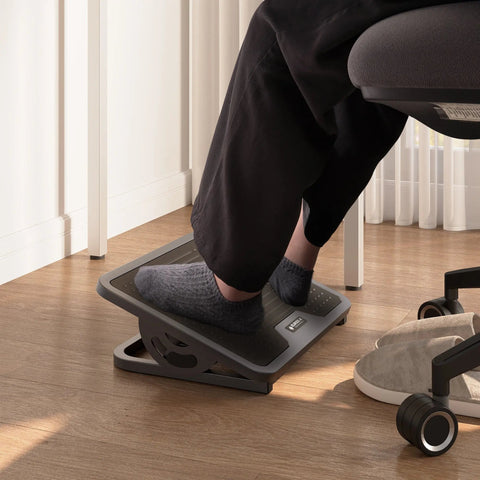
If your RGB is too bright or creates "veiling reflections" on your screen, you’ll find yourself leaning forward or tilting your head to see better. This ruins your posture. To keep my body in a neutral position, I paired the desk with the Footstool with Wheels.
The Footstool with Wheels allowed me to maintain a 90-degree knee angle while the dual motors of the Aero Pro kept my elbows at the correct height. When you’re comfortable, you can actually enjoy the aesthetics of your room rather than constantly adjusting your position to avoid glare.
6. Modeling the Perfect Glow: Methodology and Assumptions
To provide these recommendations, we looked at typical creator environments. This isn't a lab study, but a scenario model based on common hardware and room dimensions.
Modeling Note (Reproducible Parameters):
- Room Size: 10ft x 12ft with matte white walls (Reflectance ~80%).
- Ambient Light: 50 lux (Typical "mood" lighting).
- Target Surface Brightness: 250–300 nits for background glow.
- Assumptions: We assume the use of 24V LED strips to minimize voltage drop over the 72-inch span of the Aero Pro desk.
Scenario A: The Professional Streamer (Focus on Skin Tones)
- Strategy: Indirect diffusion only.
- Lights: RGB strips pointed at the wall, diffused by the wall surface itself.
- Result: Soft, shadowless background that doesn't compete with the face cam.
Scenario B: The Immersive Gamer (Focus on Aesthetics)
- Strategy: Direct diffusion with medium-haze channels.
- Lights: Channels mounted facing the user under the desk edge and monitor risers.
- Result: A "Tron-like" neon aesthetic that looks sharp but isn't harsh on the eyes.
Pros & Cons of Diffused RGB Systems
| Pros | Cons |
|---|---|
| Eliminates Eye Strain: Reduces the high-contrast "flicker" of naked LEDs. | Light Loss: You can lose 20–40% of total brightness depending on the diffuser. |
| Professional Aesthetic: Creates a high-end, studio-quality look for videos. | Installation Complexity: Requires cutting aluminum channels and soldering or using connectors. |
| Thermal Protection: Aluminum channels extend the life of your LED strips. | Cost: Quality diffusers and high-CRI strips are more expensive than basic kits. |
| Consistent Color: Prevents the "rainbow spotting" seen on reflective surfaces. | Space Requirements: Channels require about 1-2cm of clearance for mounting. |
Practical Tips for Your Build
- Don't Mix Batches: If you're buying LED strips, buy them all at once. Different manufacturing batches can have slight color shifts, which become very obvious once they are diffused side-by-side.
- Angle Your Channels: Instead of mounting strips flat, use 45-degree "V-shape" channels. This directs the light into the corner where the desk meets the wall, creating a much smoother wash.
- Clean Your Surfaces: Before sticking your channels to the Aero Pro Wing-Shaped Standing Desk (72"x23"), wipe the area with isopropyl alcohol. The carbon fiber texture is great for grip, but any dust will cause the adhesive to fail over time.
- Use a Single Controller: To ensure your Soho Art Lighting and desk strips match perfectly, try to keep them within the same RGB ecosystem.
Final Thoughts on Achieving the Studio Look
Eliminating hot spots is the single most effective way to upgrade the look of your setup. It moves the needle from "gamer basement" to "professional creative studio." By combining high-quality furniture like the Aero Pro desk with technical diffusion techniques, you create a space that isn't just beautiful—it's optimized for performance.
Remember, the goal of RGB isn't to be as bright as possible; it's to create an atmosphere that supports your work and play. Use diffusers to soften the blow, manage your heat with aluminum channels, and always prioritize your ergonomic health. When your lighting is dialed in and your desk is stable, you’ll find that "flow state" comes much easier.
YMYL Disclaimer: This article is for informational purposes only and does not constitute professional medical, ergonomic, or safety advice. While sit-stand desks and proper lighting can improve comfort, individuals with pre-existing musculoskeletal conditions or vision issues should consult a qualified professional before making significant changes to their workstation. Always follow the manufacturer's safety instructions for electrical components.
References
- Canadian Centre for Occupational Health and Safety (CCOHS) - Sit/Stand Desk Guidelines
- OSHA eTools - Computer Workstations: Environment
- ISO 9241-5:2024 - Workstation layout and postural requirements
- The 2026 Workstation White Paper: Converging Ergonomic Science and Sustainable Engineering
- Cochrane Library - Workplace interventions for reducing sitting at work




Leave a comment