

Many gamers share a common ritual: as the sun sets, the overhead lights go off, and the room is bathed in the glow of a high-refresh-rate monitor. Within two hours, a familiar dull ache sets in behind the eyes, often accompanied by a tension headache or a stiff neck. While many dismiss this as an inevitable part of "the grind," it is actually a physiological response to an improperly balanced visual environment.
The debate over RGB (Red, Green, Blue) lighting often centers on aesthetics—the "cool factor" of a synchronized battle station. However, when applied with scientific intent, RGB lighting transcends decoration. It becomes a functional tool for managing visual fatigue and cognitive load. This article examines the physiological principles of computer-based eye strain and how a well-configured ergonomic setup can mitigate these risks.
The Physiology of Visual Fatigue in Gaming
To understand why your eyes feel "heavy" after a long session, we must look at the mechanics of the eye. Digital eye strain, or Computer Vision Syndrome (CVS), is primarily driven by two factors: pupillary response and ciliary muscle fatigue.
When you play in a dark room with a bright monitor, your eyes are forced to navigate an extreme contrast ratio. According to the American Academy of Ophthalmology, digital devices do not necessarily damage vision permanently, but they do cause significant discomfort because we blink less frequently—about 5 to 7 times per minute instead of the usual 15. This leads to dry eyes and blurred vision.
Furthermore, the "pupillary light reflex" is under constant stress. In a dark environment, your pupils dilate to let in more light. However, the bright screen demands that they constrict. If the screen is the only light source, the eyes are caught in a state of "visual conflict," constantly adjusting to the flickering brightness of the game against the void of the room. This leads to a "static load" on the internal muscles of the eye, much like holding a heavy weight in a fixed position leads to muscular failure.
The Role of Bias Lighting and RGB
The most effective way to solve this contrast issue is through "bias lighting"—placing a light source behind the screen to illuminate the wall. This raises the ambient light level in your peripheral vision without shining light directly onto the screen, which would cause glare.
RGB lighting integrated into modern desks serves this exact purpose. By creating a diffused glow that bounces off the wall or the desk surface, you reduce the perceived brightness of the monitor. This allows the pupils to remain in a more stable, relaxed state.
However, not all RGB is created equal. A common mistake is setting lighting to maximum brightness or using fast, pulsing patterns. Research into the pathophysiological mechanisms of musculoskeletal disorders suggests that repetitive or unpredictable stimuli can increase cognitive load. In a gaming context, fast-moving RGB patterns in your peripheral vision force the brain to process unnecessary data, leading to faster mental exhaustion and involuntary eye-tracking, which contradicts the goal of relaxation.
Optimizing the RGB Environment for Health
To transform RGB from a distraction into an ergonomic asset, we recommend a disciplined approach to configuration. Based on expert observations of high-performance setups, the following table outlines the ideal parameters for ambient lighting.
| Lighting Parameter | Recommended Setting | Rationale |
|---|---|---|
| Ambient Brightness | 20–30% of Maximum | Provides enough fill light to reduce contrast without becoming a primary light source. |
| Color Temperature | 2700K – 3500K (Warm) | Minimizes high-energy blue light, which is linked to sleep disruption and retinal stress. |
| Animation Style | Static or Slow "Breath" | Minimizes cognitive load and prevents peripheral distraction. |
| Light Placement | Indirect / Diffused | Bouncing light off a wall prevents "hotspots" and direct glare points. |
For those seeking a professional-grade foundation, the GTG-G55, Glass Desktop Gaming Standing Desk (55"x23") offers an integrated solution. Its tempered glass surface is designed to diffuse light across the entire workspace, creating a soft, immersive glow that effectively functions as a large-scale bias light.

Beyond Lighting: The Ergonomic Foundation
While lighting addresses visual fatigue, eye strain is often exacerbated by poor posture. If your monitor is too low or too high, you may tilt your head, causing the muscles in your neck to compress the nerves and blood vessels that serve the head and eyes.
The OSHA eTools: Computer Workstations - Monitors guideline emphasizes that the monitor should be positioned so that the top line of text is at or slightly below eye level. This ensures that the neck remains in a "neutral position," reducing the risk of Musculoskeletal Disorders (MSDs).
To achieve this, many users require a riser or an adjustable stand. The Carbon Fiber Dual Monitor Stand provides the necessary elevation to align screens with the user's natural line of sight. This small adjustment can significantly reduce the "tension headaches" often mistaken for simple eye strain.

The Importance of Movement and "Sit-Stand" Rhythms
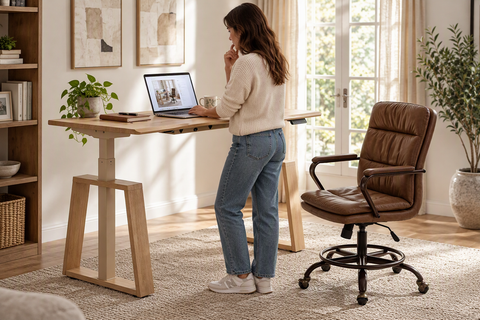
Even with perfect lighting and monitor height, the human body is not designed for prolonged static positions. The Cochrane: Workplace interventions for reducing sitting at work review highlights that sit-stand desks can reduce sedentary time by over 80 minutes per day. For gamers, this is critical.
Prolonged sitting leads to "static load," where muscles remain contracted to support the body, hindering blood circulation. We advocate for the "20-8-2" rule developed by ergonomics experts at Cornell University: for every 30 minutes of work or play, sit for 20 minutes, stand for 8 minutes, and move or stretch for 2 minutes.
Using a desk like the GTG-G55, Glass Desktop Gaming Standing Desk (55"x23") allows you to transition between these states seamlessly. The dual-motor system ensures that your carefully calibrated monitor height and RGB settings remain consistent, whether you are seated or standing.
Scenario Analysis: The Pro Gamer vs. The Remote Worker
The application of these principles varies depending on the user's primary activity.
Scenario A: The Competitive Gamer In high-stakes play, focus is paramount. We recommend a static, warm amber or soft green RGB setting at 25% brightness. This provides the necessary bias lighting to protect the eyes without any moving patterns that could break concentration during a critical match.
Scenario B: The Multi-Tasking Remote Worker For someone balancing spreadsheets and video calls, a larger desk surface like the Gaming Desk with Z Shaped Legs (61"x25") is ideal. In this scenario, the RGB can be used as a "status indicator"—for example, a soft blue light during focus hours and a warmer tone as the workday ends to signal the body to begin winding down.

Addressing Common Implementation Pitfalls
Through our observation of hundreds of home setups, we have identified several "gotchas" that can undermine your ergonomic efforts:
- The Visual Parallax Error: Many users set their standing desk height too high because they look at the desk surface rather than their elbow angle. According to BIFMA G1-2013 Ergonomics Guidelines, the desk should be at a height where your elbows are at approximately a 90-degree angle while your shoulders remain relaxed.
- The RGB Glare Trap: If your RGB strips are visible in the reflection of your monitor, they will cause "veiling glare," which significantly increases eye strain as you try to look "through" the reflection. Always use diffused strips or position them to bounce light off the wall.
- The "Standing is Exercise" Myth: Standing is better than sitting, but it is not a substitute for movement. The WHO 2020 Guidelines on Physical Activity remind us that reducing sedentary behavior is only half the battle; we must also incorporate moderate-intensity activity. Use your standing desk as a platform for micro-movements—calf raises or shifting your weight—rather than standing perfectly still.
Building a Health-First Setup
If you are limited by space but want the benefits of integrated lighting, the GTG - I43, LED Glass Desktop Gaming Desk (43"x23") offers a compact footprint with the same full-surface RGB technology. This ensures that even in a small bedroom or apartment, you can maintain the contrast-reducing benefits of bias lighting.

Summary of Best Practices for Gamers
To maximize the benefits of your setup and protect your long-term musculoskeletal health, follow this checklist:
- Set RGB to Static: Avoid fast-pulsing patterns to lower cognitive load.
- Warm Tones Only: Stick to 2700K–3500K color temperatures in the evening.
- The 20-30% Rule: Keep ambient light at a fraction of your monitor's brightness.
- Monitor Alignment: Ensure the top of the screen is at eye level using a Carbon Fiber Dual Monitor Stand.
- Hydrate Your Eyes: Follow the 20-20-20 rule—every 20 minutes, look at something 20 feet away for 20 seconds to relax the ciliary muscles.
- Verify Stability: Use a desk with reinforced legs, such as the Gaming Desk with Z Shaped Legs (61"x25"), to prevent monitor wobble, which can cause motion-related eye fatigue.
By viewing RGB lighting as a functional component of your ergonomic strategy rather than just an aesthetic choice, you can create a gaming environment that supports both your performance and your long-term well-being.
YMYL Disclaimer: This article is for informational purposes only and does not constitute professional medical advice, diagnosis, or treatment. Always seek the advice of your physician or other qualified health provider with any questions you may have regarding a medical condition or musculoskeletal pain. Ergonomic adjustments should be tailored to individual needs; if you have pre-existing back or eye conditions, consult a specialist before making significant changes to your workstation.
References
- American Academy of Ophthalmology. (2024). Digital Devices and Your Eyes. https://www.aao.org/eye-health/tips-prevention/digital-devices-your-eyes
- BIFMA. (2013). G1-2013 Ergonomics Guideline for Furniture. https://www.bifma.org/news/119419/Updated-BIFMA-Ergonomics-Guideline-Now-Available.htm
- Cochrane Library. (2018). Workplace interventions for reducing sitting at work. https://www.cochranelibrary.com/cdsr/doi/10.1002/14651858.CD010912.pub5/abstract
- OSHA. (n.d.). Computer Workstations eTool - Monitors. https://www.osha.gov/etools/computer-workstations/components/monitors
- World Health Organization. (2020). Guidelines on Physical Activity and Sedentary Behaviour. https://www.who.int/publications/i/item/9789240015128
- ISO. (2024). ISO 9241-5:2024 Workstation layout and postural requirements. https://www.iso.org/standard/86222.html




Leave a comment