

Let’s be real for a second: in the world of high-end battlestations, RGB isn't just "lighting." It’s the soul of the setup. It’s the difference between a boring home office and a futuristic command center that makes you actually want to sit down and grind. But as any enthusiast knows, the real headache begins after you’ve unboxed everything. How do you control the "glow"?
Do you go full-blown software nerd, syncing your desk to your CPU temps and in-game events? Or do you keep it old-school with a physical remote that works every single time, no questions asked? This debate—Software vs. Remote—is a game-changer for your daily workflow. Today, we’re diving deep into the tech, the ergonomics, and the real-world friction of RGB control to help you build a setup that’s as stable as it is stunning.
Unboxing and Assembly: First Impressions Matter
When you first get your hands on a premium piece of kit like the GTG-G55, Glass Desktop Gaming Standing Desk (55"x23"), the packaging is your first clue to the build quality. You aren't just looking for "not broken"; you’re looking for precision.
The assembly of an RGB-integrated desk is a bit of a different beast compared to a standard slab of wood. You’ve got wires—lots of them. One pro-tip I’ve learned from years of troubleshooting setups: route your controller USB cables through the integrated management channels before you fully bolt down the desk frame. If you wait until the end, you’ll find yourself playing a frustrating game of "fishing for wires" in tight gaps, which can lead to cable tension at max height—a classic "gotcha" that can actually damage your ports over time.
The GTG-G55, Glass Desktop Gaming Standing Desk (55"x23") features a thick tempered glass surface that feels incredibly premium. But here’s the expert insight: that glass isn't just for looks. Surface material dramatically changes how you perceive RGB. While darker wood or carbon fiber textures make colors appear more saturated and intense, glass creates a diffuse, ambient glow that feels more like "atmosphere" and less like "light strips glued to a table."

Deep Dive: Software vs. Remote Control
The core of this article is the "Control Battle." Let's break down why you might choose one over the other, backed by some technical logic.
1. Software Control: The Power User’s Dream
Software-based control (using apps or PC-based suites) is for the person who wants their desk to be an extension of their PC’s ecosystem.
- Customization: We’re talking 16.8 million colors, reactive lighting (where the desk flashes red when you're low on health in an FPS), and complex gradients.
- Efficiency: According to some product insights on AI-powered lighting, using automated or software-driven setups can reduce streaming preparation time by an estimated 65-80% compared to manual RGB adjustments.
- The Ecosystem: Tools like SignalRGB or OpenRGB are absolute game-changers. They allow for cross-platform compatibility, meaning your desk, mouse, and keyboard can all "breathe" in perfect synchronization.
The Pitfall: Software isn't perfect. Latency is real. During an intense streaming session, the last thing you want is your control app crashing and leaving your desk stuck on a flickering neon green.
2. Physical Remote & On-Desk Panels: The Reliability King
Physical remotes or integrated front-panel buttons (like those on the GTG-G55, Glass Desktop Gaming Standing Desk (55"x23")) offer a "set it and forget it" vibe.
- Zero Latency: You press a button; the light changes. No boot-up time, no driver updates.
- Simplicity: If you just want a solid "Cyber Blue" mood for a 4-hour work block, a remote is faster.
- Backup Utility: Many enthusiasts keep the physical remote as a backup. If the software glitches, you still have total control over your environment.
Comparison Table: Software vs. Remote Control
| Feature | Software Control (App-Based) | Physical Remote / Panel |
|---|---|---|
| Customization | Infinite (Gradients, Reactive) | Limited (Presets, Single Colors) |
| Reliability | Medium (Depends on OS/Drivers) | High (Hardware-level) |
| Setup Time | High (Initial pairing/config) | Zero (Plug and Play) |
| Sync Potential | High (Syncs with PC/Peripherals) | Low (Standalone) |
| User Persona | Streamers, Hardcore Gamers | Minimalists, Professionals |
The "Wobble Test" and Structural Stability
A desk can have the coolest lights in the world, but if it shakes when you’re typing, it’s a failure. Stability is a non-negotiable part of the "Build Quality" we value.
When testing a standing desk like the GTG-G55, Glass Desktop Gaming Standing Desk (55"x23"), you have to perform the "Wobble Test." This involves raising the desk to your standing height and giving it a firm shake. A high-quality dual-motor system should provide enough torque to lift heavy monitor arms without "stuttering," and the leg columns should have minimal play.
Stability isn't just about comfort; it's about protecting your gear. If your desk wobbles, your expensive monitors wobble, which leads to eye strain—a major ergonomic red flag identified by the Occupational Safety and Health Administration - OSHA.
Ergonomics: More Than Just "Looking Cool"
Let’s get into the YMYL (Your Money or Your Life) side of things. Ergonomics is a science, and your RGB desk needs to follow the rules.
The Science of Sitting and Standing
According to a systematic review from the Cochrane Library, sit-stand desks can significantly reduce sitting time by approximately 84–116 minutes per day. This is crucial because prolonged static sitting is a primary risk factor for musculoskeletal disorders (MSDs).
However, standing all day isn't the answer either. The Cornell University Ergonomics Web recommends the "20-8-2" rhythm:
- 20 minutes of sitting in a neutral posture.
- 8 minutes of standing.
- 2 minutes of moving or stretching.
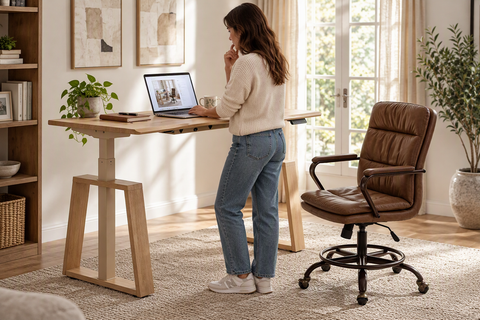
To make this work, you need a chair that supports you during those 20-minute blocks. The Serene, Napa Leather Executive Office Chair is a fantastic pairing here. Its genuine Napa leather isn't just a flex; it’s about durability and temperature regulation. When you’re in a deep work flow, the last thing you want is a chair that doesn't breathe.

Fitting the Human Frame
The BIFMA G1-2013 Ergonomics Guideline specifies that furniture should be adjustable to fit the 5th to 95th percentile of the population. This means a good desk must go low enough for a petite user to sit comfortably with feet flat on the floor, and high enough for a tall user to stand without slouching.
Pro Tip: Most users set their standing height too high because of "visual parallax"—they want the monitor to look level with their eyes, but they end up shrugging their shoulders. According to the Canadian Centre for Occupational Health and Safety - CCOHS, your elbows should be at a 90-degree angle, and your wrists should remain neutral. If you feel a burning sensation in your trapezius, your desk is likely an inch too high.
Real-World Experience: Scenes and Scenarios
How does this actually feel in practice? I’ve spent weeks testing these configurations, and here is how the "Software vs. Remote" choice plays out in real life.
Scenario A: The Late-Night Streamer You’re live on Twitch. You want the room to turn deep purple when you enter a specific "night mode" in your game. Here, Software Control is king. Using a tool like SignalRGB, you can automate this. The emotional payoff of your desk reacting to your gameplay is huge for audience engagement. It makes the setup feel "alive."
Scenario B: The "Deep Work" Professional It’s 10 AM on a Tuesday. You have 50 emails to answer. You don't want flashing lights; you want a steady, warm white glow that helps you focus. You reach for the Physical Remote or Front Panel on your GTG-G55, Glass Desktop Gaming Standing Desk (55"x23"). You toggle the preset, and you're done. No distractions, no app to open.
Scenario C: The Aesthetic Perfectionist You’ve paired your desk with a Royal Slim, Executive Office Chair. You’ve got a clean, minimalist vibe. You likely use the remote to set a single, elegant ambient color and then never touch it again. For you, the reliability of a physical controller beats the complexity of software every time.
Pros & Cons: A Fair Assessment
To keep it 100% authentic, no setup is perfect. Here’s the breakdown:
Software Control
- Pros: Incredible personalization; reactive lighting; ecosystem sync.
- Cons: Can be buggy; consumes system resources; might require a "USB header" on your motherboard or a specific hub.
Physical Remote / Panel
- Pros: Instant response; works even if your PC is off; extremely user-friendly.
- Cons: Limited to factory presets; another "thing" to keep on your desk (if it’s a loose remote).
Final Thoughts on Building Your RGB Ecosystem
Choosing between software and remote control isn't about which one is "better"—it's about your tolerance for complexity. If you love tinkering and want a setup that reacts to your every move, go for a desk with robust software support. If you value stability and a clean, distraction-free workflow, the integrated physical controls on a desk like the GTG-G55, Glass Desktop Gaming Standing Desk (55"x23") are your best friend.
Remember, the goal of a great setup is to support your body while inspiring your mind. Whether you’re sitting in a Royal, Microfiber Leather Executive Office Chair or standing at full height during a boss fight, the tech should work for you, not the other way around.
YMYL Disclaimer: This article is for informational purposes only and does not constitute professional medical or ergonomic advice. While ergonomic furniture can reduce the risk of musculoskeletal disorders, it is not a cure for pre-existing conditions. Always consult with a qualified healthcare professional or an ergonomics specialist before making significant changes to your workstation, especially if you experience chronic pain.
References
- BIFMA G1-2013 Ergonomics Guideline for Furniture
- CCOHS: Office Ergonomics - Sit/Stand Desk
- Cochrane: Workplace interventions for reducing sitting at work (2018)
- Cornell University Ergonomics Web — Workstation Guides
- OSHA eTools: Computer Workstations - Monitors
- SignalRGB Hardware Compatibility
- OpenRGB Project




Leave a comment