

The modern workspace is shrinking. As remote work and high-performance gaming setups move into residential environments, the "shallow desk"—typically defined as having a depth of 24 inches or less—has become a common compromise. While these compact surfaces fit neatly into alcoves and guest rooms, they create a significant ergonomic paradox: the displays we use are growing larger and higher in resolution, while the physical distance between the user and the screen is decreasing.
When a large monitor sits on its factory stand atop a shallow desk, it often occupies the "focal sweet spot," forcing the user into a cramped, near-field viewing position. This proximity is not merely a matter of comfort; it is a physiological stressor that triggers a cascade of musculoskeletal and ocular issues. Reclaiming this focal space is not about getting a bigger room; it is about using structural mounting solutions to move the screen beyond the physical constraints of the desk’s edge.
The Physiology of Focal Strain and the "Near-Field" Trap
The human visual system is not designed for prolonged, high-intensity focus on objects less than 20 inches away. When a monitor is positioned too close—a common occurrence on 24-inch desks where the stand itself can take up 8 to 10 inches of depth—the eyes must constantly engage in two taxing processes: accommodation and convergence.
Accommodation is the process by which the ciliary muscles in the eye contract to change the shape of the lens to focus on near objects. Convergence is the inward rotation of the eyes to keep the image centered on the fovea. According to the Occupational Safety and Health Administration (OSHA) eTools for Computer Workstations, "the preferred viewing distance is between 20 and 40 inches (50 and 100 cm) from the eye to the front surface of the computer screen."
When a screen is forced into the "near-field" (less than 20 inches), these muscles remain in a state of tonic contraction. This leads to Asthenopia, or eye strain, characterized by blurred vision, headaches, and a burning sensation. Furthermore, the Canadian Centre for Occupational Health and Safety (CCOHS) notes that improper screen placement often leads users to tilt their heads back (neck extension) or lean forward (protraction), both of which disrupt the spinal neutral position and increase the static load on the cervical spine.
The Geometry of Space Reclamation: Quantifying the Deficit
To understand the solution, we must first quantify the problem. A standard 24-inch depth desk, when paired with a 27-inch monitor on a stock stand, typically leaves only 14 to 16 inches of actual viewing distance. This creates a "focal deficit."
Based on technical simulations of high-end setups, the deficit becomes even more pronounced with ultrawide displays. For a 49-inch super ultrawide monitor (32:9 aspect ratio), the THX-recommended viewing distance for an immersive yet safe experience is approximately 64.8 inches. On a 24-inch shallow desk, this creates a staggering 40.8-inch deficit.
A 2022 study by the Human Factors and Ergonomics Society (HFES) found that using a monitor mount allows users to reclaim an average of 18% of functional desk space. This "reclaimed space" is often the difference between a cluttered, stressful environment and one that supports the "neutral reach zone"—the area where you can reach tools without leaning or twisting.
Table 1: Viewing Distance and Desk Depth Compatibility
| Monitor Size | Ideal Viewing Distance (Min) | Desk Depth (Standard Stand) | Resulting Focal Deficit |
|---|---|---|---|
| 24" 1080p | 20 inches | 24 inches | ~4 inches (Minimal) |
| 27" 1440p | 25 inches | 24 inches | ~9 inches (Moderate) |
| 34" Ultrawide | 32 inches | 24 inches | ~16 inches (Significant) |
| 49" Super Ultrawide | 40+ inches | 24 inches | ~24+ inches (Critical) |
The Mechanism of the Monitor Arm: Beyond the Desk Edge
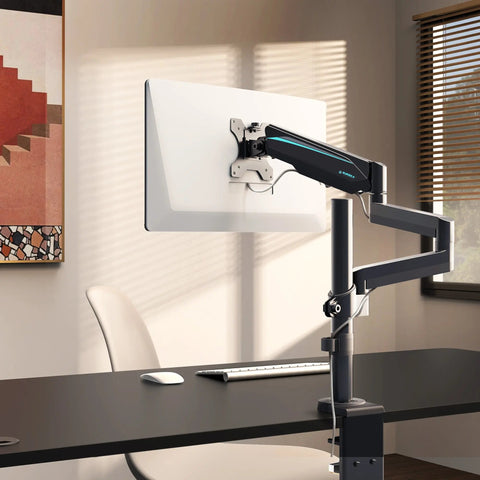
A monitor arm functions as a mechanical extension of the human body’s ergonomic needs. By replacing the static, wide-base factory stand with a slim C-clamp or grommet mount, the monitor can be suspended in "zero-gravity" space.
The primary ergonomic advantage of a high-quality arm is its ability to provide forward and backward extension. On a shallow desk, the arm can actually position the monitor behind the rear edge of the desk if the desk is not flush against a wall. If the desk is against a wall, the arm allows the screen to be pushed back until the bezel is nearly touching the wall, a feat impossible with most factory stands that require 5–8 inches of rear clearance for stability.
Engineering Controls: Gas Spring vs. Tension
When selecting a mounting solution for a shallow desk, the mechanism of adjustment is critical.
- Gas Spring Arms: These use a pressurized gas cylinder to counterbalance the weight of the monitor. They offer the most fluid movement, allowing for "one-touch" adjustments. For sit-stand desks, gas spring arms perform more consistently than tension models because they maintain the set height even during the vibration of the desk moving.
- Mechanical Tension Arms: These rely on a coiled spring and a tightened bolt. While often more affordable, they require more effort to adjust and can "drift" over time if the monitor is near the arm's maximum weight capacity.
According to ISO 9241-5:2024, which specifies workstation layout and postural requirements, furniture should encourage frequent changes in posture. A gas spring arm facilitates this by allowing the user to pull the screen closer for detail work and push it back for reading or video conferencing, maintaining the ideal 20-degree downward viewing angle.
Structural Integrity: The "Gotchas" of Mounting
Reclaiming space through mounting introduces new mechanical stresses on the furniture itself. A common mistake is mounting a heavy, long-reach arm to a desk made of particleboard or hollow-core materials.
The C-clamp mechanism concentrates the entire weight of the monitor and the leverage of the arm into a small surface area (typically 3–4 square inches). On soft wood or bamboo, this can cause permanent indentation or even structural failure.
Expert Insight: If you are using a shallow desk made of composite materials, always use a steel reinforcement plate. This plate sits between the clamp and the desk, distributing the pressure over a larger area (15–20 square inches), effectively preventing the "crush" effect.
Furthermore, you must verify the dynamic load rating. While a monitor might weigh 15 lbs (static load), the force exerted on the arm and desk during adjustment can double that figure. Ensuring your desk is rated for the total equipment load is vital. In professional setups where equipment (PC, triple monitors, studio gear) approaches 100 kg, a dual-motor standing desk is often mandatory to ensure the lift mechanism can handle the weight without burning out or wobbling.
Practical Setup: The Step-by-Step Calibration
Achieving the perfect focal distance on a shallow desk requires a systematic approach. Do not simply clamp the arm and walk away; follow this calibration sequence derived from Cornell University Ergonomics Web guides:
- Establish the Neutral Reach Zone: Sit in your chair with your shoulders relaxed and elbows at a 90-degree angle. Your keyboard and mouse should be positioned where your hands naturally fall. This is your "home base."
- Initial Height Setting: Mount the arm so that the top of the monitor is at or slightly below eye level. A common error is mounting the arm too high initially, which leads to neck extension. Start lower and adjust upward in half-inch increments.
- The Focal Distance Test: Extend your arm toward the screen. Your fingertips should just barely touch the glass. This represents a viewing distance of approximately 20–30 inches. On a shallow desk, you will likely need to push the monitor arm elbow back toward the wall to achieve this.
- The 20-Degree Tilt: According to BIFMA G1-2013 Ergonomics Guidelines, a slight upward tilt of 10 to 20 degrees helps align the screen surface perpendicular to your line of sight, reducing glare and improving readability.
- Cable Tension Check: Ensure your cables have enough "service loop" (slack). A common failure point occurs when a user raises a sit-stand desk and the monitor arm cables are too tight, potentially damaging the ports on the monitor or the PC.
Beyond the Screen: Holistic Desk Management
Reclaiming focal space is the first step, but a shallow desk still faces a width constraint. For gamers, specifically eSports athletes using low-sensitivity settings (e.g., 400 DPI), the mousepad alone can require 170 cm of width.
By lifting the monitor off the desk, you remove the "dead zone" created by the stand. This allows the mousepad to slide partially under the monitor if necessary, providing the "sweeping" room required for competitive play.
Additionally, consider the "behind-chair" space. If your shallow desk is part of a professional streaming setup, you must account for the 24-inch buffer required for lighting and greenscreens. The monitor arm’s ability to "tuck" the screen away when not in use is a critical feature for multi-purpose rooms.
Summary of Best Practices for Shallow Desks
| Feature | Recommendation | Why it Matters |
|---|---|---|
| Mounting Type | C-Clamp with Reinforcement | Prevents desk damage and ensures stability. |
| Arm Type | Gas Spring | Allows for fluid movement and one-touch height changes. |
| Viewing Distance | 20–30 inches | Reduces accommodation-vergence stress on the eyes. |
| Monitor Height | Top line at eye level | Prevents neck strain and promotes neutral posture. |
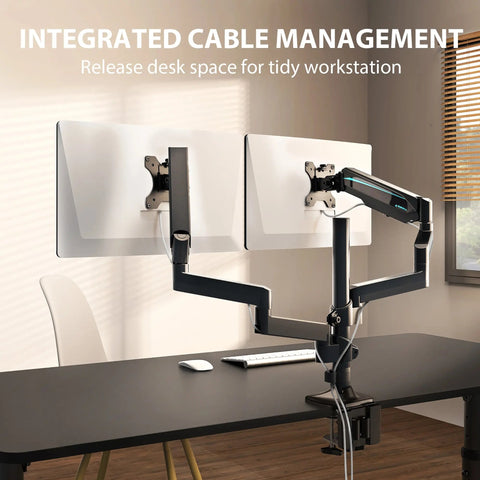
| Cable Management | Integrated Channels | Prevents snagging during height or depth adjustments. |
Navigating the Transition
Transitioning from a traditional stand to a monitor arm on a shallow desk often reveals how much we have been subconsciously compensating for poor ergonomics. You may find that you no longer need to lean forward to read small text, or that the persistent tension in your upper traps begins to dissipate.
However, remember that no single piece of equipment is a panacea. Even the most perfectly positioned monitor cannot offset the risks of prolonged static behavior. The World Health Organization (WHO) 2020 Guidelines emphasize the importance of interrupting long periods of sedentary behavior. Use your reclaimed space to incorporate micro-movements, and follow the Cornell "20-8-2" rule: 20 minutes of sitting, 8 minutes of standing, and 2 minutes of moving or stretching.
By solving the focal space problem, you aren't just making your desk look cleaner; you are engineering a workspace that respects the biological limits of the human body.
YMYL Disclaimer: This article is for informational purposes only and does not constitute professional medical advice, diagnosis, or treatment. Always seek the advice of a qualified health provider with any questions you may have regarding a musculoskeletal condition or eye strain. The ergonomic recommendations provided are based on general industry standards and may not be suitable for individuals with pre-existing injuries or specific clinical needs.
Sources
- Canadian Centre for Occupational Health and Safety (CCOHS) - Office Ergonomics
- OSHA eTools - Computer Workstations: Monitors
- Cornell University Ergonomics Web - Workstation Setup Guide
- ISO 9241-5:2024 - Workstation Layout and Postural Requirements
- BIFMA G1-2013 Ergonomics Guideline for Furniture
- World Health Organization (WHO) Guidelines on Physical Activity and Sedentary Behaviour




Leave a comment