

The professional workspace has undergone a radical transformation, yet a fundamental health crisis persists. Despite the widespread adoption of ergonomic chairs and height-adjustable desks, a significant portion of the workforce continues to experience chronic neck and shoulder discomfort. Research indicates that approximately 60% of office workers still suffer from "tech neck" or related musculoskeletal issues, even when utilizing adjustable technology.
The primary culprit is not necessarily the equipment itself, but the "set and forget" mentality. Many users establish what they believe is a "perfect" neutral position and remain static for hours. This article explores why fluid motion—specifically facilitated by gas spring monitor arms—is the missing link in preventing musculoskeletal disorders (MSDs) and how intentional, periodic adjustments can fundamentally alter the physiological impact of a workday.
The Physiology of Static Load and Tissue Adaptation
Human anatomy is optimized for movement, not prolonged stasis. When a professional maintains a fixed gaze on a monitor for extended periods, they subject their body to a "static load." This physical principle describes the effort required to hold a posture against gravity without movement.
According to the ISO 11226:2000 standard for the evaluation of static working postures, the health risks associated with static postures are determined by the duration of the hold and the deviation from a neutral joint angle. When the neck is tilted forward even by 15 degrees to compensate for a monitor that is too low, the effective weight of the head on the cervical spine increases from roughly 12 pounds to nearly 27 pounds.
Over time, this leads to "tissue adaptation." The muscles in the upper back and neck become chronically overstretched, while the chest muscles tighten. This imbalance restricts blood circulation, leading to the accumulation of metabolic waste products in the muscle tissue, which manifests as the familiar afternoon "burning" sensation in the trapezius. The European Agency for Safety and Health at Work (EU-OSHA) notes that these pathophysiological mechanisms are the precursors to chronic MSDs, emphasizing that early intervention through postural variation is critical.
The Engineering of Fluid Motion: Gas Spring Technology
To combat static load, a workstation must encourage movement rather than just accommodating a single "correct" position. This is where gas spring technology outperforms traditional mechanical spring or friction-based mounting systems.
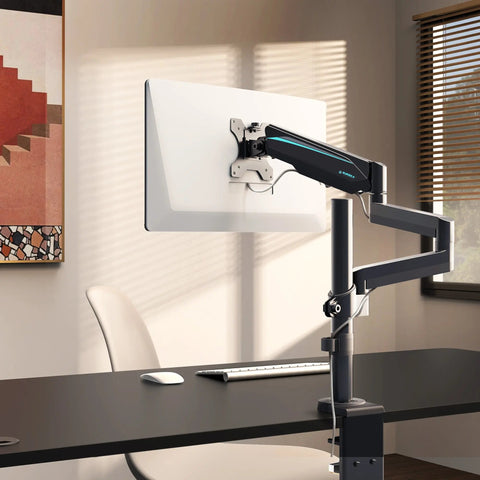
A gas spring (or pneumatic spring) utilizes a cylinder filled with high-pressure nitrogen gas. When you move the monitor, a piston compresses the gas, providing a smooth, counterbalanced resistance. This allows for "fluid motion"—the ability to reposition a heavy display with a single hand and have it stay exactly where you leave it.
Gas Spring vs. Mechanical Spring: A Technical Comparison
| Feature | Gas Spring (Pneumatic) | Mechanical Spring (Tension) |
|---|---|---|
| Adjustment Effort | Near-zero; one-handed operation. | Often requires two hands or significant force. |
| Smoothness | Consistent resistance throughout the range. | Resistance often increases as the spring compresses. |
| Longevity | High, though gas can eventually leak over years. | Can lose tension or become "creaky" over time. |
| Noise | Silent operation. | May produce metallic clicking or squeaking. |
The OSHA eTools guide on computer workstations emphasizes that monitors should be positioned so the top line of text is at or slightly below eye level. However, the guide also acknowledges that viewing needs change based on the task—reading a long document might require a different tilt than detailed graphic design work. Gas spring arms facilitate these micro-adjustments without interrupting the user's cognitive flow.
Information Gain: The Tall Professional Case Study
General ergonomic advice often focuses on the "average" user, but the benefits of gas spring arms are most pronounced for those at the edge cases of anthropometry. Consider the requirements of a 95th percentile male (approximately 189 cm or 6'2.5") managing a complex multi-monitor setup.
In a simulated ergonomic assessment for this demographic, we identified several critical "deficits" that standard fixed stands cannot solve:
- Vertical Height Deficit: A tall professional requires a seated desk height of approximately 78.2 cm (30.8 inches). When transitioning to standing, the monitor must rise significantly higher than it would for a shorter user to maintain the neutral eye-level gaze.
- Viewing Distance Paradox: Large monitors, such as 49-inch super ultrawides, require a much greater viewing distance—often over 160 cm (63 inches) according to THX standards. On a standard 24-inch deep desk, the monitor must be pushed back far beyond the desk's rear edge. A gas spring arm provides the necessary "reach" and articulation to position the screen in free space behind the desk.
- Load Stability: High-end workstations often involve heavy displays. A dual-motor desk paired with a high-capacity gas spring arm ensures that the 94 kg load of a full "battlestation" remains stable during height transitions.
Table: Ergonomic Requirements for the 95th Percentile User (189 cm)
| Parameter | Seated Requirement | Standing Requirement | Range Needed |
|---|---|---|---|
| Desk Height | 78.2 cm (30.8") | 116.0 cm (45.7") | 37.8 cm (14.9") |
| Monitor Center | ~122 cm from floor | ~160 cm from floor | 38 cm Adjustment |
| Viewing Distance | 164.6 cm (for 49" UW) | 164.6 cm | Extended Arm Reach |
The Proprioception Factor: Why Resistance Matters
While "fluid motion" is the primary selling point, the resistance of the gas spring serves a secondary, often overlooked neurological purpose. Recent research suggests that proprioceptive feedback—the body's ability to sense its own position and movement—is enhanced when moving against a controlled resistance.
A study published in Frontiers in Rehabilitation Sciences discusses how multi-sensory integration is essential for maintaining optimal movement patterns. When a user manually adjusts a gas spring arm, the kinesthetic awareness of that movement helps the brain "reset" its internal map of the body's posture. This is why a gas spring arm that is set too "light" can actually be less effective; the resistance should feel substantial enough to require intentional movement, which in turn triggers the user to be more aware of their physical state.
Practical Recommendation: The "20-8-2" Rhythm
To truly unlock the health benefits of gas spring technology, users should adopt the "20-8-2" rule developed by Cornell University Ergonomics Web. This protocol suggests:
- 20 Minutes of sitting in a neutral posture.
- 8 Minutes of standing.
- 2 Minutes of moving or stretching.
During these transitions, use the gas spring arm to make "micro-adjustments." Even a 2-degree change in monitor tilt or a 1-inch change in height every 60 to 90 minutes can prevent the onset of muscle fatigue. This prevents any single muscle group from bearing the static load for too long.
Setup Checklist for Optimal Fluidity
- Tension Calibration: Adjust the gas spring tension until the monitor "floats." It should stay in place when released but move with a gentle push. If you have to use two hands or brace the desk, the tension is too high.
- Structural Integrity: Ensure the clamp or grommet mount is secured to a solid part of the desk. Avoid mounting on thin particleboard without a reinforcement plate, as the leveraged force of moving the arm can cause the desk material to fail over time.
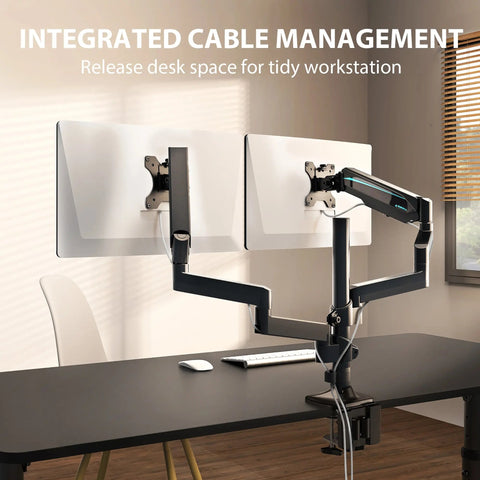
- Cable Management: Leave enough "slack" in your cables at the arm's maximum extension. Tight cables are the most common cause of restricted movement and can eventually damage the ports on your monitor or PC.
- Alignment: According to the Canadian Centre for Occupational Health and Safety (CCOHS), if you use dual monitors, they should be angled in a slight semi-circle to minimize head rotation.
Addressing the "Friction Points" of Implementation
In real-world applications, several non-obvious mechanical issues can undermine the benefits of a monitor arm. One of the most common "gotchas" is the interaction between the arm and the wall behind the desk. Many gas spring arms require several inches of clearance behind the desk to fold the "elbow" of the arm. In tight home offices, this often forces the desk away from the wall, creating a gap where items can fall.
Furthermore, users often forget to account for visual parallax. When you move from sitting to standing, your viewing angle relative to the screen changes. A fixed stand forces you to tilt your head back to compensate. A gas spring arm allows you to quickly tilt the screen downward for a standing position and upward for a seated position, maintaining a perpendicular line of sight that reduces eye strain and "tech neck."
The Integrated Wellness Strategy
A monitor arm is not a panacea. To achieve the best health outcomes, it must be part of an integrated system. This includes:
- Administrative Controls: Using timers or software reminders to trigger postural shifts.
- Environmental Adjustments: Managing glare and lighting to prevent the "turtling" posture (leaning forward to see the screen better).
- Physical Training: Strengthening the core and upper back to better support the spine during the periods of sitting that are unavoidable in knowledge work.
By viewing the gas spring arm not as a static bracket, but as a tool for continuous movement, professionals can significantly reduce their risk of long-term injury and improve their daily well-being.
YMYL Disclaimer: This article is for informational purposes only and does not constitute professional medical advice, diagnosis, or treatment. Always seek the advice of your physician or other qualified health provider with any questions you may have regarding a medical condition or musculoskeletal pain. The ergonomic recommendations provided are general guidelines and may need to be adjusted based on individual physical requirements or pre-existing conditions.
Sources
- ISO 11226:2000: Evaluation of static working postures. https://www.iso.org/standard/25573.html
- OSHA eTools: Computer Workstations - Monitors. https://www.osha.gov/etools/computer-workstations/components/monitors
- Cornell University Ergonomics Web: Workstation Guides and the 20-8-2 Rule. https://ergo.human.cornell.edu/ergoguide.html
- CCOHS: Office Ergonomics - Sit/Stand Desk. https://www.ccohs.ca/oshanswers/ergonomics/office/sit_stand_desk.html
- EU-OSHA (OSHwiki): Pathophysiological mechanisms of musculoskeletal disorders. https://oshwiki.osha.europa.eu/en/themes/pathophysiological-mechanisms-musculoskeletal-disorders
- Frontiers in Rehabilitation Sciences: The Effectiveness of Proprioceptive Training. https://www.frontiersin.org/journals/rehabilitation-sciences/articles/10.3389/fresc.2022.830166/full




Leave a comment