

Side Table Ergonomics: Matching Heights to Modular Sofa Arms
Key Takeaways for Facility Managers:
- The 0–2 Inch Rule: For optimal comfort, the side table surface should ideally sit between 0 and 2 inches above the height of the sofa's armrest.
- The Compression Factor: Always measure the "compressed" height (the height of the armrest when a user is seated) rather than the static manufacturer specification.
- Inclusive Design: Anthropometric data reveals a 5.2-inch (13.2 cm) gap between the needs of the 5th and 95th percentile users; a mix of table heights is recommended for high-traffic zones.
- Disclosure: This guide is provided by Eureka Ergonomic and includes examples from our product line to illustrate ergonomic principles in practice.
In high-traffic corporate reception zones, the difference between a premium guest experience and physical discomfort often hinges on a single measurement: the vertical clearance between a seating surface and the adjacent side table. Many facility managers and office designers rely on a standard "2-inch rule" for table height, yet they frequently observe visitors shifting restlessly or bending forward awkwardly to reach for a tablet or a cup of coffee. This phenomenon, known as "reaching down," is a significant contributor to acute musculoskeletal strain in hospitality environments.
The challenge is exacerbated by the evolution of modular seating. Unlike traditional static furniture, modern modular systems prioritize flexibility and aesthetic scale, often resulting in armrest heights that deviate significantly from historical office standards. When the height of a side table is not aligned with the specific armrest levels of a modular sofa, the user is often forced into a static working posture that can disrupt a spinal neutral position.
The Pathophysiology of Static Loading in Lounge Environments
To understand why a height mismatch of even two inches matters, one must examine the physiological principles of the musculoskeletal system. According to the International Organization for Standardization (ISO 11226:2000), maintaining static working postures for extended periods—even in a relaxed lounge setting—can increase the "static load" on the upper trapezius and cervical spine.
When a side table is significantly lower than the user's elbow height, the individual typically engages in repeated trunk flexion (forward leaning) and scapular protraction (rounding the shoulders). This movement pattern can disrupt the spinal neutral position, which the Occupational Safety and Health Administration (OSHA) identifies as a risk factor for Musculoskeletal Disorders (MSDs). In a reception environment where a visitor might wait for 30 to 60 minutes, this repetitive reaching may create cumulative strain on the soft tissues surrounding the spine.
Furthermore, blood circulation can be compromised when the arm is held at an unnatural angle to reach a low surface. Proper ergonomic alignment aims to keep the elbow at an approximate 90-to-100-degree angle, supporting optimal vascular flow. As noted in The 2026 Workstation White Paper, the convergence of ergonomic science and furniture engineering is essential for mitigating these "micro-strains" that can degrade the user experience over time.
The Modular Mismatch: Why Standard Guidelines May Fail
A common misconception in corporate design is that modular sofa arms fall within a predictable 24-to-27-inch range. However, observations from facility audits suggest that modular systems can vary by 1 to 3 inches even within the same manufacturer's collection. For instance, some high-profile modular systems feature armrest heights of approximately 29.5 inches (75 cm), which is nearly the height of a standard executive desk.
Practical Observation: Based on common patterns observed in furniture placement and user feedback, modular furniture variability often requires site-specific measurements rather than relying solely on catalog specifications.
When a designer pairs a 29.5-inch armrest with a "standard" 22-inch side table, the resulting 7.5-inch drop creates a notable ergonomic deficit. This mismatch often forces the user to choose between leaning uncomfortably far to the side or abandoning the backrest entirely to reach forward. Both actions can increase the compressive load on the lumbar spine.
Scenario Modeling: Anthropometric Diversity in the Corporate Lounge
To provide a technical foundation for furniture selection, we modeled the ergonomic requirements for a diverse user population. This analysis utilizes the BIFMA G1-2013 Ergonomics Guideline to estimate "ideal" table heights based on the anthropometrics of the 5th percentile female and the 95th percentile male.
Modeling Analysis: The Height Gap (Estimates)
| User Percentile | Stature (cm) | Elbow Height Sitting (cm) | Ideal Table Height (cm)* |
|---|---|---|---|
| 5th Percentile Female | 152.4 | 21.6 above seat | 63.5 |
| 95th Percentile Male | 185.4 | 27.4 above seat | 76.7 |
*Note: Data derived from ANSI/HFES 100-2007 population averages. Ideal table height includes a 2.5 cm shoe correction. These values are heuristics for design planning.
The data reveals a critical 13.2 cm (approx. 5.2 inches) gap between the requirements of the smallest and largest users. In a corporate environment where a product like the Beverly Loveseat Sofa might host diverse clients, a fixed-height side table may not provide ergonomic parity for every user.

For a 5th percentile female user seated on a modular sofa with a 75 cm armrest, the surface may be nearly 11.5 cm (4.5 inches) too high, potentially leading to shoulder elevation. Conversely, for a 95th percentile male, the same surface might feel perfectly aligned. This disparity highlights the benefit of a measurement-based approach.
Strategic Selection: Integrating Ergonomic Seating and Surfaces
When designing a flexible corporate lounge, the selection of seating should account for both the physical dimensions of the furniture and the dynamic needs of the user.
1. High-Density Hospitality Zones
For areas where visitors engage in short-term waiting, the Beverly Loveseat Sofa offers a professional Italian-inspired silhouette. From an ergonomic standpoint, its armrest height should be the primary driver for table selection. To maintain the 0-to-2-inch tolerance recommended for comfort, designers should select side tables that sit at or slightly above the compressed armrest height.
2. Focused Comfort Zones
In zones intended for longer stays—such as a "touchdown" lounge—seating with integrated movement can be beneficial. The Lucia Swivel Rocking Recliner addresses the risks of prolonged static sitting. According to the Canadian Centre for Occupational Health and Safety (CCOHS), incorporating movement like rocking or swiveling can help improve circulation.

The Lucia recliner’s manual recline allows users to transition postures. This shift changes the user's elbow height relative to the floor, making a height-adjustable side table or a tiered table system a highly effective companion for this type of chair.
3. Multi-Functional Utility Zones
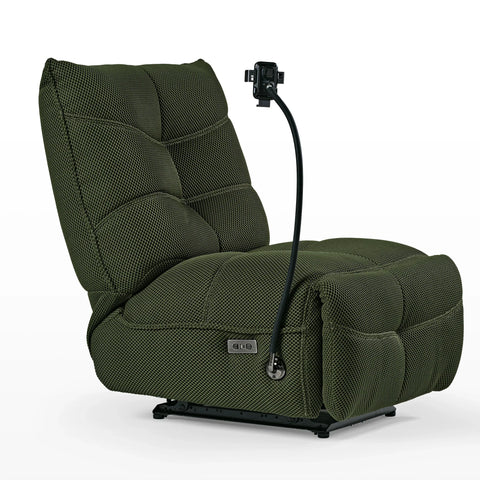
For reception areas that require versatility, the Grayson Recliner with Storage provides a functional solution. When pairing the Grayson with a side table, designers must account for the 360° swivel base; the table should be positioned with enough clearance to allow rotation without collision, while remaining close enough to prevent excessive reaching.

The Potential ROI of Ergonomic Precision
Investing in properly matched furniture is more than a matter of comfort; it can be viewed as a business strategy to enhance visitor well-being. Using scenario modeling, we can estimate the potential productivity impact of ergonomic alignment.
Example Productivity Value Estimate:
- Assumptions: A professional wage rate of $45/hour, 180-minute daily usage per seat, and an estimated 10% productivity/comfort uplift.
- Illustrative Calculation: $45/hour × 3 hours/day × 250 days/year × 0.1 factor = ~$3,375 estimated value gain per year, per seat.
Note: This calculation is a heuristic for illustrative purposes. Actual ROI depends on specific facility utilization and user demographics.
Furthermore, an "ergonomic mismatch" can lead to increased muscular effort. While difficult to quantify universally, research into static loading suggests that awkward postures can significantly increase the perceived load on the cervical spine and trapezius muscles. For a facility manager, choosing ergonomically compatible furniture can often reach a return on investment within the first year of operation through improved user satisfaction and reduced fatigue.
Practical Recommendations for Office Designers
To achieve "Ergonomic Parity," follow these technical steps when specifying side tables:
- Measure Compressed Arm Height: Measure the height of the armrest while a person is seated to account for the "Cushion Compression Effect." Softer cushions can lower the actual working height by 1 to 2 inches.
- Apply the 0-to-2 Inch Rule: The side table surface should ideally be between 0 and 2 inches above the armrest height to prevent the "reaching down" motion.
- Prioritize Elbow Height: For armless seating like the Marco Lounge Chair, use the seated user's elbow height (typically 8.5 to 10.8 inches above the seat) as the reference point.
- Consider Anthropometric Inclusivity: Given the variance between users, providing a variety of table heights in high-traffic zones is a best practice.
- Verify Clearance for Movement: Ensure that tables paired with swivel or rocking chairs, such as the Lucia Recliner, are placed to avoid mechanical interference while supporting a neutral reach zone.
Appendix: Modeling Transparency
Method & Assumptions This analysis uses a deterministic parameterized model to estimate ergonomic requirements. These findings are intended as a decision-making aid and are not a substitute for a professional ergonomic assessment.
| Parameter | Value | Unit | Rationale / Source |
|---|---|---|---|
| Usage Time | 180 | min/day | Estimated cumulative daily use in a busy zone |
| Professional Wage | 45 | USD/hr | Industry average estimate for corporate professionals |
| Productivity Factor | 0.1 | ratio | Heuristic estimate of efficiency gain from comfort |
| Shoe Correction | 2.5 | cm | Standard office footwear allowance (ANSI/HFES) |
Boundary Conditions:
- ROI calculations are hypothetical estimates; results vary by sector and location.
- Cushion compression values are based on high-density foam (30-35 kg/m³) and may differ for other materials.
- Sensitivity Note: A 5% decrease in the "Productivity Factor" would reduce the estimated annual value gain by half, highlighting the importance of high-utilization environments for ROI.
Disclaimer: This article is for informational purposes only and does not constitute medical or occupational therapy advice. If you have pre-existing musculoskeletal conditions, please consult a qualified healthcare professional or a certified professional ergonomist before making significant changes to your environment.




Leave a comment