

Maximizing your screen real estate without expanding your desk's footprint is a common challenge for multitaskers, developers, and designers. A stacked dual monitor setup, which places one screen on top of the other, is an elegant solution that leverages vertical space. However, a poor setup can lead to significant neck and shoulder strain. This guide provides a comprehensive, step-by-step approach to configuring your stacked monitors ergonomically, ensuring you boost productivity without compromising your well-being.
We will cover the core scientific principles of monitor placement, how to select the right mounting hardware, and a detailed process for calibration, grounded in authoritative guidelines from occupational health and safety experts.
The Ergonomic Foundation of a Vertical Monitor Setup
Before you mount anything, it's crucial to understand the principles of workplace ergonomics. The goal is to achieve a neutral posture, where your joints are naturally aligned, minimizing stress on your muscles and spine. For computer workstations, this involves a specific set of angles and distances for your eyes, neck, and limbs. According to the Occupational Safety and Health Administration (OSHA), maintaining neutral body postures is the foundation of a safe and comfortable computer workstation.
Positioning Your Primary (Bottom) Monitor
Your primary monitor is the one you spend the most time looking at for active tasks like writing, editing, or coding. It should be positioned directly in front of you. A common mistake is to place the top edge of this screen at eye level. While well-intentioned, this often forces you to tilt your head back slightly or gaze upwards, creating tension.
Instead, a more sustainable posture involves a slight downward gaze. Ergonomics practitioners recommend that the center of your primary screen should be positioned about 10-20 degrees below your horizontal eye line. For most users, this means the top third of the monitor will be at or just below eye level. This position allows your neck to remain in a more relaxed, neutral position.

Positioning Your Secondary (Top) Monitor
The top monitor should be reserved for secondary, glanceable information—think communication apps, reference materials, or system monitoring tools. You should not be performing long-duration tasks on this screen. To minimize neck extension (tilting your head back), the top monitor should be tilted downward at a 15 to 30-degree angle. This allows you to view the screen by moving your eyes rather than your entire head.
As a firm rule, your neck flexion should not exceed 30 degrees for anything more than brief glances. As research from sources like Cornell University Ergonomics Web demonstrates, prolonged or repetitive awkward postures are a primary risk factor for musculoskeletal disorders.

Common Misconception: "Eye Level" Is Not the Whole Story
The advice to "place your monitor at eye level" is often oversimplified. It doesn't account for the vertical size of modern displays. If you place the top of a 27-inch or 32-inch monitor at eye level, the center of the screen will be too low, forcing you to look down and flex your neck. Conversely, placing the center at eye level can push the top too high.
The most reliable method is to use your line of sight as the guide. Sit back in your chair in a neutral posture and look straight ahead. The top of the viewable area on your primary screen should be at or slightly below this line. This principle is a cornerstone of guidelines provided by agencies like the Canadian Centre for Occupational Health and Safety (CCOHS), which focus on creating a setup that fits the individual user.
Choosing the Right Hardware for a Stacked Setup
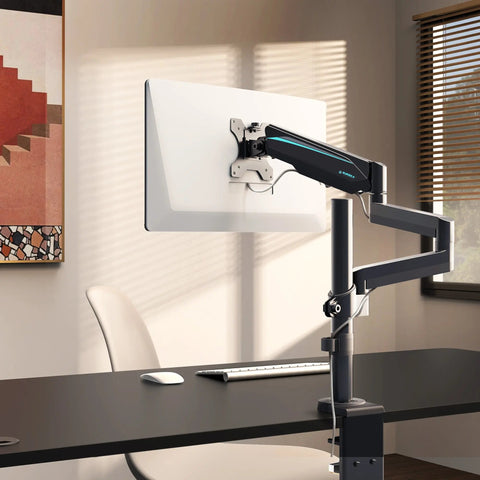
A stable and highly adjustable mounting system is non-negotiable for a stacked monitor configuration. While some monitors come with basic stands, they rarely offer the height or tilt range needed for proper vertical alignment. You will need a dedicated monitor arm or stand.
Expert Warning: Monitor Weight Specs Can Be Deceiving
It’s easy to assume that if a monitor arm’s weight capacity exceeds your monitor’s weight, you’re good to go. However, the reality is more complex. Torque and the monitor’s center of gravity play a huge role. Larger screens (27"+), especially curved or ultrawide models, have a center of mass that sits further from the VESA mounting plate. This creates greater leverage on the arm’s joints.
An arm might be rated for 20 pounds, but it can still sag, droop, or wobble if a deep monitor places too much torque on it. For stacked setups, stability is paramount. Always choose an arm that explicitly lists support for your monitor’s size and form factor (e.g., curved compatibility), not just its weight. Placing the heavier or deeper monitor on the bottom arm can also improve overall stability.
Checklist for Selecting a Monitor Arm
Use this table to evaluate your options and ensure you purchase a mount that is safe, stable, and ergonomic.
| Feature | What to Look For | Why It Matters |
|---|---|---|
| Mount Type | Desk Clamp, Grommet, or Freestanding Pole | Choose based on your desk's material and whether it has a grommet hole. Clamps are most common. |
| VESA Compatibility | 75x75mm, 100x100mm | Must match the mounting pattern on the back of your monitors. |
| Vertical Travel | At least 25-40 cm (10-15 inches) of height adjustment | Essential for positioning both monitors correctly and for accommodating sit-stand desk height changes. |
| Weight Capacity | Rated for at least 1.5x your monitor's weight | Provides a safety margin, especially for the top monitor. |
| Size & Curve Support | Explicitly states support for your monitor size and if it's curved | Accounts for the center-of-gravity issue and ensures the arm can handle the torque. |
| Tilt Mechanism | At least 30° of downward tilt for the top arm | Crucial for angling the top monitor down to reduce neck extension. |
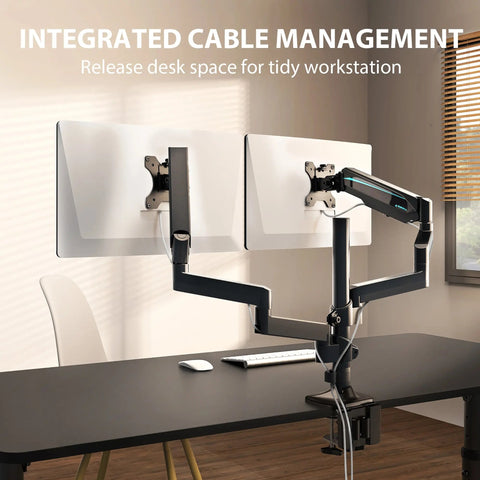
| Cable Management | Integrated channels or clips | Keeps cables tidy and prevents them from getting snagged, especially with a height-adjustable desk. |
Step-by-Step Guide to Setting Up Your Stacked Monitors
Follow these steps systematically to build your ergonomic workstation.
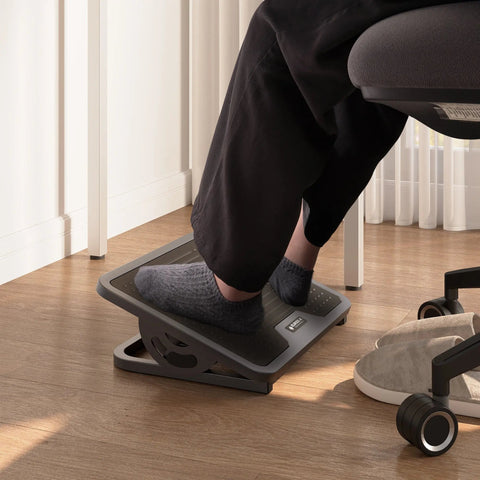
Step 1: Establish Your Ergonomic Baseline Before touching the monitors, set up your chair and keyboard. Your feet should be flat on the floor or on a footrest. For added comfort and to promote circulation, an Adjustable Ergonomic Footrest can be a valuable addition. Your knees should be at roughly a 90-degree angle. Adjust your chair height so your elbows are also at a 90-degree angle when your hands are on the keyboard. A Pull-out Keyboard Tray can help achieve this if your desk is too high.
Step 2: Mount the Arms and Monitors Securely attach the monitor arm or pole to your desk according to the manufacturer’s instructions. Attach the VESA plates to your monitors and then mount them onto the arms. It’s often easier to do this with two people.
Step 3: Position the Primary (Bottom) Monitor Sit in your neutral posture. Adjust the bottom monitor so its top edge is at or just below your horizontal eye level. The viewing distance should be about an arm's length away—typically 50-70 cm (20-28 inches) for 24-27" screens.
Step 4: Position the Secondary (Top) Monitor Move the top monitor directly above the primary one, leaving as little gap as possible to create a continuous visual field. Tilt it downwards between 15 and 30 degrees. The goal is to be able to see the screen by just shifting your gaze up, without tilting your head back.
Step 5: Manage Your Cables If you use a height-adjustable desk, this step is critical. Route all power and video cables through the arm's management channels, leaving 30-50 cm (12-20 inches) of slack. This service loop prevents cables from being pulled taut or disconnected when you change from sitting to standing. To keep your computer tower moving with your desk, a solution like the Mobile Height Adjustable CPU Cart prevents cables from being stretched or unplugged.
Step 6: Test and Refine Use your new setup for at least 20-30 minutes. Pay attention to any feelings of strain in your neck, shoulders, or eyes. Don’t hesitate to make small adjustments. Your comfort is the ultimate measure of success.
Advanced Considerations for Power Users
For those with more complex setups, a few extra details can make a significant difference.
Pro Tip: Working with Mixed-Resolution Displays
Using monitors with different resolutions or refresh rates is common. To avoid issues, always plug your primary monitor (e.g., a high-refresh-rate gaming screen) into your computer’s most powerful video port (usually a DisplayPort 1.4 or HDMI 2.1). Modern operating systems like Windows 11 and macOS handle per-display scaling well, but try to keep the scaling differences modest (e.g., 100% on one and 125% on another) to prevent older applications from appearing blurry.
Integrating with a Sit-Stand Desk
A stacked setup on a sit-stand desk requires careful calibration. You need two ergonomic presets: one for sitting and one for standing. The geometry of your monitor heights relative to your eye level must be maintained in both postures. This is where a monitor arm with significant vertical travel is essential. You must ensure the arm can lift the entire stack high enough to maintain the correct eye-level alignment when you are standing. For guidance on optimizing your entire workstation, see our article on setting up your standing desk for peak productivity.

The Rhythm of Movement: Micro-Breaks Are Key
Even with a perfect setup, static postures are detrimental. With a stacked layout, you’re not only sitting or standing but also performing repetitive vertical eye movements. It is beneficial to adopt a structured break schedule. Combine the well-known 20-20-20 rule (every 20 minutes, look at something 20 feet away for 20 seconds to relax your eyes) with short 3-5 minute posture breaks every half hour. Stand up, stretch, and move around to allow your neck and shoulder muscles to recover.
Key Takeaways
Building an ergonomic stacked monitor workstation is about more than just clearing desk space; it’s an investment in your long-term health and productivity.
- Prioritize Ergonomics: Your primary monitor should be below eye level to support a neutral neck posture. The secondary monitor is for glancing, not prolonged work, and should be tilted down.
- Choose Hardware Wisely: Invest in a high-quality, stable monitor arm that is rated for your monitor’s size and weight, paying attention to torque and center of gravity.
- Calibrate Systematically: Set your chair and keyboard position first, then adjust your monitors to fit your posture—not the other way around.
- Embrace Movement: A perfect setup doesn't eliminate the need for regular breaks. Alternate between sitting and standing and incorporate micro-breaks to prevent muscle fatigue.
By following these evidence-based guidelines, you can create a powerful, dual-monitor setup that is both highly efficient and genuinely comfortable.
Frequently Asked Questions (FAQ)
1. Is a stacked monitor setup bad for your neck? It can be if set up incorrectly. If you follow ergonomic principles—placing the primary screen correctly and using the top screen only for occasional glances with a downward tilt—it can be perfectly safe and comfortable. The key is to move your eyes, not your head.
2. What’s better, stacked or side-by-side monitors? This depends on your desk space and workflow. Side-by-side setups are great if you have enough width and your tasks involve frequent work on both screens. Stacked setups are ideal for narrow spaces and for workflows where you have a clear primary and secondary screen.
3. Can I stack monitors of different sizes? Yes, and it’s a common practice. Typically, the larger monitor is used as the primary display on the bottom. Just ensure your monitor arm can support both the weight and dimensions of each screen.
4. How high should the top monitor be? The top monitor should be as close to the bottom monitor as possible to create a seamless visual field. Its height should be such that you can view it with a slight upward gaze of no more than 20 degrees, avoiding any significant backward tilt of your neck.
Disclaimer: This article is for informational purposes only and does not constitute professional medical advice. If you have pre-existing musculoskeletal conditions or experience persistent pain, please consult a qualified healthcare professional or a certified ergonomist to design a workstation tailored to your specific needs.




Leave a comment