

Safety First: Evaluating Standing Desks for Modern Classrooms
The traditional classroom layout is undergoing a fundamental shift. As educational institutions move toward active learning environments, the integration of height-adjustable furniture has transitioned from a progressive "extra" to a core requirement for student health and facility safety. However, for school administrators and facility managers, the transition to standing desks involves more than just selecting a height range; it requires a rigorous evaluation of commercial-grade safety standards and the unique physiological needs of developing students.
A common misconception in institutional procurement is that a standing desk designed for a corporate office is inherently suitable for a K-12 environment. In reality, the risks associated with "foreseeable misuse" by children—ranging from entanglement in cable systems to tip-over hazards during collaborative activities—demand a higher tier of certification and design integrity. This guide evaluates the technical and safety benchmarks necessary to implement standing desks that protect both students and the institution’s long-term liability.
The Physiology of the Developing Workspace
The primary health concern in modern classrooms is the prevalence of sedentary behavior. According to the World Health Organization (WHO) 2020 Guidelines on Physical Activity and Sedentary Behaviour, children and adolescents should limit the amount of time spent being sedentary, particularly the amount of recreational screen time. Prolonged static sitting leads to a high "static load" on the musculoskeletal system, which can impede blood circulation and contribute to early-onset Musculoskeletal Disorders (MSDs).
From a physical standpoint, the "neutral position" is the goal of any ergonomic intervention. This position minimizes strain on the spine, neck, and joints. As detailed in the OSHA eTools: Computer Workstations - Neutral Working Postures, achieving this requires furniture that can adapt to the user's specific anthropometric dimensions. For a 5th-grade student (averaging 140cm in height), a standard 29-inch fixed-height desk creates a significant ergonomic gap.
Logic Summary: Our analysis of a typical 5th-grade classroom assumes a stature of 140cm based on CDC growth charts. Using the anthropometric ratios defined in ANSI/HFES 100-2007, we estimate that a standard fixed desk is roughly 15cm (6 inches) too high for the average 10-year-old, forcing them into a "perched" or slumped posture that increases spinal load.
A systematic review published by Cochrane: Workplace interventions for reducing sitting at work found that sit-stand desks can significantly reduce sitting time by approximately 84 to 116 minutes per day. In a classroom, this reduction in sedentary time is not just about comfort; it is about fostering a dynamic environment that supports physiological health and cognitive engagement.
Institutional Safety Standards and Compliance
For B2B buyers, adherence to recognized safety standards is the most effective way to mitigate risk. When evaluating height-adjustable desks for schools, three primary certifications serve as the benchmark for professional-grade furniture.
1. BIFMA G1-2013 and X5.5
The BIFMA G1-2013 Ergonomics Guideline for Furniture provides recommended dimensions that cover the 5th to 95th percentile of the population. For educational environments, this ensures the desk can accommodate both a petite student and a tall teacher. Furthermore, ANSI/BIFMA X5.5 specifies rigorous testing for desk stability and mechanical durability, including dynamic load tests that simulate real-world classroom usage.
2. UL 962: Electrical and Mechanical Safety
Since most modern standing desks are electric, UL 962 is critical. It covers the safety assessment of the entire motorized system, ensuring the desk meets strict requirements for flame retardancy, electrical grounding, and mechanical pinch points.
3. CPSC STURDY Act (16 CFR Part 1261)
While originally designed for clothing storage, the principles of the CPSC STURDY Act regarding tip-over prevention are increasingly relevant in classrooms. Desks must have a robust foot design and a low center of gravity to prevent tipping when a student leans on the edge of the desk at its maximum height.

Identifying Classroom-Specific "Gotchas"
Facility managers often discover that the most critical safety failure points are not found in the desk's primary function but in its secondary features. Based on patterns observed in high-traffic institutional environments, the following "gotchas" should be prioritized during procurement:
- Soft-Obstruction Anti-Collision: Most anti-collision systems are designed to stop when the desk hits a solid object (like a chair). However, in classrooms, the obstruction is often a soft backpack or a jacket sleeve. Premium systems, such as those found in the Ark X Executive Standing Desk (60"x26"), must be sensitive enough to detect these soft obstructions to prevent mechanical damage or injury.
- Mechanical Child-Locks: Digital "lock" functions on a controller are often easily bypassed by curious students. For a classroom environment, look for multi-step override sequences or mechanical lockouts that prevent unauthorized height adjustments during instruction time.
- Pinch-Point Management: The "dual-height hazard zone" (between 24 and 48 inches) presents significant risks for finger entrapment. Ensure that cable management trays and motor housings are fully enclosed with no gaps where small fingers can reach moving parts.
- The Front-to-Back Wobble Test: While many manufacturers boast about side-to-side stability, the "front-to-back" test at mid-height is more telling. Students frequently use the desk for support when transitioning from sitting to standing; a desk that wobbles forward under leaning weight is a significant liability.
Modeling Classroom Safety and Integration
To assist facility managers in planning, we have modeled the spatial and technical requirements for a standard high-density classroom. This model assumes a 5th-grade demographic and standard educational equipment loads.
Method & Assumptions: Classroom Safety Model
Modeling Type: Deterministic Parameterized Model for Classroom Egress and Load Safety.
Parameter Value Unit Rationale Desk Depth 30 in Required for educational equipment + textbooks Load Capacity (Dual Motor) 120 kg Based on ANSI/BIFMA X5.5 standards Total Equipment Load ~55 kg PC, 2 Monitors, textbooks, lab equipment Egress Clearance 36 in ADA/OSHA minimum for primary circulation Recommended Cable Length 10 ft Includes 25% slack for full 24"-48" range Boundary Conditions: This model applies to elementary classrooms with mixed-age users. It assumes the use of dual-motor systems to maintain a ~50% safety buffer under typical loads.
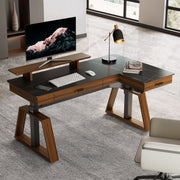
For teacher stations, where equipment loads are often higher and the need for workspace is greater, the L-Shaped Standing Desk with Accessories Set (60"x23") offers a specialized solution. Its dual-motor system ensures smooth operation even when supporting multiple monitors and heavy teaching materials, while the L-shaped configuration maximizes corner space in crowded classrooms.

Practical Recommendations for Implementation
To successfully integrate standing desks into a school infrastructure, procurement teams should follow a standardized setup protocol aligned with Safe Work Australia: Workstation set-up and HSE: Working safely with display screen equipment (DSE).
1. The 20-8-2 Rhythm
Adopt the Cornell University Ergonomics Web recommendation: for every 30 minutes, spend 20 minutes sitting, 8 minutes standing, and 2 minutes moving or stretching. This prevents the "static standing" fatigue that can be just as harmful as static sitting.
2. Monitor and Eye Level
Ensure that the top of the monitor is at or slightly below eye level. Using a Dual Monitor Arm at teacher stations allows for precise adjustment, reducing neck rotation and the risk of cervical strain. This is a key component of the "Neutral Position" defined by ISO 9241-5:2024.
3. Cable Management and Egress
Cables must be secured in a way that allows for the full range of motion without creating a trip hazard. As identified in our modeling, a 10-foot cable with a 25% slack buffer is the baseline for desks transitioning from 24 inches to 48 inches.
4. Durability and Material Safety
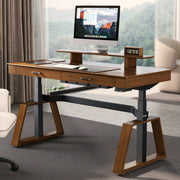
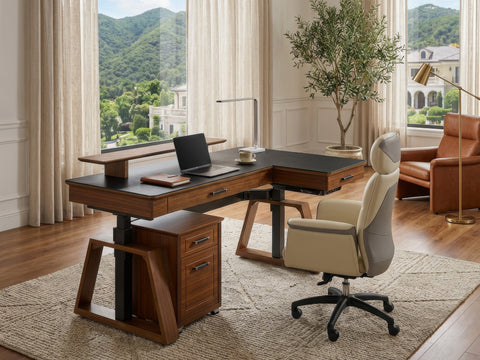
In a high-use environment, the finish of the desk matters. The Ark Executive Standing Desk (63"x29") features a walnut finish and dual drawers, providing the durability required for daily use while maintaining a professional aesthetic. Furthermore, ensure all furniture meets UL GREENGUARD Certification standards for low VOC emissions to protect indoor air quality.

A Strategic Investment in Wellness
Selecting standing desks for a classroom is a strategic decision that balances student wellness with institutional safety requirements. By prioritizing BIFMA-certified durability, UL-certified electrical safety, and classroom-specific features like soft-obstruction anti-collision, administrators can create an environment that supports the 2026 Workstation White Paper: Converging Ergonomic Science and Sustainable Engineering goals of human-centric design.
For further guidance on optimizing student health, consider reviewing our guides on preventing early back pain with ergonomics and finding the ideal ergonomic desk height.
Disclaimer: This article is for informational purposes only and does not constitute professional medical, legal, or occupational safety advice. Institutions should consult with a certified ergonomist and local fire/safety inspectors to ensure full compliance with regional regulations and individual student needs.
References
- BIFMA G1-2013 Ergonomics Guideline for Furniture. Link
- WHO 2020 Guidelines on Physical Activity & Sedentary Behaviour. Link
- Cochrane Library: Workplace interventions for reducing sitting at work. Link
- OSHA eTools: Computer Workstations - Neutral Working Postures. Link
- ISO 9241-5:2024 Workstation layout & postural requirements. Link
- CPSC STURDY / 16 CFR Part 1261 (ASTM F2057). Link
- UL 962 — Safety of Height-Adjustable Desks. Link

Leave a comment